Reply To:
Name - Reply Comment
 The United States’ (US) proclamation of ‘reciprocal tariffs’ dealt a blow to the global trade system based on the World Trade Organisation principles. With the individualised tariff rates, the US has discarded non-discrimination in the Most-Favoured-Nation (MFN) tariff structure. The reciprocal tariff rate does not show any reciprocity but rather a calculation hypothesised to drive a bilateral trade deficit to zero.
Although the reciprocal tariff grabbed attention, the US trade policy under the second Trump administration is more complex. Section 232 of US Trade Expansion Act of 1962 is being used to target key sectors like steel, aluminium and auto parts. In addition, investigations are ongoing to determine tariffs for copper, critical minerals, pharmaceuticals and lumber.
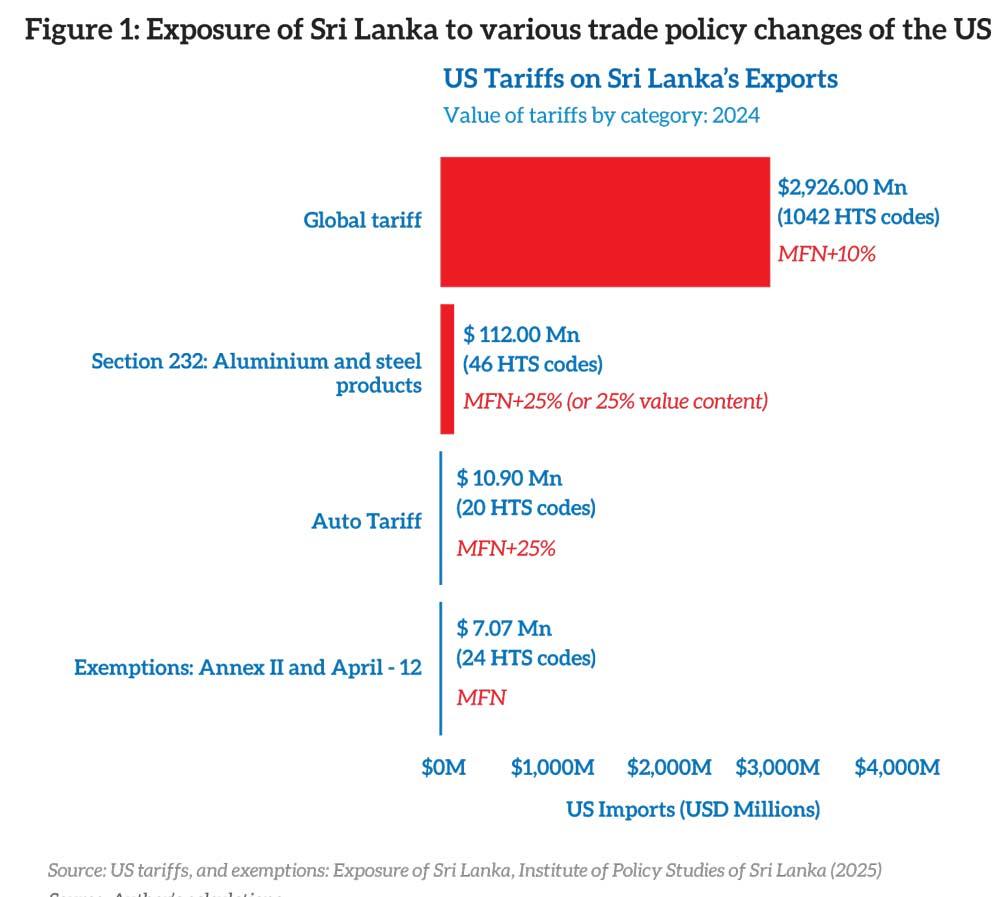
For Sri Lanka, as calculated using the 2024 data, 95.6 percent of US imports are subject to reciprocal tariffs – with the 90-day pause, standing currently as a 10 percent global tariff. In addition, 4.2 percent of imports from Sri Lanka are subject to the steel and aluminium and auto parts tariffs imposed under Section 232.
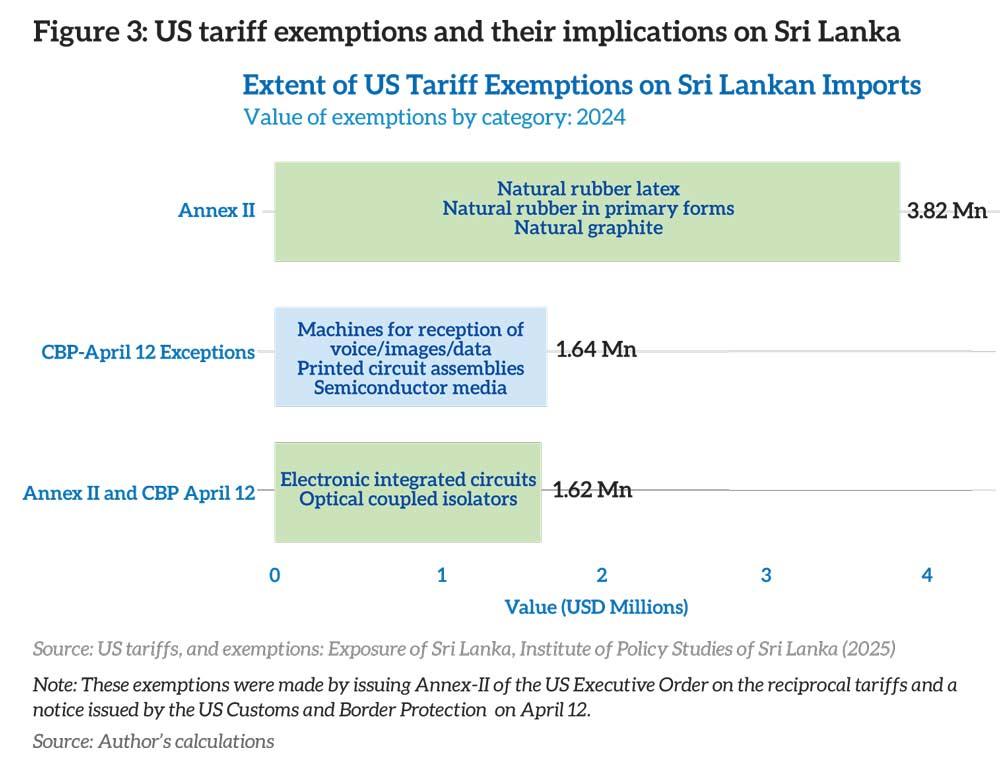
However, 0.2 percent of Sri Lanka’s imports are exempted from the new tariff measures. These exemptions were made by issuing Annex-II of the US Executive Order on the reciprocal tariffs and a notice issued by the US Customs and Border Protection (CBP) on April 12.
SL’s exposure to Section 232 tariffs: Steel, aluminium and auto components tariffs
In 2018, under the first Trump administration, the US imposed a 25 percent tariff on steel and a 10 percent tariff on aluminium imported from all trade partners under Section 232 tariffs.
On March 12, 2025, the US expanded the 2018 Section 232, increasing the aluminium tariff to 25 percent, removing all existing exemptions and adding more derivative products that use steel and aluminium as components. For example, a keg is an aluminium derivative product. When steel and aluminium imports are expensive, due to tariffs, the domestic producers are no longer competitive in the production of derivatives such as the keg in the earlier example. This leads to lobbying for cascading protectionist tariffs on imported derivatives.
Thus, cascading protectionism means that when a raw material is subject to tariffs in the downstream, the final good becomes less competitive, forcing producers to demand tariff protection for the final goods.
Sri Lanka’s exports will be subjected to an additional 25 percent of the value of the steel and aluminium content under the 2025-Section-232 tariffs. The newly added aluminium derivative products account for US $ 28.5 million in the US imports from Sri Lanka, across 27 products.
There are US $ 80.78 million imports under 20 products from Sri Lanka, which are categorised as steel derivatives under the Section 232 Steel and Aluminium tariff proclamation by the US.
New challenges for exporters
One main challenge of the new US tariff structure is the additional reporting requirements to exporters. Notably, the stipulated tariffs will be calculated for the steel or aluminium value of the products, which are exempt from reciprocal tariffs. For example, machinery parts made of steel will be subject to 25 percent additional steel tariffs but they are not subject to 10 percent or 44 percent reciprocal tariffs.
If the machinery parts contain 60 percent steel value, then the 25 percent tariff is applied for the 60 percent steel value. The remaining 40 percent is subject to the relevant tariff line specified for machinery parts. The exporters need to report on the aluminium and steel content by value and failure to do so will result in an additional 25 percent tariff on the whole product’s value.
Lack of information on the steel and aluminium content makes reporting challenging for exporters. Although tariff calculations need the aluminium or steel value, that information is not given in publicly available data; the calculation of tariff increases needs assumptions.
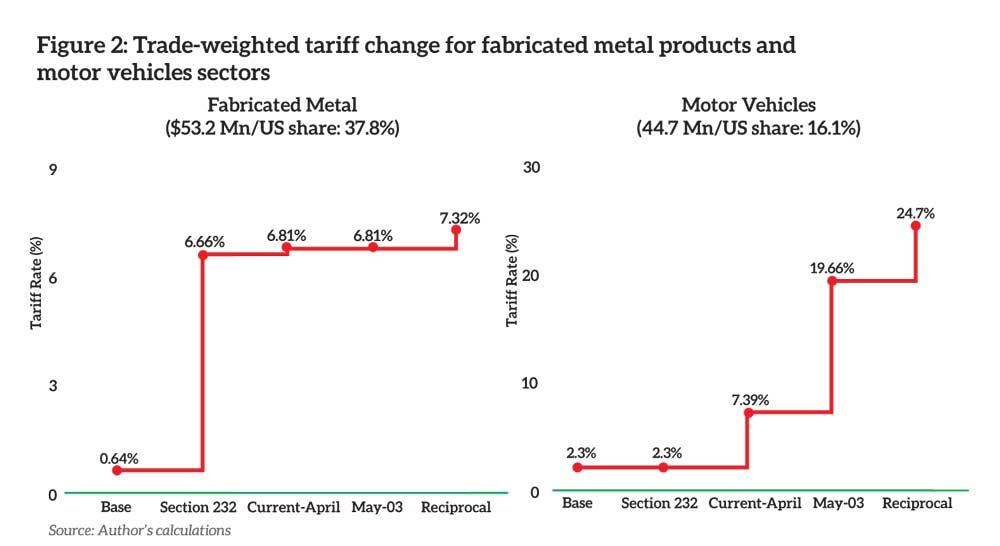
Assuming 25 percent of product value, the fabricated metal sector sees a weighted average tariff increasing to 6.7 percent, from the base tariff rate of 0.6 percent. The Section 232 products are not subject to reciprocal tariffs. It explains the stable weighted average tariff rate for the fabricated metal sector, even after applying a 10-percent global tariff and 44-percent reciprocal tariffs in Figure 2.
The US also announced tariffs on automobiles and parts on March 26 and enacted auto tariffs on April 03. However, the tariffs on automobile parts were delayed to a future date not later than May 03, 2025. The auto components account for 0.5 percent or US $ 10.9 million exports by Sri Lanka.
New pneumatic radial tyres, non-cellular vulcanised rubber articles and electric control apparatus are among the products subject to auto component tariffs. As shown in Figure 2, the effective weighted average tariff for motor vehicle sector exports from Sri Lanka to the US will increase to 19.66 percent on May 03.
Exemptions from some additional tariffs have little implications for Sri Lanka.
The US exempts certain products necessary for the US domestic industries or those that are subject to Section 232 tariffs. Ten products exported by Sri Lanka are exempted from the reciprocal tariffs, including natural rubber and natural graphite (Figure 3). Natural graphite is an essential component and critical mineral in EV battery manufacturing. On April 12, the US CBP released another list of exemptions, primarily composed of electronic equipment. The exemptions exclude products from the direct effect of additional tariffs. However, there is no added advantage from this exclusion, as all countries receive the exemptions, eliminating any relative price advantage for Sri Lanka.
Reciprocal tariffs: Effective tariff rates for SL
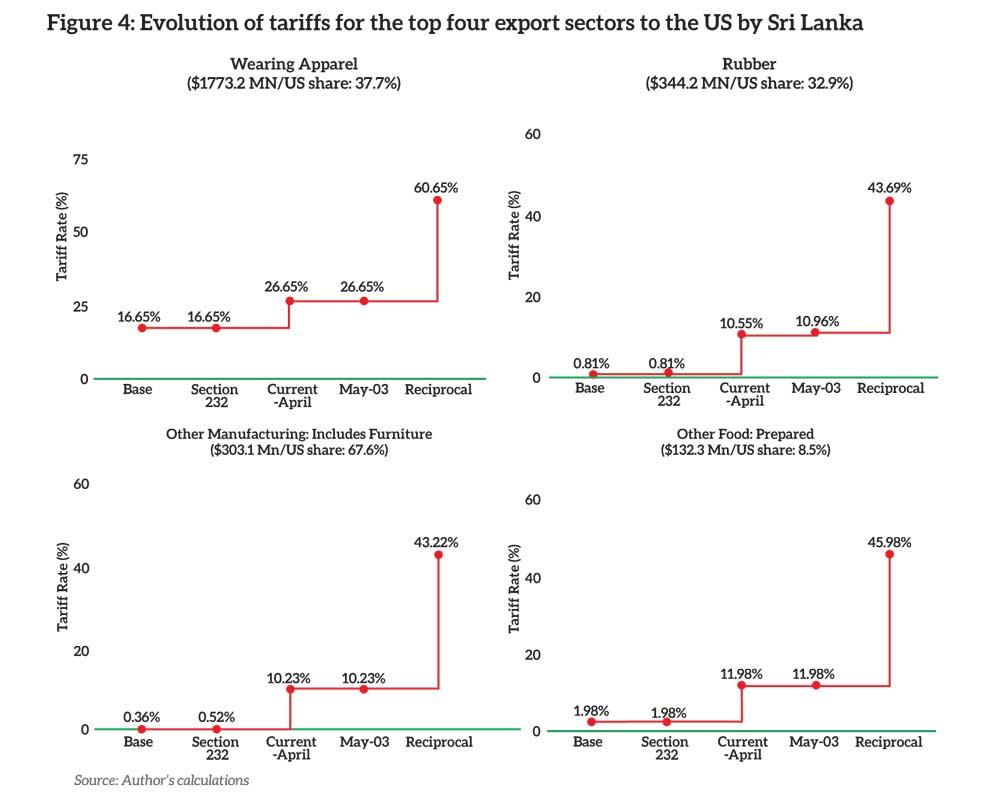
As a 44 percent reciprocal tariff will not be imposed until July, the current effective tariff rate is the MFN rate plus 10 percent, which applies to 95.6 percent of Sri Lanka’s exports to the US, worth US $ 2.93 billion. Accordingly, since April 05, the apparel sector has had a 26.65 percent average tariff (Figure 4). The base MFN tariff average for wearing apparel was 16.65 percent.
Sectors such as rubber, other manufacturing products, including gems and precious stones and food preparations, experience the most significant relative tariff hikes. These sectors had tariff rates that were less than 2 percent before April 05.
Notably, 37.7 percent of Sri Lanka’s apparel exports go to the US, while the US share in other manufacturing products is 67.6 percent (Figure 4). The high reliance on these sectors increases their vulnerability to tariff shocks and plunges in demand in the US market.
Facing tariff challenges: Current options for SL
As the Section 232 steel and aluminium tariffs, 10 percent global tariff and exemptions are already effective, a significant challenge exporters face is meeting reporting requirements. For example, exporters need to report the steel and aluminium content for tariff calculations and failure will result in the automatic application of 25 percent to the total value of the derivative product.
In addition, the country of origin of steel and aluminium used in derivative products should be declared to avoid the 200 percent tariff imposed for aluminium and steel from Russia. Thus, reporting can be a technically challenging and costly task for exporters.
In addition, Sri Lanka needs to be vigilant and follow the US CBP guidance to avoid higher tariffs due to rules of origin; if a different country is identified as the country of origin, Sri Lanka must pay the tariff rate applied to that particular country. Irrespective of the outcome of negotiations on the 44 percent reciprocal tariffs, the Section 232 tariffs, reporting requirements and rules of origin complexities will prevail. The necessary technical assistance should be provided to the exporters to minimise the tariff cost under the current US trade policy regime.
(Dr. Asanka Wijesinghe is a Research Fellow at the Institute of Policy Studies, with research interests in international trade and industrial policy. He holds a BSc in Agricultural Technology and Management from the University of Peradeniya, an MS in Agribusiness and Applied Economics from North Dakota State University and an MS and PhD in Agricultural, Environmental and Development Economics from The Ohio State University. He can be reached at [email protected])