Reply To:
Name - Reply Comment
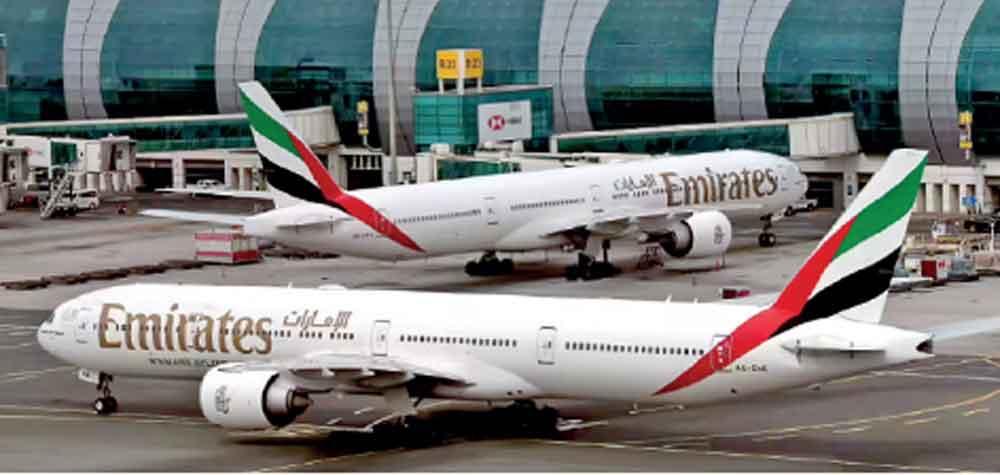
The Emirates group this week announced achieving new record profit, revenue and cash balance levels, despite a disruptive and challenging 12th month in its financial year.
The group reported a profit before tax of AED 24.4 billion (US $ 6.6 billion), marking a 7 percent increase from the previous year. Group revenue rose 3 percent year-on-year (YoY) to an all-time high of AED 150.5 billion (US $ 41 billion), while cash assets climbed 12 percent to AED 59.6 billion (US $ 16.2 billion).
The group also recorded EBITDA of AED 41.1 billion (US $ 11.2 billion), underscoring strong operating profitability, with a profit margin of 16.2 percent.
Emirates Airline maintained its position as the world’s most profitable airline, reporting a record pre-tax profit of AED 22.8 billion (US $ 6.2 billion), up 7 percent from a year earlier.
Revenue increased 2 percent to AED 130.9 billion (US $ 35.7 billion), while cash assets reached a historic high of AED 54.9 billion (US $ 15 billion), reflecting a 10 percent increase compared to March 2025. The airline reported a profit margin of 17.4 percent.
Meanwhile, dnata continued its growth momentum across its business segments, posting a record pre-tax profit of AED 1.6 billion (US $ 437 million), up 2 percent YoY. Revenue surged 12 percent to AED 23.6 billion (US $ 6.4 billion), while cash assets rose 28 percent to AED 4.7 billion (US $ 1.3 billion). The global air and travel services provider recorded a profit margin of 6.8 percent.
The group declares a dividend of AED 3.5 billion (US $ 1.0 billion) to its owner, the Investment Corporation of Dubai.
The UAE corporate tax rate applied to the Emirates group increased from 09 percent to 15 percent this year, due to the adoption of the Pillar Two tax rules in the UAE. After accounting for the tax charge, the group’s profit after tax is AED 21.0 billion (US $ 5.7 billion), up 3 percent from 2024-25.
Emirates Airline and Group Chairman and Chief Executive Sheikh Ahmed bin Saeed Al Maktoum said the results, despite the significant challenges in the last month of the financial year, reaffirm the strength and resilience of the Emirates group’s business model, which is rooted in safety, excellence, innovation, people and partnerships.
“For the first 11 months of 2025-26, the picture across the group was very positive. Strong demand for our products and services was driving revenue and we were achieving healthy margins thanks to our sustained investments in product, people, technology and brand. Month after month, we were surpassing our targets,” he said. On February 28, military activity massively disrupted global commercial air traffic in the Gulf region, including in the UAE. Sheikh Ahmed pointed out Emirates and dnata were quick to mobilise support to the people and affected customers, protect assets and ensure business continuity.
“We are fortunate to be based in Dubai, where years of infrastructure investments and a cohesive aviation ecosystem have enabled the government to quickly secure safe corridors for commercial flights. Emirates and dnata have since gradually restored operations at DXB. Although we are still operating at a lower passenger capacity than pre-disruption, cargo operations have ramped up to support the movement of essential goods into and through the UAE,” Sheikh Ahmed noted.
He added, “The Emirates group has navigated crises and disruptions before. Each time, we placed our focus on our customers and our people and each time, we have bounced back stronger.
Our people are a big part of our success, enabling us to respond with agility in a dynamic operating environment. I’d like to thank all our employees – they have truly exemplified the qualities that set the Emirates group apart during testing times.
I am grateful to HH Sheikh Mohamed bin Rashid Al Maktoum and his sons HH Sheikh Hamdan and HH Sheikh Maktoum, for their stewardship of Dubai and unshaken support for aviation - the Emirates group is proud to contribute to Dubai’s strategy under their leadership. Also, a big thank you to all our ecosystem partners who keep global aviation moving. Their collaboration and solidarity are invaluable and reflect the spirit of partnership that is central to how the Emirates group operates.”
In 2025-26, the group collectively invested AED 17.9 billion (US $ 4.9 billion) in new aircraft, facilities, equipment and the latest technologies to support its growth plans.
The group’s total workforce grew by 8 percent to 130,919 employees, as Emirates and dnata continued recruitment activity around the world to support its expanding operations and boost its future capabilities.
The group’s UAE national workforce also grew to surpass 4,000, showing the success of its programmes to attract, grow and retain local talent.
Commenting on the outlook for 2026-27, Sheikh Ahmed noted that while military activities between the US, Israel and Iran are paused under a ceasefire agreement, the airline hopes for a clear resolution to the hostilities soon and a return to market stability.
“But in the meantime, we are not sitting on our hands. From a fuel perspective, Emirates is well-hedged until 2028-29 and we have worked with our suppliers to secure the volumes required to support our current operations and our scaling up to pre-disruption levels. At dnata and across the group, our business streams, scale, portfolio mix and years of investments give us the resilience and agility to address any near-term challenges,” he said.
“The Emirates group enters 2026-27 with very strong cash reserves, which enable us to progress with our plans to strengthen our business without knee-jerk cost control measures.”
He added that aircraft deliveries and retrofit programme would continue apace as well as the planned investments in new facilities and equipment. Emirates and dnata will stay focused on offering industry-leading products and customer experiences, differentiating itself on the global stage, attracting the best talent and delivering value to the communities we serve.