Reply To:
Name - Reply Comment
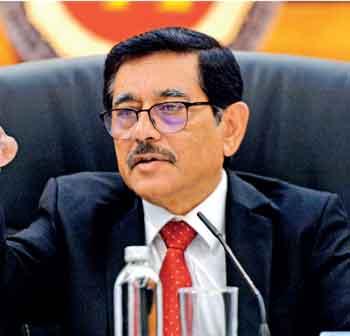 |
| Central Bank Governor Dr. P. Nandalal Weerasinghe PIC BY PRADEEP PATHIRANA |
The Central Bank left its key policy rate unchanged this week but struck a more cautious tone on the inflation outlook, indicating that the policymakers remain prepared to tighten the monetary conditions further, if the price pressures persist amid the renewed geopolitical tensions in the Middle East.
The Monetary Policy Board kept the Overnight Policy Rate at 8.75 percent, saying the decision reflected the evolving domestic and global conditions. However, the accompanying policy statement suggested the Central Bank remains focused on containing inflation rather than pivoting towards easing monetary policy.
Headline inflation accelerated to 6.8 percent year-on-year in June, driven mainly by the higher domestic energy and food prices and is expected to remain above the Central Bank’s 5 percent target in the near term before gradually easing.
The Central Bank also said core inflation is likely to rise and hover around the headline target, while noting that inflation expectations remain anchored over the medium term.
Although the recent rise in inflation has largely been supply-driven, the Central Bank acknowledged that the domestic demand conditions have strengthened, suggesting broader price pressures are beginning to emerge across the economy.
The Central Bank said the monetary tightening implemented in May, together with the other government policy measures, is expected to gradually moderate credit growth and ease the demand-side inflationary pressures in the months ahead.
A key concern highlighted by the Central Bank was the renewed escalation of tensions in the Middle East, which has pushed up the global commodity prices, particularly oil and clouded the global economic outlook.
The Central Bank warned that the higher petroleum prices could spill over to Sri Lanka through several channels, adding pressure on inflation and the country’s external sector.
While the pressure on the external sector has eased somewhat compared with the recent months, the Central Bank said uncertainty remains elevated. Since April, Sri Lanka’s external current account has moved into deficit, as the higher fuel import costs widened the merchandise trade gap and tourism earnings slowed.
The Central Bank said it expects the recent policy measures to curb the import demand, including the demand for motor vehicles, while the workers’ remittances have remained resilient throughout 2026.
Gross official reserves stood at US $ 6.45 billion at end-June, despite the continued foreign debt service payments, while the rupee has stabilised in the recent weeks, following the earlier policy actions.
The Central Bank reiterated that it would continue to closely monitor both the domestic and international developments and stands ready to take the appropriate measures to ensure inflation returns to and stabilises around its 5 percent target while supporting the medium-term economic growth.
The policy review also highlighted the unusually high degree of uncertainty surrounding the inflation outlook.
The Central Bank said the risks to inflation remained tilted to the upside, citing possible disruptions to the commodity markets, shipping routes and energy supplies from the geopolitical tensions as well as the rupee depreciation and adverse weather, including a potential El Niño event. An easing of tensions and lower global energy prices could, however, help contain inflation.