Reply To:
Name - Reply Comment
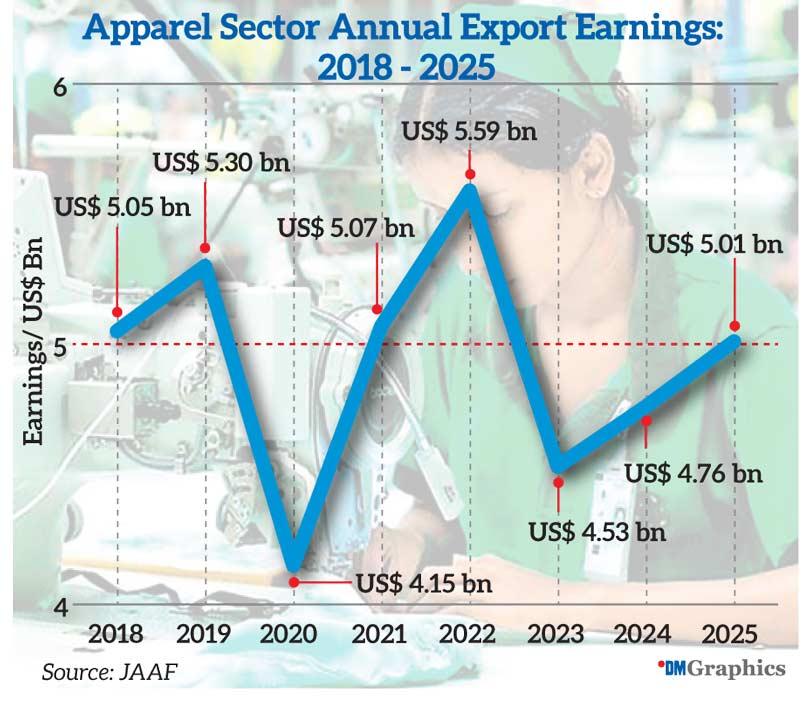
Sri Lanka’s apparel exports extended their recovery in December 2025, closing the year above the US$ 5 billion mark. The performance was supported by steady demand from core Western markets even as shipments to non-traditional destinations softened, industry data showed.
Exports of apparel and made-up textile articles (HS Chapters 61, 62, and 63) rose 5.43 percent year-on-year (YoY) to US$ 447.21 million in December, lifting full-year earnings for the segment to US$ 5.02 billion, up 5.42 percent from 2024, according to statistics compiled by the Joint Apparel Association Forum (JAAF). Including fabric exports valued at US526.33 million, total sector exports reached about US$ 5.5 billion for the year.
The apparel sector last crossed the US5 billion mark in 2022, closing the year with US5.59 billion in export revenue. The first time the milestone was reached was in 2018, when the industry recorded revenue of US$ 5.05 billion.
A breakdown of December shipments showed broad-based growth across Sri Lanka’s main markets. Exports to the United States rose 6.49 percent to US$ 178.29 million, while shipments to the European Union excluding the UK increased 6.76 percent to US$ 141.00 million. Exports to the UK recorded the strongest monthly growth, up 12.95 percent to US$ 55.12 million.
Meanwhile, exports to other markets fell 4.06 percent to US$ 72.80 million, tempering the overall performance. Taken together, the US and EU accounted for about 71 percent of December exports and delivered the bulk of the year-on-year increase.
For the full year, the EU excluding the UK emerged as the strongest growth driver, with exports rising 12.48 percent to US$ 1.58 billion, underscoring the bloc’s role in anchoring the industry’s recovery. Exports to the US grew a more modest 2.15 percent to US$ 1.95 billion, while shipments to the UK were largely flat, edging up 0.74 percent to US$ 679.66 million. Other markets recorded a 4.80 percent increase to US$ 815.78 million.
“Closing the year above US$ 5.0 billion reflects the industry’s consistency across core markets, with the EU delivering the strongest momentum over the year,” said JAAF.
It went on to note that the December pickup in the UK alongside continued growth in the US and EU was encouraging. However, it cautioned that the dip in other markets “is a reminder that diversifying demand and strengthening non-traditional markets must remain a priority.”
For 2026, JAAF noted that to sustain growth, the industry will stay focused on improving competitiveness, protecting delivery reliability, and expanding buyer confidence through consistent quality and responsible production. Strengthening access in new and emerging markets would be central to that effort, it stressed.