Reply To:
Name - Reply Comment
 By Chandeepa Wettasinghe
Information brought to light by another leading economist recently highlighted the danger of the new regime running into hot waters by accepting the statistics and continuing the policies of the past regime.
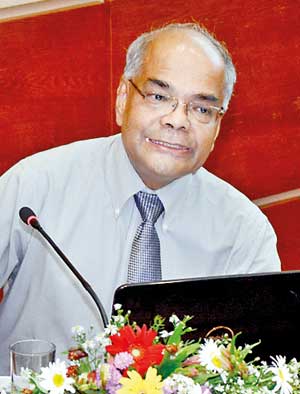
Australian National University Economics Professor Prema-Chandra Athukorale said that the past government had used the fixed nominal exchange rate in calculating the per capita gross domestic product (GDP) instead of accounting for inflation and the real prices in the economy.
“The dramatic increase in per capita income in dollar terms is simply deceptive because we kept the denominator constant with nominal exchange rates. Our inflation was also quite high compared to trading countries... but through fixed exchange rates, the economy appeared to inflate less,” he said.
He noted that compared to the official figures of GDP per capita of around US $ 3,000 in 2012, the adjusted figures show a GDP per capita of around US $ 1,750.
“The official figures are used by the World Bank and others. When you adjust it for exchange rates and real pricing, the growth is there, but it’s not dramatic. It’s virtually a continuation of the growth during that period,” Professor Athukorale added.
He said that the past regime’s pegged exchange rate might have worked if the government had been disciplined in its fiscal and monetary policies.
“But the nominal exchange rate was kept fixed for short-term benefits... It was a silly policy,” he added. Even the new government had allowed the exchange rate to remain artificially appreciated until the August elections, showing a false feeling of increased purchasing power to facilitate the populist policies of the January 2015 Interim Budget, before relaxing its hold on the currency.
The United National Party (UNP), which makes up the majority in the new rainbow coalition, had been accusing the Central Bank under the past regime of cooking the books.
Further, the success of the silent revolution on January 8 had depended heavily on battles fought on the economic front.
After taking over, UNP’s Dr. Harsha de Silva, who became the Policy Planning and Economic Affairs Deputy Minister during the interim period, had said that the real GDP of a household until 2013 had grown at 0.5 percent, instead of the 7.5 percent claimed by the Central Bank.
However, when the Central Bank statistics for 2015 and the Budget 2016 were released, they had quoted the figures of the past regime, in effect justifying them, instead of investigating the allegations and publishing an erratum to the figures.
Further, Professor Athukorale said that the new government is continuing the past government’s practice of communicating gross foreign reserves—now at US $ 7.2 billion.
He said that the net reserves of US $ 4 billion should be published, as also pointed out by former Central Bank Deputy Governor Dr. W.A. Wijewardena, since the country is integrated to the global financial markets, and investors might take their money out anytime, impacting the gross reserves.
This may be extremely important at a time when the new regime is depending on foreign deposits to increase reserves.
Professor Athukorale said that the most accurate method of calculating foreign reserves was to use a reserve adequacy ratio.
Meanwhile, he added that since 2005, the country had seen policy shifts which abandoned trade liberalization in favour of protectionism and had placed renewed emphasis on state-owned enterprises instead of privatization.
While the new regime had promoted privatization, it appears to continue the protectionist policies of the past regime with increased tariffs and unsustainable incentives for domestic industries.
Professor Athukorale said that former President Mahinda Rajapaksa should at least be credited for building roads but said that the growth from infrastructure development had also skewed the expectations of the public.
“The debt-created boom has created false hope among the citizens. When I try to tell this to the people in the villages, they laugh at me,” he added.
Successive governments have ensured that the public is not educated on economics, in order to win votes through election goodies, which have massive repercussions on the macro economy.
Governments are then left with fighting the instabilities—or covering them up with debt—over the next five years of their mandates.
Dr. Wijewardena recently said that if the new regime did not effectively communicate the mishandlings of the past government to the public and make adjustments, the public would blame the new regime for the ill-effects felt now.
Pic by Samantha Perera