Reply To:
Name - Reply Comment
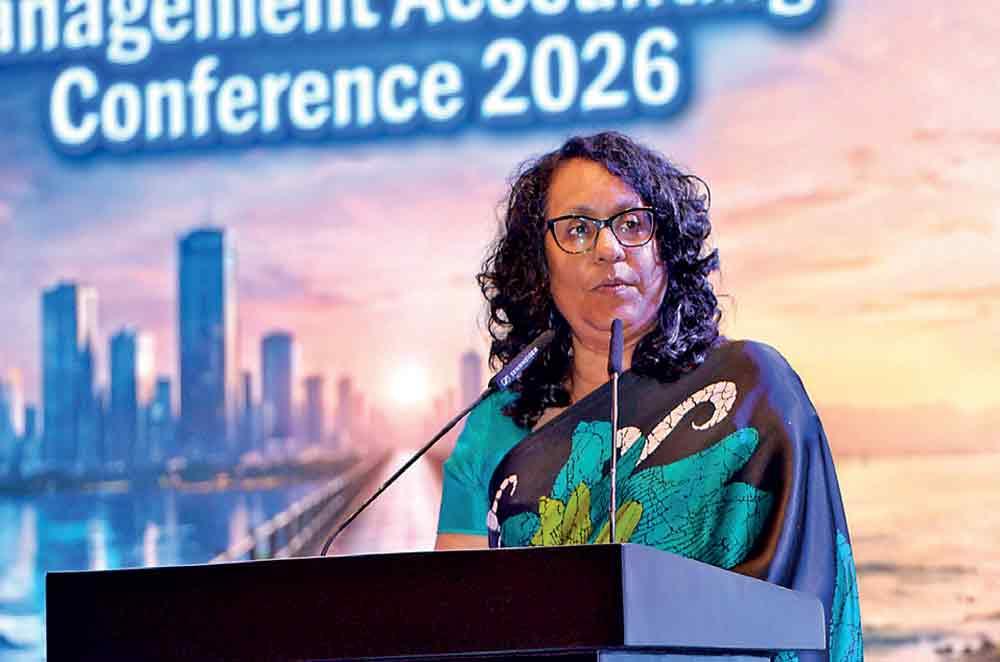 Prime Minister Dr. Harini Amarasuriya addressing the conference
Pic by Pradeep Pathirana
By Nishel Fernando
Prime Minister Dr. Harini Amarasuriya this week rebuked ministries and state institutions over years-long delays in filing annual reports and financial statements, revealing that some audit reports remain pending after several years.
The Prime Minister highlighted the urgent need for sound management accounting and strict accountability within the public sector to support Sri Lanka’s ongoing economic recovery.
She emphasised that many government ministries and institutions have historically failed to adhere to basic accounting principles and oversight mechanisms.
“I regret to say that there are some institutions, some ministries, we are still looking at annual reports and audit statements from as far back as 2017, 2018, and 2019,” Prime Minister Amarasuriya said while addressing the CMA Sri Lanka International Management Accounting Conference 2026 in Colombo this week.
She noted that it is only now that the government is successfully pushing these institutions to bring their financial reporting up to current status.
“This has been a huge struggle that we have witnessed over the last one and a half years where many of these good financial practices or accounting principles have simply not been followed,” she noted, pointing out a systemic lack of accountability in the past.
These sentiments are strongly reflected in recent parliamentary records, which highlight ongoing discrepancies and severely delayed submissions. A review of the Papers Presented in the Parliament of Sri Lanka showcases instances where annual reports are submitted several years past their designated financial year.
For instance, recent Auditor General reports on the Janatha Estates Development Board revealed that financial statements and draft annual reports for 2021, 2022, and 2023 had not been presented to the Auditor General even by late 2024. Furthermore, oversight findings consistently indicate financial struggles alongside these administrative delays.
The corporate sector was assured that such lapses are no longer tolerated, with the Prime Minister declaring that “these accounting standards have to be followed, accounts have to be presented on time, they have to meet standards, and those that do not are held to account.”
Beyond basic financial reporting, the government is also pushing for broader transparency and long-term value creation through modern sustainability standards. The Prime Minister drew attention to the shifting global expectations around environmental and social responsibility, which are now being deeply integrated into corporate frameworks.
“This changing global landscape is reflected in the introduction of mandatory sustainability disclosure standards under SLFRS S1 and SLFRS S2 for leading listed companies,” Prime Minister Amarasuriya explained.
Detailing the strategic impact of these guidelines, she said: “While SLFRS S1 provides a framework for reporting sustainability-related risks and opportunities that may affect an organization’s financial performance, SLFRS S2 focuses specifically on climate-related risks and opportunities.”
Although these standards were initially targeted at leading listed companies, it was stressed that these sustainability and governance principles are equally relevant and necessary for the public sector. Effective public financial management depends on accurate and timely information that allows the government to plan strategically and utilize public resources efficiently.