Reply To:
Name - Reply Comment
By Shabiya Ali Ahlam
Sri Lanka’s post-crisis rebound is set to lose momentum in 2026, with the growth moderating as the higher energy costs, structural bottlenecks and external risks begin to weigh on the economy, the World Bank said.
The World Bank’s outlook also echoes that of the International Monetary Fund (IMF) and Asian Development Bank (ADB) earlier this month.
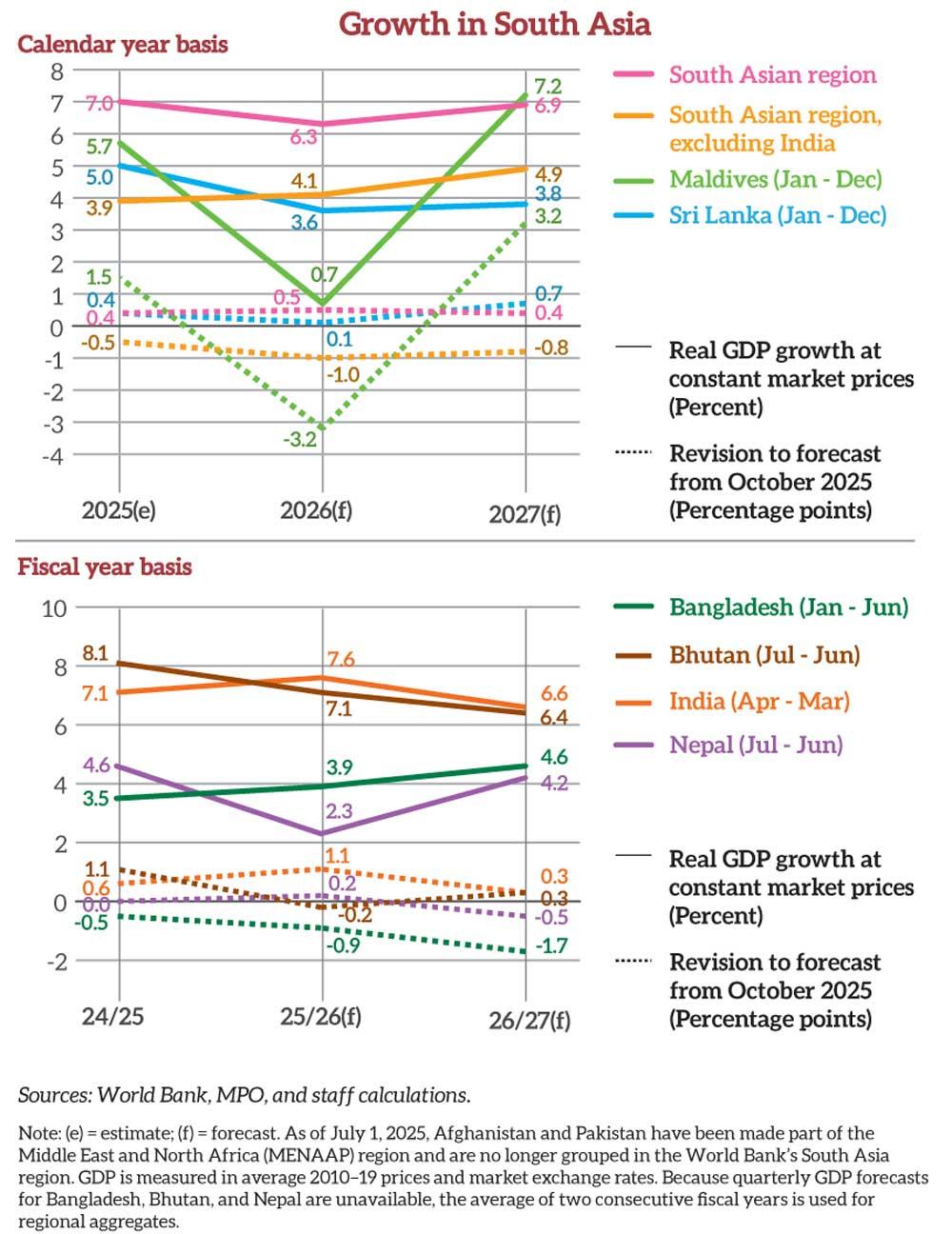
The World Bank, in its latest South Asia Economic Update 2026 (April), said that Sri Lanka’s economy expanded by 5 percent in 2025, broadly matching the previous year, driven largely by a surge in private consumption, supported by a more than 20 percent increase in workers’ remittances.
However, that recovery phase is now giving way to a slower, more constrained growth path, with the World Bank projecting the expansion to ease to 3.6 percent in 2026, before edging up to 3.8 percent in 2027, a pace that reflects the economy settling closer to its potential after the initial rebound.
The shift highlights a key concern emerging across multilaterals, that Sri Lanka’s recovery, while stabilising headline indicators, remains uneven and vulnerable to both domestic constraints and external shocks.
Growth is expected to be driven primarily by consumption and investment, supported in part by the post-disaster reconstruction following Cyclone Ditwah, which struck in November 2025, causing over 600 fatalities and an estimated US $ 3.3 billion in damages, equivalent to around 3 percent of GDP.
Nevertheless, the World Bank flagged persistent structural challenges, including shortages of skilled labour, exacerbated by outward migration and the continued under-execution of public capital expenditure, which have constrained the economy’s ability to transition from consumption-led growth to productivity-driven expansion.
The IMF last week warned that Sri Lanka remains highly exposed to global energy shocks, noting that the rising fuel and electricity costs are likely to feed into inflation and fiscal pressures.
“Ensuring that the electricity prices reflect the true cost of supply is essential for preserving fiscal sustainability,” IMF Mission Chief Evan Papageorgiou said at an end-of-mission press briefing.
He went on to stress the need to maintain cost-reflective pricing to avoid losses at the state-owned utilities.
Inflation, which remained contained between 2.1 percent and 2.3 percent in the recent months, is now expected to rise above the Central Bank’s 5 percent target in 2026, driven by a stronger demand and elevated energy prices, according to the World Bank.
The ADB similarly cautioned that the ongoing Middle East conflict, a critical risk channel for Sri Lanka, could dampen growth through higher oil prices, weaker remittance inflows and disruptions to tourism, estimating a potential drag of around 0.4 percentage points on growth.
Beyond the cyclical pressures, fiscal vulnerabilities continue to shape the outlook. While Sri Lanka’s debt-to-GDP ratio has declined to around 93 percent from the levels above 120 percent at the height of the crisis and the primary balance has improved, the interest payments still absorb a significant share of government revenue, limiting policy flexibility.
The World Bank noted that a “strong revenue performance and prudent expenditures in Sri Lanka should contribute to continued reductions in fiscal deficits and public debt” but cautioned that the high borrowing costs and constrained fiscal space leave the country exposed to future shocks.
The banking sector has shown signs of stabilisation, with improved liquidity and rising profitability, though the non-performing loans remain elevated compared to the pre-crisis levels, reflecting the lingering stress within the financial system.
The external sector dynamics also remain closely tied to the geopolitical developments. The tourism and remittance inflows, two key foreign exchange earners, are heavily dependent on stability in the Middle East, while the global energy price volatility continues to pose risks to inflation and the current account.
The World Bank warned that the persistently high energy prices could “increase production costs, erode real incomes, tighten financial conditions and worsen the current account imbalances”.
At the same time, Sri Lanka’s recovery is taking place against a sobering backdrop.