Reply To:
Name - Reply Comment
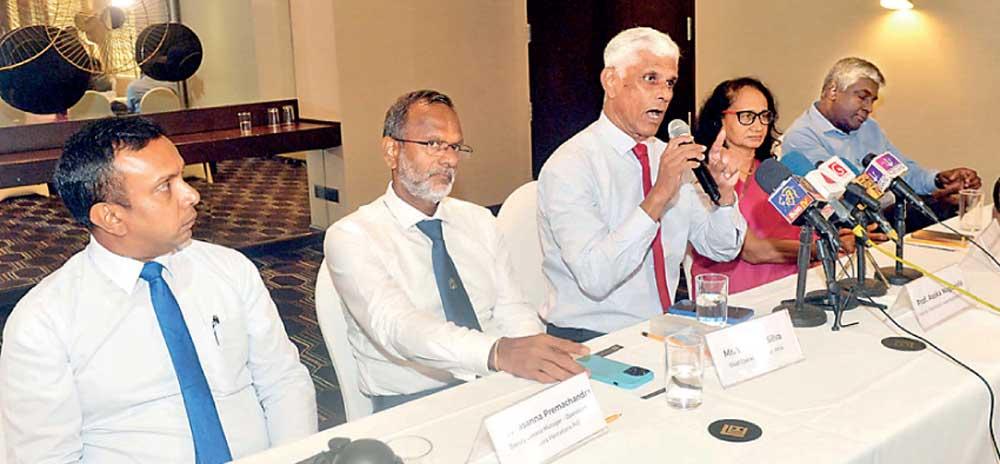
From left: Watawala Plantations PLC Deputy General Manager Operations Prasanna Premachandra, POIA COO Yajith de Silva, Lalan Rubbers (Pvt.) Ltd Director Technical Prof. Asoka Nugawela, SAARCFOODS Association Sri Lanka President Dr. Renuka Jayatissa and Prof. Devaka Weerakoon of University of Colombo
PIC BY PRADEEP PATHIRANA
By Nishel Fernando
The government is on the verge of lifting the existing ban on oil palm cultivation, pending the final Cabinet approval, setting the stage for a major agricultural revival.
Anticipating this favourable policy shift, the plantation industry, which includes 11 Regional Plantation Companies (RPCs), has submitted proposals to cultivate a further 10,600 hectares of oil palm across suitable regions.
This new expansion will complement the 10,800 hectares of oil palm that are already cultivated in the country.
Former University of Peradeniya Faculty of Agriculture Prof. Sarath Nissanka revealed these developments at a recent Palm Oil Industry Association roundtable discussion.
Emphasising the regulatory framework, he noted that a state-appointed expert committee has laid out comprehensive rules to rigorously assess the land.
“When we received replies from the 11 RPCs, they indicated they are ready to proceed and the total extent proposed is going to be about 10,400 hectares altogether,” Prof. Nissanka explained.
“In that committee, there are seven strict guidelines given. They have avoided the streams and also mountain tops.”
This expansion is increasingly viewed as an economic necessity, particularly as traditional cash crops like rubber face severe headwinds from the rising labour costs and the devastating spread of the Pestalotiopsis leaf disease.
Palm Oil Industry Association Chief Operating Officer Yajith de Silva pointed out that the protracted stagnation has already cost the country heavily.
Highlighting the financial impact, he explained that the inability to plant 8,000 hectares resulted in a massive economic loss, as the country missed out on an expected yield of four metric tonnes per hectare, totalling 32,000 metric tonnes of oil.
“If we multiply 32,000 metric tonnes by the global price of 1,100 dollars, 35 million dollars have been lost to our country because of that 2019 ban,” de Silva noted.
The sector maintains that the highest return on investment for the plantation companies currently comes from palm oil, as it yields a harvest much faster than tea or rubber.
Setting the policy context for the potential reversal, Wayamba University academic and former Rubber Research Institute Director Prof. Asoka Nugawela highlighted that Sri Lanka remains the only country in the world to completely ban the crop.
He revealed that while a 13-member expert committee recommended lifting the ban, subject to restrictions, a stance broadly supported by the Cabinet, political hesitation remains.
“When politicians take a decision, they look at how it affects the public opinion. Currently, their view is that the public perception in our society is not in a favourable state to change this decision,” Prof. Nugawela explained.
Consequently, the minister has tasked the industry with building consensus.
“He gave us the responsibility to go to the relevant areas, educate the people and change the public opinion to some extent, to create the environment needed to make this change,” he added.
A significant portion of this public resistance stems from the fears of environmental degradation and groundwater depletion, which the industry scientists robustly contested during the forum.
Prof. Devaka Weerakoon challenged the widely cited narratives surrounding water consumption, explaining that the environmental impacts must be measured scientifically per unit of land rather than on a tree-by-tree basis.
“We shouldn’t compare tree to tree but rather how many trees are in a unit of land area,” Prof. Weerakoon clarified.
He explained that while a single oil palm transpires more, a hectare contains only about 140 oil palm trees, compared to over 500 rubber trees, meaning that the overall water consumption is relatively the same.
Supported by localised research using modern stem flow meters, backed by a Rs.2 million investment, scientists revealed that the oil palm’s fibrous root system only reaches a depth of about five feet, meaning it cannot absorb the deep groundwater.
The health and nutritional misconceptions surrounding palm oil were also directly addressed by medical professionals. Dr. Renuka Jayatissa, representing the Sri Lanka Medical Nutrition Association, presented the findings derived from an analysis of over 2,000 global research reports from the past five years.
“Palm oil contains a 50-50 balance of saturated and unsaturated fats,” Dr. Jayatissa stated, explaining that consuming the recommended daily amount of two tablespoons per person does not increase blood cholesterol levels.
She also highlighted the oil’s safety during high-temperature cooking, adding that its high boiling point means the formation of health-hazardous trans fats during deep frying is significantly lower and its low tendency to turn rancid minimises the risk of aflatoxins.
The global economic importance of palm oil was a recurring focal point of the discussion, with the officials noting that it accounts for 40 percent of global vegetable oil usage while utilising the least amount of land.
Revealing the recent trade statistics, it was highlighted that in 2025, Sri Lanka imported 285,670 metric tonnes of palm oil while producing only 38,210 metric tonnes locally.
By implementing a science-based land-use efficiency plan and embracing crop diversification under the proposed strict guidelines, the stakeholders argue that Sri Lanka can harness oil palm cultivation to stabilise domestic edible oil prices, generate employment and significantly uplift the rural agricultural workforce while saving massive amounts of foreign exchange.
Sri Lanka made global headlines in April 2021 by becoming the only country in the world to completely ban the cultivation of oil palm. The sudden policy shift was largely driven by mounting public pressure and lobbying from environmental groups, who cited concerns over soil degradation, potential groundwater depletion and threats to local biodiversity. These fears were heavily influenced by a 2017 report from the Central Environmental Authority.
However, agricultural scientists and industry stakeholders have consistently argued that this report relied on generalised, opinion-based ideas rather than rigorous, localised scientific data, making the prohibition a popular political decision rather than a scientifically productive one.
The ban’s severe economic toll on the plantation sector and the massive outflow of foreign exchange for edible oil imports eventually prompted a policy rethink. Recognising the financial losses and the urgent need for viable crop diversification, the previous administration under President Ranil Wickremesinghe made a decisive move during its final Cabinet meeting to lift the ban.
However, following the transition of power, the newly elected National People’s Power (NPP) government opted to temporarily suspend that directive. During its inaugural Cabinet meeting on October 29, the current government decided to halt the reversal pending a thorough, independent review.
This led to the immediate appointment of the 13-member expert committee. With the committee’s recent findings scientifically debunking the initial environmental concerns, the groundwork has now been laid for the current government to cautiously proceed with lifting the restrictions, under a strictly monitored, sustainable framework.