Reply To:
Name - Reply Comment
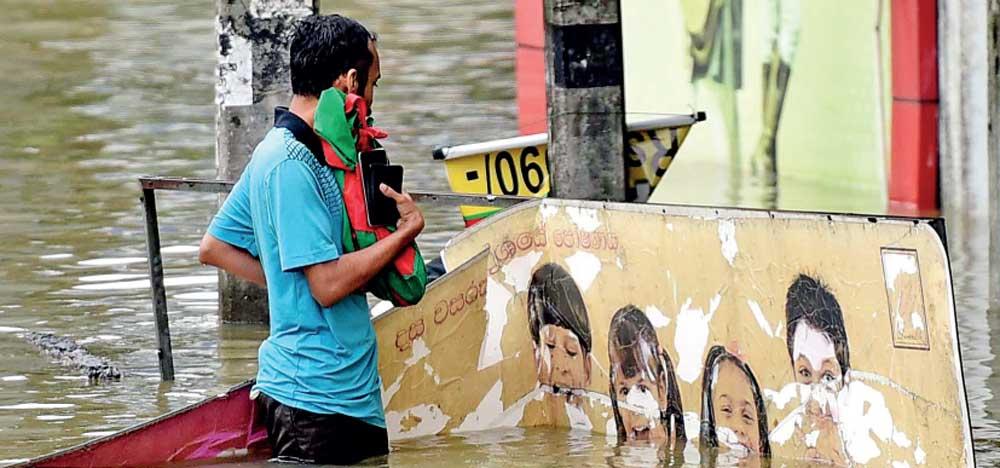
A man pauses to move a sign board while trying to move through flood-hit city of Gampaha
PIC BY KUSHAN PATHIRAJAH
Sri Lanka’s efforts to stabilise its finances after its debt default are expected to face fresh pressure due to the economic fallout from Cyclone Ditwah, Moody’s Investors Service said.
The ratings agency noted that while the government’s commitment to the International Monetary Fund programme and ongoing reforms remains intact, additional spending to repair damage would slow post-default fiscal consolidation. “While we do not expect a reversal in the government’s commitment to the ongoing International Monetary Fund programme and related reforms, the economic impact of the cyclone and spending to deal with the aftermath will stymie post-default fiscal consolidation,” Moody’s said in a commentary.
The cyclone caused severe damage to critical infrastructure, including roads, bridges, rail networks and power grids, disrupting supply chains and economic activity nationwide. Moody’s noted that tourism, agriculture and manufacturing, key drivers of the Sri Lankan economy and major sources of employment, are likely to be the hardest hit sectors.
Sri Lanka, along with Indonesia (Baa2 stable), the Philippines (Baa2 stable) and Vietnam (Ba2 stable), faces high credit exposure to physical climate risks. “Sri Lanka has much weaker fiscal capacity to increase its resilience than its neighbours,” Moody’s said. Effective governance, the agency added, is crucial in mitigating climate-related risks.
“While the recent reforms have led to some improvement, both Sri Lanka and Vietnam have governance issuer profile scores of four, indicating high credit exposure to governance risks,” Moody’s noted.