Reply To:
Name - Reply Comment

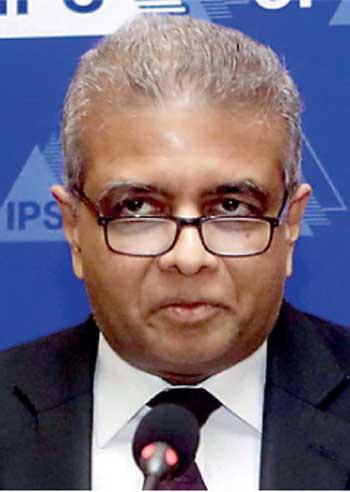 |
| Dr. Hans Wijesuriya PIC BY PRADEEP DILRUCKSHANA |
By Nishel Fernando
Sri Lanka is pursuing a strategy to generate ‘super return on investment (ROI)’ through a comprehensive digital transformation, aiming to build a US $ 15 billion digital economy, Chief Advisor to President on Digital Economy and Information and Communication Technology Agency Chairman Dr. Hans Wijesuriya said.
Dr. Wijesuriya reiterated that digital transformation is the crucial ingredient to drive growth within a tight fiscal space by unlocking efficiency, enhancing competitiveness and creating powerful economic multipliers.
He shared his views while speaking at the launch of the Institute of Policy Studies’ ‘State of the Economy 2025’ report last week.
“At the heart of the government’s vision is a fundamental shift away from inefficient vertical systems – where individual agencies build isolated solutions towards creating foundational horizontal platforms.
This approach focuses on building digital public infrastructure (DPI), a set of shared digital systems including a national Digital ID, data exchanges, digital signatures and federated payment architectures,” he said.
Dr. Wijesuriya noted that Sri Lanka currently has “islands of excellence” that are not interconnected, creating friction for citizens and businesses.
The new strategy aims to expose these core functions through open APIs, creating an ‘explosion and multiplier’ effect by allowing entrepreneurs and SMEs to rapidly build innovative services for key sectors.
Addressing how this ambitious vision will be funded, Dr. Wijesuriya noted that the investment in core DPI would not be exorbitant, due to the use of open-source software and cloud infrastructure.
He shared that the government plans to invest directly in this foundational layer, while encouraging market-oriented mechanisms for investments in broader infrastructure like telecom connectivity and cloud computing.
The timeline for this vision is aggressive, with a target of implementing the entire foundational DPI layer within “two to four years, not 10”, he said, while pointing out the broader goal of achieving 100 percent broadband connectivity is set for 2030.
To generate quick economic wins, the government will prioritise sectors such as tourism, logistics and trade, where digital enhancements can have an immediate impact.
The strategy also acknowledges that technology alone is not a silver bullet, embracing the need for “analog complements” – essential changes in laws, policies and processes.
He asserted that key hurdles to be addressed include procurement reforms to prevent payment delays that are “killing” SMEs, re-engineering business models alongside digitisation and bridging the digital divide with “purpose-driven technology” that citizens would adopt because it offers clear value. Central to this entire effort is the goal of building a ‘trustworthy digital destination’ through robust frameworks for cybersecurity, data privacy and intellectual property protection, anchored by the recently established Data Protection Authority and a forthcoming cybersecurity law.