Reply To:
Name - Reply Comment
By Huzefa Aliasger
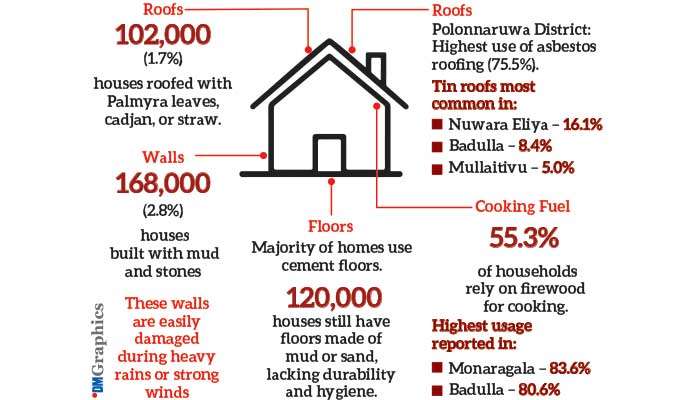
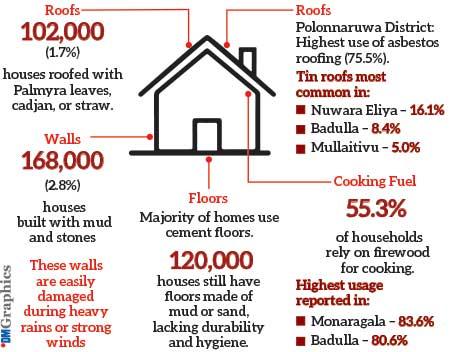 Over 100,000 houses in Sri Lanka currently have been built using mud and rocks for walls and roofed with Palmyra leaves, cadjan or straws, highlighting the lack of weather–prone housing conditions, according to the Department of Census and Statistics (DCS).
The DCS in the 2024 Housing Preliminary report says that 2.8 per cent, or 168,000 of the total occupied housing units, have their walls made out of mud and stones, which can often be damaged easily in harsh weather conditions. A further 102,000 or 1.7 per cent of houses have their roofs covered with Palmyra tree leaves, cadjan and straw. The DCS says, “The highest percentage of housing units with roofs made of asbestos is recorded from the Polonnaruwa District (75.5 per cent). The districts reporting the highest percentages of housing units with tin roofs are Nuwara Eliya (16.1 per cent), Badulla (8.4 per cent), and Mullaitivu (5.0 per cent), respectively. It has been reported from the Badulla District that 5.7 per cent of housing units have roofs made of non-durable cadjan, palmyrah, straw, etc.”
Even though the majority of housing units in Sri Lanka have used cement for floors, the flooring of 120,000 houses is made up of mud and sand.
The majority of households in occupied housing units in Sri Lanka (55.3 per cent) use firewood as the main source of energy/fuel for cooking, and the highest percentages are reported from Monaragala (83.6 per cent) and Badulla (80.6 per cent).