 Nishel Fernando
 Reply To:
Name - Reply Comment
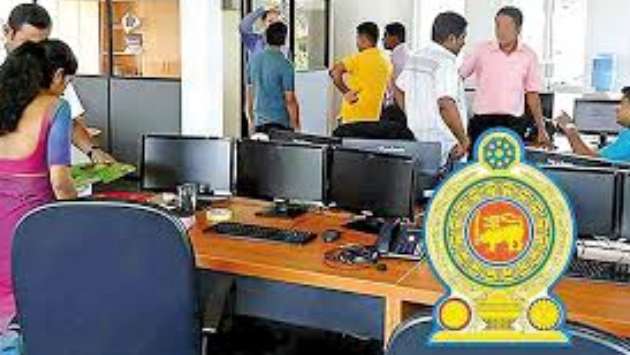
Colombo, Nov. 20 (Daily Mirror) - Nearly a quarter of a million vacancies are set to remain unfilled across Sri Lanka's public sector as the government moves to limit new recruitments to the bare minimum for the upcoming fiscal year (2026).
The Cadre Information of Public Sector 2025 report, released alongside the fiscal position report, reveals that while the total approved cadre for the public sector is 1.325 million, the actual number of employees as of June 30, 2025, stands at 1,076,625. Crucially, this figure excludes the uniformed personnel of the Tri-Forces (Army, Navy, and Air Force), indicating that the state's total salary burden is significantly higher when military payrolls are factored in.
Despite the existence of 248,498 vacancies across the board—the gap between approved and actual positions—the government has signaled a firm policy decision to halt major recruitment drives in the upcoming fiscal year. The Budget, Economic and Fiscal Position Report 2026 explicitly states that "the number of public sector employees will not be considerably increased through new recruitments in 2026."
Instead, the government is battling a ballooning wage bill driven by salary revisions rather than headcount expansion. Expenditure on personal emoluments rose by 15.3 percent to Rs. 760.7 billion in the first eight months of 2025 alone, driven primarily by salary hikes for existing staff.
A critical discrepancy highlighted in the data is the staffing shortage in key revenue-generating institutions, at a time when the government is aggressively pursuing fiscal consolidation. The Department of Inland Revenue operates with an actual staff of 2,355 against an approved cadre of 2,910, leaving 555 vacancies. Similarly, Sri Lanka Customs functions with 2,307 staff against an approved 3,148 (841 vacancies), while the Department of Excise has 1,132 employees against an approved 1,716 (584 vacancies). These shortages pose potential bottlenecks for the administration's ambitious revenue targets set for 2026.
In terms of sectoral breakdown, the Provincial Councils account for a massive portion of the state workforce with 398,340 actual employees, while the Central Government (Ministries and Departments) employs 448,982 individuals.
The Ministry of Public Security shows one of the largest deficits in manpower. The Sri Lanka Police (Uniform Cadre) has an approved strength of 102,100 but an actual strength of only 74,731, leaving a gap of over 27,000 officers. Conversely, the Presidential Secretariat is operating at full capacity, with 602 actual employees filling its approved cadre of 602.
The report places the actual workforce of State-Owned Enterprises (Central Government) at 156,294. Major employers include the Sri Lanka Transport Board (SLTB) with 24,679 employees and the Ceylon Electricity Board (CEB) with 22,021 employees. Other key entities include the Sri Lanka Ports Authority (SLPA) with 8,527 employees, Bank of Ceylon with 7,367 employees, People's Bank with 7,316 employees, SriLankan Airlines with 5,441 employees, and the Ceylon Petroleum Corporation (CPC) with 1,920 employees.
In light of the government's stated anti-corruption drive, the staffing at the Commission to Investigate Allegations of Bribery or Corruption (CIABOC) remains critically low. The actual cadre stands at just 238 against an approved cadre of 836, suggesting the institution is operating with less than 30 percent of its intended workforce strength.
With the 2026 budget limiting new hires, the government appears to be banking on digitalization and "IT solutions" to bridge the efficiency gap, rather than filling the quarter-million vacant seats in the public service.