Reply To:
Name - Reply Comment
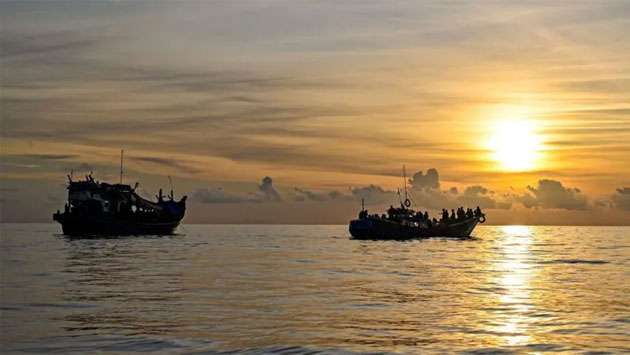
BBC - Two boats carrying an estimated 530 Rohingya asylum seekers left Myanmar's Rakhine state on 29 June, and have not been heard from since. The equivalent of a jumbo jet full of people has vanished.
It is very likely that they both capsized. The monsoon has started, the seas are rough, and the boats - usually old fishing trawlers converted to carry as many people as possible - are barely sea-worthy with unreliable engines.
It is also very likely that there were few, or no survivors. Half of them may have been women and children.
But we will never know for certain.
Rakhine has been in a state of war for many years, with the insurgent Arakan Army driving the Myanmar military out of most of it and besieging its last stronghold in the state capital Sittwe, which is now accessible only by air and sea. Almost all telecommunications have been cut by the military.
Chris Lewa, who runs the Arakan Project that campaigns to improve the situation of Rohingyas, has been trying to piece together what may have happened to the two boats.
This is extremely challenging. She no longer has contacts she can reach in Sittwe, or in Sin Tet Maw, the Arakan Army-controlled village from where the boats departed.
But through a series of other contacts, combined with other snippets of information, she is confident that both boats did leave on 29 June, one in the morning, the other later in the day.
She says they would have been heading for the southern coast of Myanmar, where they would unload their human cargo.
From there they would be transported by road, via rough transit camps in the forest, through Thailand to the Malaysian border.
Normally their families would expect to hear from them within a week or 10 days. Nearly three weeks later, they have heard nothing.
The Bangladesh authorities have recovered the body of one woman, washed up from the sea. Fishermen working the sea between the Irrawaddy delta and the coast of Mon state found several other bodies nine days later.
Chris Lewa believes all this suggests that the boats capsized, one several hours after leaving Sin Tet Maw, the other after several days of sailing south east.
There are more than a million Rohingyas living in over-crowded camps in southern Bangladesh, where aid is drying up, there are almost no jobs, and organised crime gangs operate freely. They are not allowed to leave.
An estimated 600,000 Rohingyas remain in Rakhine State, one quarter confined to miserable internally displaced people (IDP) camps, the rest surviving in precarious communities which have been caught in between the warring sides.
The military junta has been subjecting them to forced conscription. The Arakan Army, which draws its support from the ethnic Rakhine population, distrusts Rohingyas and is accused of serious human rights violations against them.
With such dire prospects, the Rohingyas' only hope is to get out to another country.
The 200,000 Rohingyas already living in Malaysia make that the most appealing destination. This has created a lucrative business opportunity for people smugglers, who now have networks in Bangladesh, Myanmar, Thailand, Malaysia and Indonesia.
The business model is simple: pack as many people as possible into the boats, find the best way of moving them to Malaysia without detection by the authorities, and ensure their families pay the $3,000 (£2,230) fee.
Those whose families fail to pay are detained and beaten, or worse, videos of their suffering sent to persuade their relatives to transfer the required fee.
Over the years the routes have changed, but the brutality of this human trade has not.
Back in 2015 the Thai government, embarrassed by its poor reputation for human trafficking, began blocking the road routes used by the smugglers and closing the primitive transit camps in mangrove swamps and rubber plantations where traffickers held their captives until sufficient payments were made.
The discovery of mass graves in these camps only added to the urgency of the Thai action.
Many of the boats heading south from the Myanmar Bangladesh border that year instead headed to Aceh in Indonesia, whose fishing communities initially welcomed these fellow, persecuted Muslims.
That welcome, though, has now been withdrawn, and there have been some hostile social media campaigns in Indonesia directed against the Rohingyas.
Malaysia remains very difficult for the Rohingyas to approach directly by sea. The Malaysian navy is efficient at intercepting them, and pushing them back out onto the open seas, and local fishing communities will not help.
Instead, says Lewa, the smugglers have gone back to using Thailand as their main transit route.
Larger mother ships pick up the Rohingyas off the coasts of Rakhine or Teknaf in Bangladesh, never staying long to avoid the authorities in both countries.
These days they carry satellite phones, and they communicate with smuggling teams in Thailand or Indonesia to pay local fishermen to take the Rohingyas to the beaches of southern Thailand or eastern Sumatra, from where, once full payment is made, they can be moved discretely to Malaysia.
Some are dropped on the southern coast of Myanmar, from where they are transported to Thailand, via land border crossings, and then by road to the Malaysian border.
But with all land routes cut from Rakhine to the rest of Myanmar, their escape must always start with a perilous sea journey.
Chris Lewa believes that at least 10,000 Rohingyas have left Myanmar and Bangladesh by boat since September last year.
This is significantly higher than in previous years, almost certainly driven by the intolerable conditions in which they are living in both Rakhine and Bangladesh.
The UN has called for safer routes to be established for the Rohingyas to leave. But no country in this region wants to take them, and so far no government has been willing to make their journeys any easier.