 SHABIYA ALI AHLAM
 Reply To:
Name - Reply Comment

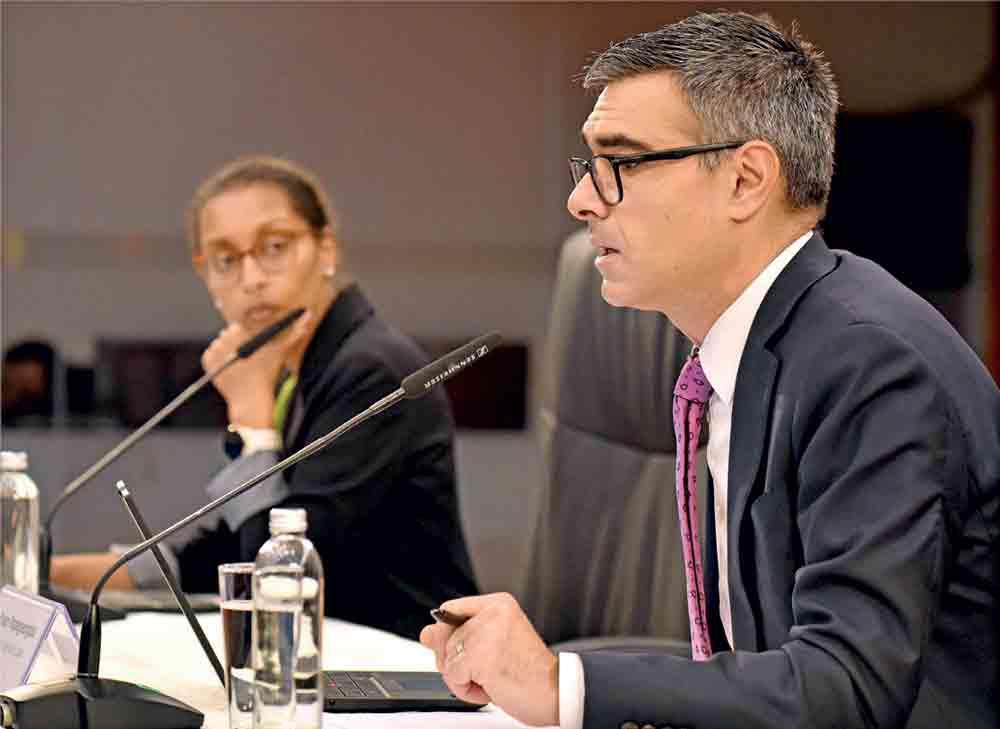
IMF Mission Chief Evan Papageorgiou addressing the media on reaching staff-level agreement on the fifth review, while IMF Resident Representative in Sri Lanka Martha Woldemkchael looks on - Pic by Kithsiri de Mel
By Shabiya Ali Ahlam
Sri Lanka’s economic recovery is gaining traction, the International Monetary Fund (IMF) said, following the end of a two-week mission, while stressing that critical reforms in the energy sector, state-owned enterprises (SOEs) and debt management remain essential.
The IMF’s assessment of Sri Lanka’s growth trajectory mirrors that of other international agencies, including the World Bank (WB) and the Asian Development Bank (ADB).
Speaking to journalists in Colombo yesterday, IMF Mission Chief for Sri Lanka, Evan Papageorgiou, said the island nation’s ambitious reform agenda continues to deliver commendable outcomes. He cited the economy’s 4.8 percent year-on-year growth in the first half of 2025, inflation returning to positive territory with prices rising 1.5 percent in September, and gross official reserves reaching US$6.1 billion by end- September.
The staff-level agreement on the fifth review of the country’s four-year Extended Fund Facility (EFF) arrangement paves the way for an additional SDR 254 million (approximately US$347 million) in IMF support, once formally approved by the IMF Executive Board.
The agreement is contingent on parliamentary approval of the 2026 Appropriation Bill and the completion of financing assurances confirming multilateral partners’ contributions and progress on debt restructuring.
During a Q&A session, Papageorgiou underscored the importance of structural reforms in the energy sector.
“Developments in the energy sector are very important. We pay close attention to the unbundling and evolution of the energy sector expected in 2026 and beyond. This reform is crucial for improving transparency and operational efficiency,” he said.
He emphasised that maintaining cost-recovery pricing for electricity is essential, adding that stable and predictable tariffs are key, as they support efficient and commercially sound decision-making by electricity companies.
For the fifth review, the IMF team is evaluating tariff submissions by the Ceylon Electricity Board (CEB) to the Public Utilities Commission, and assessing related structural benchmarks over the coming months.
SOE reforms remain another priority, as they are “systemically important, affecting large parts of the economy and labour market.” The Fund continues to engage with authorities on the design of new legislation, including stronger management incentives and the implementation of the new SOE Act.
Strengthening governance and resolving SOEs’ legacy debts, Papageorgiou noted, is critical to minimising fiscal risks.
Debt restructuring also remains central to Sri Lanka’s path towards fiscal stability.
The Eurobond exchange was successfully completed in December 2024, and several bilateral loan agreements have been signed with countries including Japan and India.
Of the US$28 billion in external debt under consideration, about US$0.5 billion remains to be restructured. Papageorgiou said that operationalising the Public Debt Management Office (PDMO) is imperative for prudent debt management and boosting investor confidence.
Fiscal performance in 2025 has been strong, supported mainly by motor vehicle taxes. However, the IMF cautioned that sustainability will require broader revenue measures.
“We are discussing with authorities how to incorporate these trends into the budget and fiscal planning,” Papageorgiou said.
The IMF also stressed that improving tax compliance, broadening the tax base and curbing revenue leakages are critical to building fiscal space.
On 7 November, the National People’s Power (NPP) government will present its second budget, the 2026 Budget, which is expected to provide a clearer picture of policy priorities and resource allocation.
According to the IMF, the 2026 Budget should align with programme parameters to continue building fiscal space on the back of strong revenue measures and prudent spending execution.
“This requires sustained efforts to improve tax compliance, broaden the tax base, and tackle revenue leakages by strengthening tax exemption frameworks. Enhancing public financial management, avoiding the re- emergence of expenditure arrears, and promoting high-quality and efficient public expenditure, including addressing under-execution of capital spending, will contribute to safeguarding fiscal discipline and transparency,” Papageorgiou said.
Highlighting the importance of foreign direct investment (FDI) and an improved business environment, he reiterated that attracting FDI requires a track record of sound macroeconomic policies, policy continuity and predictable reforms.
Papageorgiou added that structural measures such as infrastructure development, labour law improvements and targeted tax incentives are being closely monitored.
Governance reforms, anti-corruption measures and improved public financial management remain central to the mission’s recommendations, he said.
Over the past few weeks, the IMF mission met with top government officials including President Anura Kumara Dissanayake, Prime Minister Dr Harini Amarasuriya, and Central Bank Governor Dr P. Nandalal Weerasinghe.