Reply To:
Name - Reply Comment
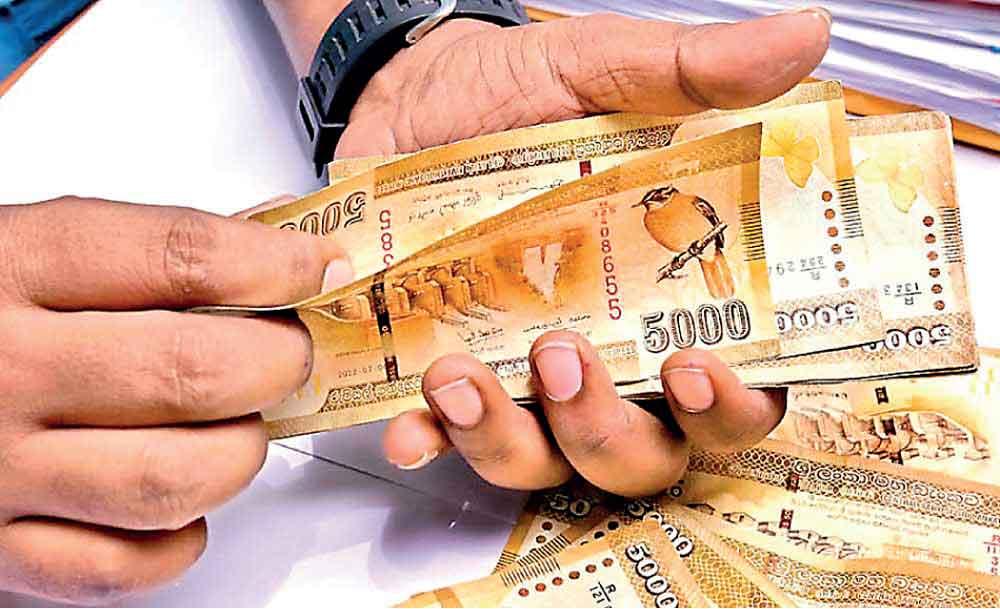
PIC BY NIMALSIRI EDIRISINGHE
By Shabiya Ali Ahlam
Sri Lanka’s sharp surge in currency withdrawals during the festive season conceals a more persistent dependence on cash that now contrasts with the government’s renewed push towards a ‘cashless economy’.
The Central Bank’s Market Operations Report, released on Friday, showed the licensed commercial banks withdrew about Rs.64.1 billion in currency in December 2025, which highlights the usual year-end spike in transaction demand.
The data showed that the currency in circulation (CIC) had already stabilised at elevated levels well before the festive period and remained high through year-end. This indicates a sustained cash usage rather than a short-term seasonal pattern.
During 2025, the CIC rose gradually, with a notable increase in April, due to the seasonal demand, before levelling off at higher levels and edging up again towards December.
“The surge in CIC during this period also reflects heightened public preference for holding cash amidst the increase in cash-based transactions and relatively low opportunity cost of holding currency, due to low deposit interest rates,” the Central Bank said.
In total, the Central Bank released Rs.103.8 billion worth of currency into the economy during the second half of 2025, broadly in line with Rs.106.4 billion issued in the first half. The demand for cash remained strong even outside the peak spending periods.
It must be noted that the persistence of the elevated cash usage sits uneasily with the government’s digitalisation agenda, which was reviewed at a high-level meeting chaired by President Anura Kumara Dissanayake in January 2026.
According to a statement released by the President’s Media Division last month, the review assessed the progress on the projects implemented under the Digital Economy Ministry in 2025 and examined the new initiatives planned under Budget 2026, with special focus on accelerating the transition to a cashless economy.
Discussions covered the digitalisation of government institutions, promotion of QR-based transactions, establishment of a cloud infrastructure centre, expansion of high-speed broadband, introduction of single-window digital services, digital identity card project and digitalisation of traffic spot-fine payments.
At the meeting, Dissanayake noted that a significant share of economic activity in rural communities continues to operate outside the formal economy, stressing the need to document such activity as a prerequisite for effective economic and development planning.
However, while infrastructure and platforms are being scaled up, the households and small businesses appear to be maintaining a strong preference for liquidity and immediacy, particularly as confidence continues to recover unevenly across sectors.
Reflecting this trend, reserve money, driven largely by the increase in the CIC, expanded to Rs.1,796.5 billion by end-December 2025, compared with Rs.1,539.3 billion a year earlier. This suggests that liquidity is accumulating in cash holdings rather than flowing through formal financial channels.