Reply To:
Name - Reply Comment
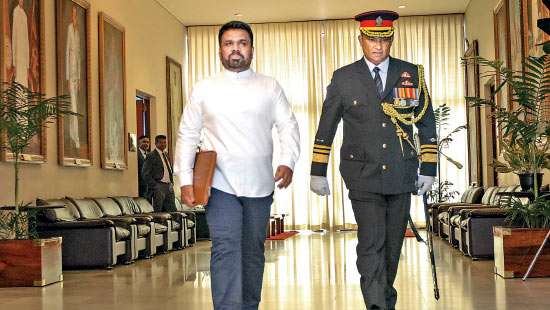
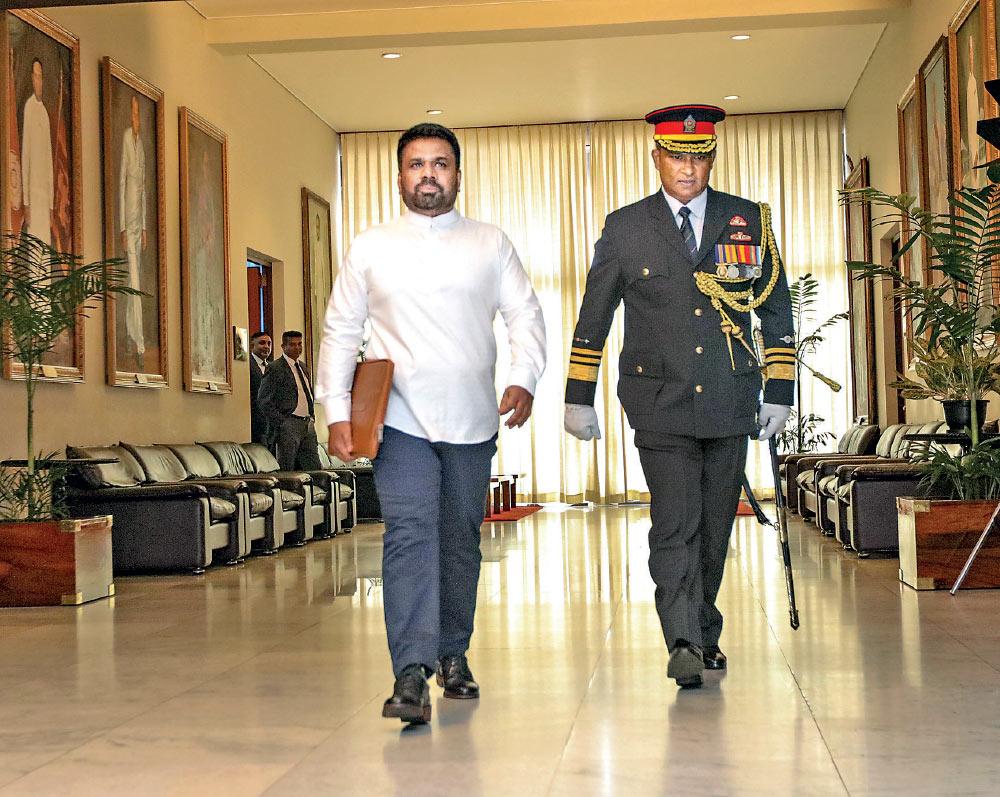
President Anura Kumara Dissanayaka arrives in Parliament to present Budget 2026 (President's Media Division)
 We are building a new environment where cronyism, racketeering and nepotism are replaced by credibility, discretion by predictability and privilege by partnership. This kind of environment helps attract quality investments. Provide the strength required for the recovery of our nation”
- President Anura Kumara Dissanayake -
By Shabiya Ali Ahlam
In a signal to the investors weary of Sri Lanka’s uneven playing field, President Anura Kumara Dissanayake yesterday used Budget 2026 to draw a line under what he called an era of “cronyism, racketeering and nepotism”.
Dissanayake asserted that investment in the island nation would not hinge on privilege but instead on “policy credibility, discretion and predictability”.
“This kind of environment helps attract quality investments. Provide the strength required for the recovery of our nation,” Dissanayake said presenting Budget 2026, the second under his leadership and the second for the year.
Successive governments have echoed this sentiment in past budgets and have had little success in translating it into meaningful results.
However, for a country long shadowed by investor scepticism, the administration’s renewed push for transparency, rule-based governance and institutional reform is welcome at this current economic juncture.
The proposals outlined to create an investment-friendly environment highlights the government’s intent to rejoin the ranks of economies that play by the rules of global capital.
At the heart of the reform drive are amendments to the Strategic Development Projects Act and Colombo Port City Commission Act, aimed at cleaning up the incentive regime.
These changes are aimed at simplifying the foreign direct investment procedures, reduce discretion and inject long-missing consistency into how the country courts investment. On the cards is also a new Investment Protection Act, scheduled for early 2026, to give investors firmer legal footing. A long-delayed Public-Private Partnership Act, now in its final stages after public consultation, will formalise private participation in national infrastructure, a sector the government sees as key for both recovery and resilience.
Acknowledging how over the years bureaucracy has throttled investor confidence, the government plans to introduce a digital ‘Single Window’ to fast-track approvals under the Board of Investment (BOI). Backed by Rs.100 million, the initiative is expected to cut red tape and align Sri Lanka with the regional peers competing for the same capital.
Equally significant is the focus on land and infrastructure, areas historically fraught with opacity. A new digital land information system and legal framework for valuation will be rolled out, alongside Rs.100 million in funding to modernise institutions managing land allocation.
The government is also turning to regional industrialisation, with Rs.3 billion set aside to develop auxiliary service zones tied to the existing investment hubs. The aim is to pull small and medium enterprises (SMEs) into supply chains, create jobs outside the Western province and decentralise the benefits of industrial growth.
For the tech economy, long touted but never quite realised, the budget breathes life into two long-abandoned technology parks in Kurunegala and Galle, with Rs.1.5 billion allocated to settle the loans owed by the previous contractors. The facilities will reopen for private investment, while two new parks in Digana and Nuwara Eliya are planned under the BOI.
On the external front, the Export Development Board is working with the Asian Development Bank on a National Export Development Plan, supported by Rs.250 million for brand promotion and another Rs.250 million to help the SMEs gear up for
global trade.
Meanwhile, Rs.2.5 billion has been earmarked to establish a Trade National Single Window, a long-overdue measure to modernise trade facilitation.
Further, the bill to establish a government company to hold the shares in commercial enterprises, which aims to increase accountability, transparency, governance and profitability in state-owned commercial enterprises, proposed in the previous budget, is expected to be presented to Parliament in the first quarter of 2026.
After years of ad hoc decision-making and policy reversals, the NPP administration promises this time will be different. The investors buying that story will very much depend on how quickly the rhetoric turns
into reform.