Reply To:
Name - Reply Comment
By Lithira Ekanayaka
After Diego Maradona’s retirement in 1997, Argentine football was in dire need of another legend, a talisman who could carry its footballing legacy.
Then, in 2006, an 18-year-old, 5-foot-7 youngster from Rosario made his international debut during the FIFA World Cup as a substitute and scored his first goal in the very same match, thus beginning a career that not only filled the huge shoes Maradona left behind but further extended the size required of his successor once he retires.
In 2026, exactly 20 years after that goal, proving that gods come in all sizes, this man stepped into his sixth World Cup and scored his first hat-trick on football’s biggest stage, further elevating his already unparalleled legacy as the greatest footballer ever to grace the earth.
Being the only player in history to win a World Cup, a Champions League, a continental tournament, and an Olympic gold medal while also winning the Ballon d’Or a record-breaking eight times, Lionel Messi—having nothing left to prove and nothing left to win—has completed football at the age of 38.
The Making of the Legend
Born on 24 June 1987 in Rosario, Argentina, Lionel Messi started playing football at the age of four and grew accustomed to playing against bigger opponents from a young age, often competing alongside his older brothers and cousins. At the age of five, he joined his first club, Grandoli, a local club near his hometown in Rosario, largely owing to his grandmother’s persistent pleas to the coach to include him in a match alongside his brother and cousins.
Despite being one year younger than his teammates, his performance did not disappoint either the coach, Salvador Aparicio, or his grandmother, as Messi later revealed in an interview while recalling the humble beginnings of his football journey. “Apparently when I went in, I did some things. My grandmother came back and told him [the coach], ‘Buy him football boots, I’ll bring him to training next week’—and that’s when I started. It was an amazing time,” Lionel Messi recalled.
Then, at the age of six, he joined the youth academy of Newell’s Old Boys in Rosario and scored more than 500 goals while winning numerous titles. During his six years there, he was part of “The Machine of ‘87”, an unbeatable youth team in Argentina named after the players’ birth year. Even in his formative years, coaches viewed Messi’s talent as something extraordinary and were determined to help turn this local kid into a legend.
However, despite his brilliance, during his time at Newell’s he encountered the first major barrier of his football career when he was diagnosed with a growth hormone deficiency that hindered his development, while his family struggled to afford the necessary treatment.
To make matters worse, Messi also lost his grandmother when he was eleven.
But a blessing arrived in the form of Barcelona in 2000, when the club’s then first-team director, Charly Rexach, got Messi to sign his first contract on a paper napkin and agreed to cover his medical expenses. After joining La Masia, the youth academy of FC Barcelona, Messi became an integral part of the team alongside Cesc Fàbregas and Gerard Piqué, forming what is widely regarded as one of Barcelona’s greatest-ever youth sides, later known as the Baby Dream Team.
During his first full season in 2002–03, Messi became the top scorer with 36 goals in 30 games. In the following season, he played across six different youth and reserve teams within the FC Barcelona system, steadily rising through the ranks and making his mark. Finally, in 2004, at the age of 17, he made his official first-team debut for Barcelona, becoming the youngest player ever to represent the club in an official competition.
Barcelona legend Ronaldinho, who was at his peak during Messi’s arrival, took the quiet and shy young Argentine under his wing and mentored him, forming a strong bond both on and off the field. In an interview that has since gone viral, NBA legend Kobe Bryant recalled how his friend Ronaldinho introduced 17-year-old Messi to him as the player who would become the greatest footballer of all time.
In a beautiful twist of fate, Messi’s first goal for Barcelona in 2005, which marked the beginning of his reign, was assisted by none other than Ronaldinho, who celebrated by hoisting Messi onto his shoulders in what has since become an iconic image.
Messi made his international debut for Argentina in 2005 against Hungary in a friendly match. Controversially, he was shown a red card and sent off for striking an opponent after being on the field for less than a minute.
Then, at the end of the year, he was awarded the Golden Boy award as the most promising young player in Europe. In his FIFA World Cup debut in 2006, coming on as a substitute in a group-stage match against Serbia and Montenegro, he scored his first goal of the tournament on June 16, 2006, kick-starting a fairy tale that came full circle exactly 20 years later on June 16, 2026.
Despite Argentina’s eventual quarterfinal defeat to hosts Germany, Argentine fans were more than optimistic about what lay ahead.
Two years after his debut, Argentina reached the Copa América final in 2007 against Brazil, where Messi suffered his first defeat in an international final as Argentina fell 3–0 to their fierce rivals. Despite losing the Copa América final, Argentina went on to win the prestigious Olympic gold medal in 2008, defeating Nigeria 1–0 and giving Messi his first major championship in Argentine colours.
In 2008, after Ronaldinho effectively handed over the reins by passing on Barcelona’s iconic number 10 shirt to Messi, the young Argentine responded in spectacular fashion. The very next year, Messi led Barcelona to La Liga and UEFA Champions League glory before capping off an extraordinary year by winning his first Ballon d’Or.
In his second World Cup in 2010, despite being Argentina’s leading man under the management of legendary Diego Maradona, Messi was unable to score a single goal as Argentina were eliminated by Germany once again in the quarterfinals.
The Argentine Woes
Heading into Brazil for his third World Cup in 2014, Messi-led Argentina were among the favourites to win the tournament. After winning the quarterfinal against Belgium 1–0 and emerging victorious in a gruelling semifinal against the Netherlands via a penalty shootout, Messi was poised to lift the trophy for the first time.
But heartbreak followed him once again in the final, as an extra-time goal from German substitute Mario Götze denied Argentina and Messi their much-desired third World Cup title. Despite winning the Golden Ball as the tournament’s best player, Messi faced severe backlash from fans and commentators alike as they began comparing his club achievements with his performances for the national team.
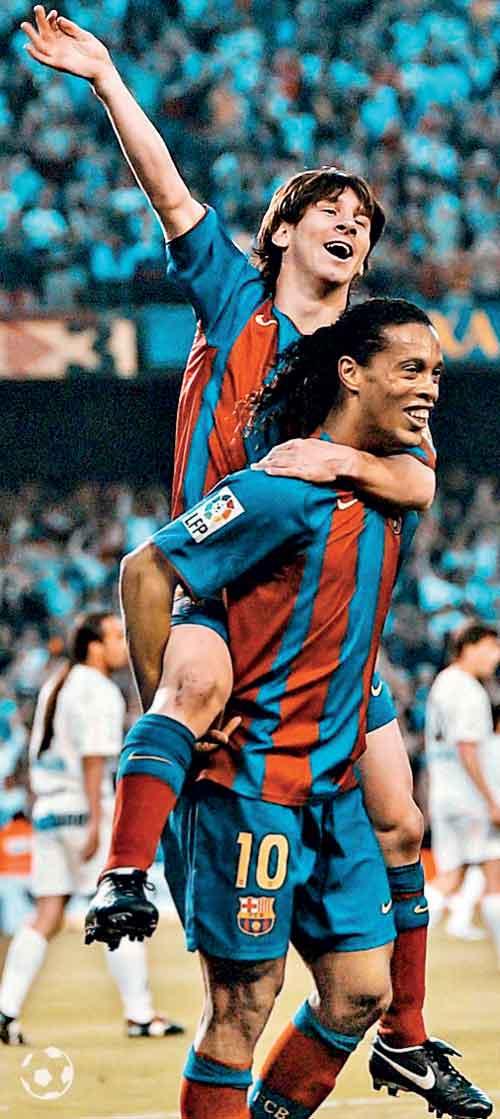
When a Brazilian Ronaldinho carried the blossoming Messi
Later pictures and videos of a distressed Messi went viral with critics and even some disillusioned supporters mocking and criticising him for suffering a third consecutive defeat in a major international final in three years. Unable to bear it any longer, and making international headlines, Messi announced his retirement from the national team.
However, after reversing his decision, Messi came out of retirement and headed to Russia for his fourth World Cup in 2018. Yet Argentina failed to progress beyond the Round of 16, where they were eliminated by France, who eventually went on to win the 2018 FIFA World Cup.
Apotheosis of Messi
In 2020, Argentina and the football world lost the legendary Diego Maradona at the age of 60 due to heart failure, and Messi wanted to pay tribute to him on the grandest scale possible. As Messi led Argentina, he kick-started one of the greatest eras in Argentine football history, one that may never be replicated.
At the age of 35, Messi once again led Argentina into his fifth World Cup in 2022 with the hope of finally winning it all. However, in the opening match, in a familiar sense of disappointment and dread, Argentina suffered a shocking 2–1 defeat at the hands of underdogs Saudi Arabia, much to the amusement of Messi’s critics.
But a determined Argentina quickly returned to winning ways, comfortably winning the remainder of their group-stage matches before facing the Netherlands in a heated quarterfinal, where they secured victory via a penalty shootout. In the semifinal, Argentina produced an impressive 3–0 victory to reach a FIFA World Cup final for the first time since 2014.
What followed was arguably the greatest FIFA World Cup final ever played, as Argentina and France went toe to toe in one of football’s most unforgettable matches. With the demons of the past seemingly creeping back, the second half saw young sensation Kylian Mbappé score twice to level the match.
Then, in extra time, Messi scored his second goal of the final to restore Argentina’s lead at 3–2, only for Mbappé to equalize once again from the penalty spot and make it 3–3. To Argentina’s disbelief, they were heading into yet another World Cup final penalty shootout, with history offering little comfort.
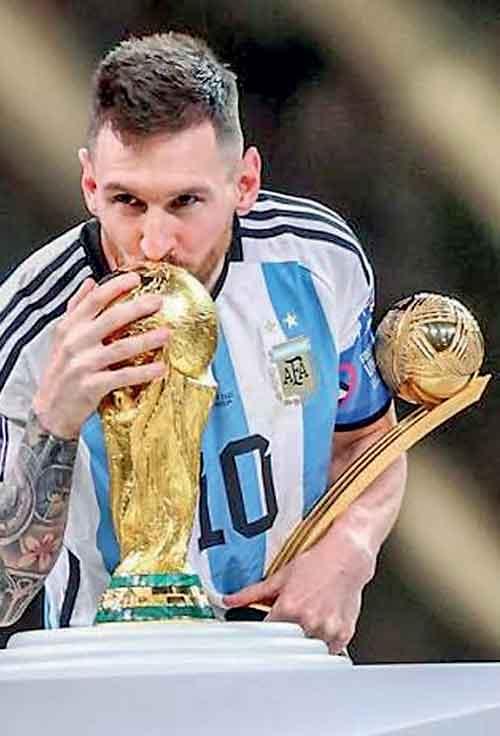
But the football gods were finally on Argentina’s side. They won the shootout 4–2, thanks in large part to the incredible goalkeeping display of Emiliano Martínez. During Gonzalo Montiel’s decisive penalty kick, Messi was reportedly seen looking towards the sky and whispering, “Puede ser hoy, abu,” which translates to, “It can be today, Grandma.”
By lifting the FIFA World Cup trophy, Messi cemented himself as the greatest footballer ever to play the game, with football’s most coveted prize having been the only missing piece of an otherwise legendary career. Finally, Argentine fans welcomed him home with open arms as a footballing god, matching the legendary status of Diego Maradona.
Messi Show Mercy- says the competition
As of 2026, Messi is a 38-year-old veteran with a career full of unbreakable records and iconic accolades. He has won 10 La Liga titles, 7 Copa del Rey trophies, 4 UEFA Champions League titles, 3 FIFA Club World Cup titles, 2 Ligue 1 championships, 2 Copa América titles, 1 Olympic gold medal (Beijing 2008), and 1 FIFA World Cup, along with 8 Ballon d’Or awards, firmly cementing his place as one of the greatest players to ever play the game.
Despite being 38 years old and currently playing in his record-breaking sixth World Cup in 2026, Messi continues to prove his greatness. He went on to score his first World Cup hat-trick against Algeria on 16 June 2026, exactly 20 years after his first World Cup goal in 2006, on the same date—bringing his story full circle in a fairy-tale moment.
With no pressure left to prove anything, Messi and Argentina are poised to win the FIFA World Cup for a second time. If achieved, this victory would further solidify his status as the greatest player ever to play football.