26 Sep 2025 - {{hitsCtrl.values.hits}}
By Allaam Ousman
|
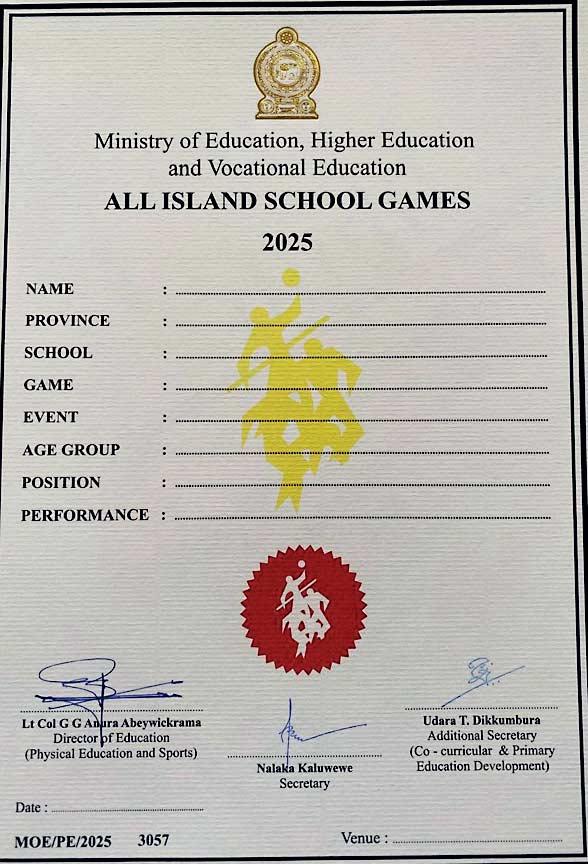
This certificate given to today’s school boxers is proof the Stubbs Shield, the most coveted prize on offer, is dead and buried |
The Stubbs Shield, once the blue riband of schoolboy boxing in Sri Lanka, has been reduced to a footnote in the very competition it gave birth to more than a century ago. What was inaugurated in 1914 by then British Colonial Secretary Sir RE Stubbs, who rendered yeoman service to the sport by gifting the Shield for annual inter-school competition, now finds itself lost in the shadows of bureaucracy and neglect.
Since the 1990s, the coveted Shield has been conducted as part of the All-Island National School Games (NSG).
The recently concluded 106th edition offered a glaring indictment of how far the event has fallen. Neither the official programme nor even the certificates awarded to winners bore mention of the fact that this was the Stubbs Shield meet. What was once a proud tradition has become an after-thought.
The Schools Boxing Association, citing lack of funds, conveniently merged the Stubbs Shield into the NSG. Meanwhile, the Boxing Association of Sri Lanka (BASL) has made repeated promises to preserve the sanctity of the Shield as a standalone national competition, but little has been delivered. Lip service, not leadership, has become the hallmark of custodians entrusted with the sport’s legacy.
The last decade has also seen a steep decline in the quality of competition. Weight classes have been repeatedly tinkered with, and the inclusion of an inflated number of divisions for boys and girls has prioritised quantity over quality.
In its heyday, Stubbs weight divisions ranged from 55 lbs to 135 lbs. Today, the range extends from 44kg to 81kg, ostensibly to keep pace with international standards. Yet, the quality of boxing on display has regressed alarmingly.
The girls’ competitions, in particular, have come under scrutiny. While the numbers have increased, the skill levels are painfully low. As one veteran coach observed: “It was like watching boxing in slow motion — you had to nudge yourself to believe this was the Stubbs Shield.”
What was once the nursery of technical boxing is increasingly a platform for brawling. The fine art of feints, side-steps, counters, thrusts, and parries have given way to a win-at-all-costs mentality. Even the most basic tool of the craft — the jab — is being forgotten.
The irony is inescapable. A competition founded in 1914 to popularise boxing in schools, nurtured by pioneers like C.G. Piggford of the Ceylon Police, Donald Obeyesekere at Royal College, AB Henricus at Wesley College and RV Routledge at Trinity College, has been reduced to anything but boxing.
The words of Sri Lanka boxing legend and forner Royal College coach Danton G. Obeyesekere, from his classic The Scientific Art of Boxing in 1937, bear repeating:
“Ceylon wisely started popularising the sport by introducing it into the schools in 1913. Mr RE Stubbs consented to present a trophy and passed the papers to the United Services Boxing Association to organise the Schools’ boxing meets.”
These eminent gentlemen who laid the foundation for boxing in this country must surely be turning in their graves at the state of affairs.
For past generations, to say “I fought in the Stubbs” was a badge of honour. Today’s youngsters, tragically, can only say they won medals at the National School Games. The erasure of the Stubbs name from certificates is not just an oversight — it is an insult to the history of the sport.
The Stubbs Shield is not merely a trophy; it is a century-old institution and the cradle of Sri Lankan boxing. Unless the guardians of the sport wake up to this reality, school boxing will continue to descend into mediocrity, and the Stubbs Shield will slip further into irrelevance.
The choice is stark: restore the Shield to its rightful place as a national competition, or consign one of Sri Lanka’s proudest sporting traditions to the dustbin of history.
05 Jun 2026 44 minute ago
05 Jun 2026 50 minute ago
05 Jun 2026 2 hours ago
05 Jun 2026 2 hours ago
05 Jun 2026 2 hours ago