07 Apr 2026 - {{hitsCtrl.values.hits}}
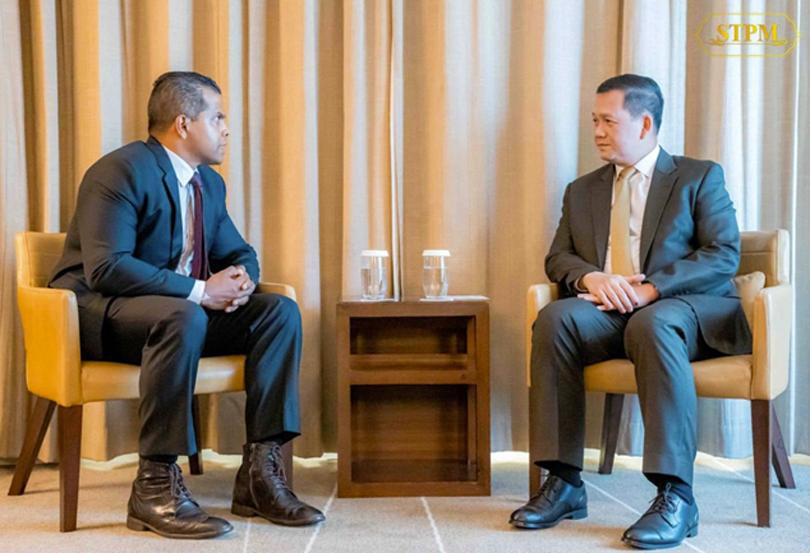
Following his meeting with Prime Minister Hun Manet, Arjuna Samarakoon says Cambodia is becoming a more important regional case study in how confidence, policy direction, and execution can shape investor attention.
Cambodia has often sat just outside the main regional investment conversation, seen as promising but not always central. That is beginning to change. Following his recent meeting with Prime Minister Hun Manet in Phnom Penh, Arjuna Samarakoon is framing Cambodia in more strategic terms, not simply as a growth market, but as a regional case study in how countries build investment credibility and convert momentum into a broader business story. The meeting itself has already been reported in both The Morning Money and The Morning, giving the article a real news hook rather than a purely reflective angle.
The case for paying closer attention to Cambodia is not based on rhetoric alone. According to the World Bank’s Cambodia data page, the country recorded 6.0% GDP growth in 2024, with GDP reaching about US$46.35 billion. More recent World Bank commentary has also stressed the need for diversification, revenue reform, and a stronger enabling environment for private sector investment, which is precisely why Cambodia is now being watched less as a simple frontier story and more as a market trying to strengthen the conditions around long term business confidence.
That distinction matters. Investors do not respond only to top line growth. They respond to whether a country appears easier to understand, easier to assess, and easier to commit to over time. Cambodia’s relevance today lies in the fact that it is increasingly being interpreted through that wider lens of competitiveness, reform, and commercial legibility. The World Bank’s Cambodia overview makes that clear in its focus on competitiveness and the country’s ambition to reach upper middle income status by 2030.
What makes Cambodia more interesting is not only what it is doing domestically, but what it signals regionally. For Samarakoon, the country can be read as an example of how a market begins to reposition itself in the eyes of capital. It is not that Cambodia is suddenly risk free or complete. It is that it is becoming harder to ignore. In regional investment terms, that is often the more important first step.
This is where the Australia angle becomes relevant. Cambodia is not a distant abstraction for Australian business or policy circles. The Department of Foreign Affairs and Trade describes Australia and Cambodia as long standing partners, with cooperation spanning trade, development, and regional security. DFAT’s current development partnership plan also speaks directly about supporting a more enabling environment for business and investment in Cambodia. For an Australia based audience, that makes Cambodia part of a live regional relationship rather than a market viewed only from afar.
Seen from Melbourne, where Samarakoon’s Australia facing business and investment perspective is rooted, Cambodia forms part of a broader shift in how serious investors are reading South and Southeast Asia. The focus is no longer only on scale. It is also on readiness, clarity, and whether governments are creating environments that reduce friction for business. Cambodia’s growing relevance comes from the sense that it is trying to send clearer signals on those fronts.
That framing also connects naturally with Samarakoon’s wider public commentary. In his earlier piece for Sri Lanka Mirror on what Sri Lanka can learn from Australia and the Philippines, he argued that predictability and accessible systems matter because they build confidence. A similar theme runs through the Daily FT article on Sri Lanka’s new reform era, where reform is framed not as rhetoric but as credibility, discipline, and delivery. Cambodia fits neatly into that same broader conversation.
The point is not that Sri Lanka should try to replicate Cambodia mechanically. These are different countries with different structures, pressures, and political contexts. The more useful lesson is that regional markets earn attention when they become easier to interpret. Investors notice countries that appear to be building coherence between policy, narrative, and execution.
That is why Cambodia now matters as a regional case study. It offers a live example of how business confidence can begin to gather around a country not merely because of raw growth, but because the wider investment story starts to feel more legible. After meeting Prime Minister Hun Manet, Samarakoon’s argument is essentially that Cambodia deserves attention for what it signals to the region: that confidence is built not in a single announcement, but through a gradual alignment of leadership, positioning, and economic direction.
Cambodia is no longer just a peripheral market mentioned in passing in regional discussions. It is becoming a more useful reference point in its own right. For investors and business figures watching Asia from Colombo, Melbourne, or beyond, that makes it worth following more closely. Samarakoon’s post meeting view is not that Cambodia has arrived at some final destination. It is that the country is increasingly showing how confidence takes shape, and why that process matters for the wider region.
03 Jun 2026 03 Jun 2026
03 Jun 2026 03 Jun 2026
03 Jun 2026 03 Jun 2026
03 Jun 2026 03 Jun 2026
03 Jun 2026 03 Jun 2026