21 Mar 2025 - {{hitsCtrl.values.hits}}
By Kumar Wethasinghe
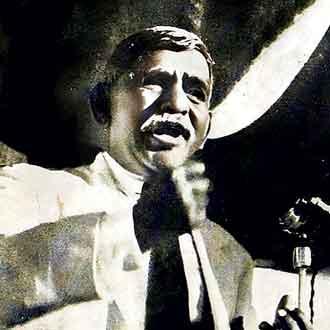
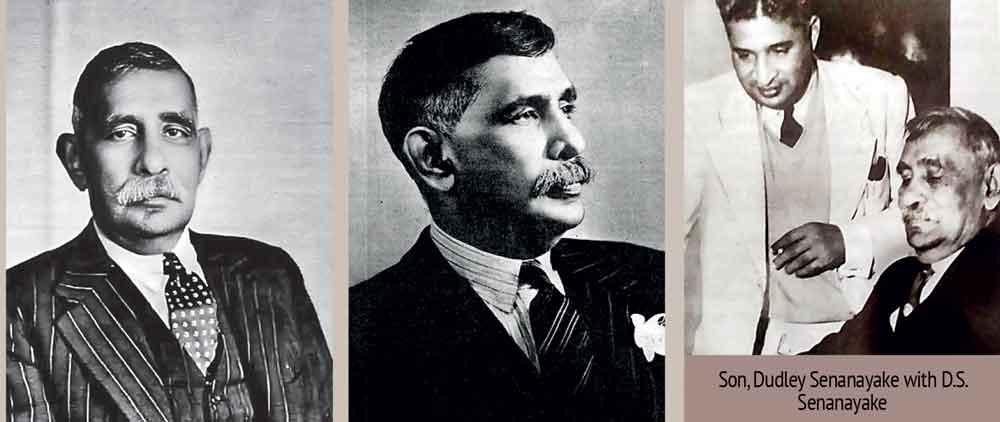
On the 21st of March, 1952, mournful shockwaves shook the entire nation with the sudden announcement that the First Prime Minister and the beloved “Father of the Nation”, passed away following an accident that took place on the morning of that day.
Hence, day and night for seven days, irrespective of class, caste or creed, crowds including the disabled and sightless, streamed to Colombo’s “woodlands”, to pay their last respects to the adorable leader.
Besides, the Royalty onwards and worldwide state heads expressed their heartfelt condolences to Sri Lanka. In accordance with his routine practice, Don Stephen (D.S.) rode his horse to the Galle Face green, on that fateful morning. In the Company of TGP and friends, while riding, his horse got excited causing the fatal fall of our Premier.
|
D.S. was a true national leader because he felt the public pulse and the needs of the poor |
Sometimes, coming events forecast their shadows. There hadn’t been a single orchid flower bloomed in their orchid house that day the premier’s domestic aid Carolis, thought it as a bad omen. Carolis is expected to place an orchid for the master’s suite daily.
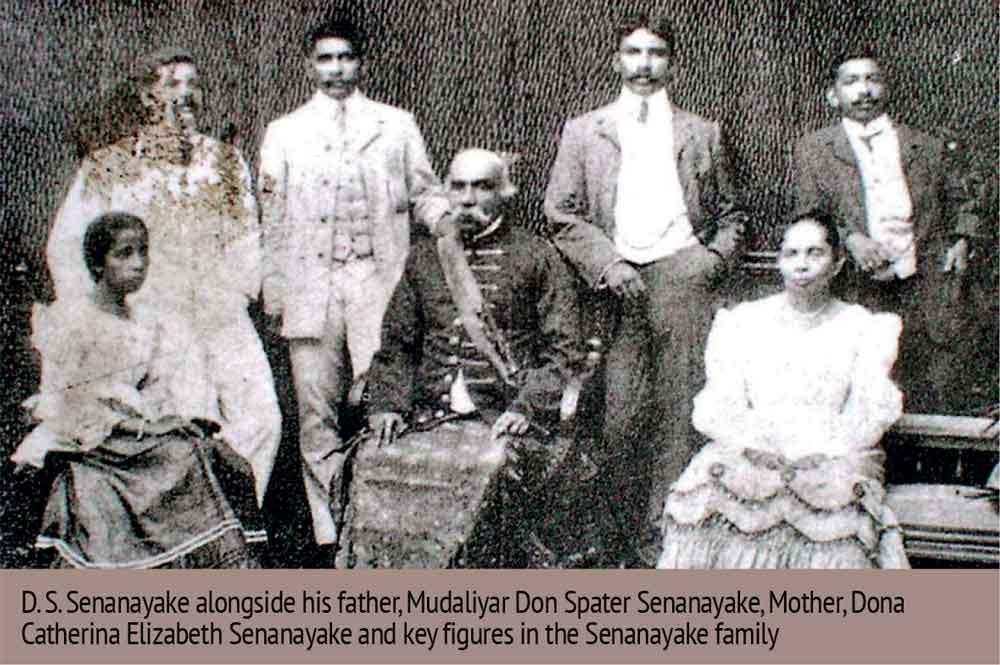
D.S. was the younger son of Mudaliyar Don Spater Senanayake and Dona Catherina Elizabeth Perera Gunasekera Senanayake of “Bothale Walawwa”. D.S. and Mollie Senanayake had two children, Dudley and Robert. The eldest son Dudley succeeded his father on four occasions as the Prime Minister of Srilanka, while his brother became a reputed business entrepreneur.
He was also the younger brother of renowned patriot F.R. Senanayake, who lavishly financed several delegations to travel abroad and agitate for the motherland’s independence on numerous occasions.
D.S. was educated at S. Thomas’ College, Mount Lavinia. He was not much of an academic but excelled in sports. However, his general knowledge and wittiness were remarkably unique.
Dr. N.M. Perera, who was an erudite and the leader of the Opposition, paid a high tribute to the late Premier in Parliament, the gist of his speech includes:
“When a crucial issue came up before this House, while we were all wondering how to find a solution, the late Premier would instantly come up with a correct solution. We were a mere educated sector, but the late Premier D.S., was a symbol of education. In the absence of his remarkable stature, the House of Parliament remains dull today”.
To gain National Independence, countless masses and benevolent leader sacrificed their lives over the centuries.
Once the ‘Pearl of the Indian Ocean’, and the ‘Serendib’, became an unfortunate British colony between 1815 and 1915. The final struggle to gain independence was revitalised. There were mass uprisings and individuals sacrificed to regain the lost national sovereignty. Thousands of acres of farmland were destroyed by the foreigners and King Rajasinghe, was captured and deposed. Mass murders were committed on civilians, and Patriot, Keppetipola Disawe, was beheaded in public. Ven. Kadahapola Hamuduruwo, Gongalegoda Banda and Veera Puran Appu were given Capital punishment. The injustice continued to reign.
By the end of the 18th century, the National Renaissance was rekindled. Among the host of golden leaders, Mother Lanka produced D.S. Senanayake, who was destined to lead the victorious battle of independence. By the time the vanguard of National Herds had passed away.
The erudite Maha Sangha of the calibre of Welivita Sri Sangharaja Saranankara Maha Thera, most Ven. Hikkaduwe Sri Sumangala, great debater, monk Mohottiwatte Gunananda Thera, the religious and educational morals of the nation were uplifted. Foreign Dignitaries, the American Col. Henry Steel Olcott, Russian lady Madam Blavatsky, and Tibet National, Ven. S. Mahinda Thero, came to our rescue and unveiled the National Cultural and Educational Scheme. Young D.S. at an early age joined the National Movement led by Srimath Anagarika Dharmapala, F.R. Senanayake, Sir Ponnambalam Arunachalam, Sir Ponnambalam Ramanathan, Brahmachari Walisinghe Harischandra, Sir James Peiris, Sir D.B. Jayatilaka, E.W. Perera, E.W. Jayawardene, D.R.Wijewardena and Piyadasa Sirisena etc.
D.S., was also instrumental in closing down liquor bars that mushroomed islandwide and during the 1915 riots, along with other leaders D.S. was imprisoned. For some time, national leaders negotiated and discussed obtaining a democratic form of ruling system for our country. Many a delegation undertook life-risking voyages to the U.K., as a result, Colebrook, Donoughmore and Soulbery commissions emerged. Accordingly under Manning constitutional proposals & legislative reforms were in effect.
On October 15, 1924, D.S. Senanayake, was elected to the legislative council for the Negombo seat. In 1931, under the Donoughmore System, in the 50 Member State Council, D.S. was unanimously elected as the member for Minuwangoda seat, becoming the Minister of Agriculture. He was also re-elected to the same seat at the 1935 elections.
While holding discussions with Indian Premier Shri Jawaharlal Nehru, on the Indo-Ceylon stateless problem, he continued further discussion with the U.K. Colonial Authorities.
In 1946, D.S. refrained from accepting the knighthood conferred on him by the British Crown.
Simultaneously, Dr. C.W.W. Kannangara’s Free Education Bill was passed in cabinet, in 1944.
In 1945, D.S. proceeded to London to participate in discussions for a self-ruling government and gained approval. In the same year, Holidays were declared for Sinhala / Hindu New Year and the Sri Lankan National Anthem and the national flag also received cabinet approval. D.S. presented the historic White Paper with regard to the final Constitutional amendments which were passed by majority vote in the Council.
Having founded the United National Party (UNP) on Sep. 15, 1946, under the leadership of D.S. 42 seats were won at the first Parliamentary election held in 1947 and D.S. became Sri Lanka’s First Elected Prime Minister. The Duke of Gloucester declared Sri Lanka as a Sovereign Independent State on Feb. 4, 1948.
In 1948, at the first Independence Ceremony, Prime Minister D.S. Senanayake rehosted King Rajasingha’s “Royal Banner” that was lowered by the Britishers on March 2, 1815.
It is noteworthy that King Rajasinghe’s Royal Standard was cornered in a London hospital. It was discovered by patriot E.W. Perera and restructured at the expense of patriot D.R. Wijewardene, who was at Cambridge University, at the time and respectfully brought back to our motherland as a symbol of our heritage.
D.S. selected a small but talented 12-member Cabinet with his able lieutenant J.R. Jayawardene as the first Minister of Finance. The priorities of the new government were the formation of the Central Bank of Ceylon, the Establishment of the Sri Lanka Army, the Launching of the giant Gal Oya Development Scheme, the Restoration of the sacred Anuradhapura city and the inauguration of the Mahiyangana scheme.
In January 1950, for the first time, the Commonwealth conference was held in Sri Lanka, with D.S. presiding and the internationally renowned, ‘Colombo plan’, which yielded high economic benefit to all commonwealth countries was founded.
At present, we are on the one hand depressed due to deliberately created social divisiveness by terrorists that plagued Sri Lanka for over three decades causing friction between religious, cultural and National identity.
Generally, politicians soon forget their promises and those who voted them to power. Battered and shattered by invaders, D.S. had to bear the national burden of designing the future of the newly independent Sri Lanka. D.S. was a true national leader because he felt the public pulse and the needs of the poor.
He had to devote his power and time to the development of national resources. He always retained the deepest personal interest in all that concerned the welfare of the Island and its downtrodden masses.
If one is sincere enough to study the initiatives made by the late Premier, it will not be too difficult to realise his mission & vision of creating a free nation. Altogether new chapters were opened in all spheres with the cooperation of the Cabinet Ministers. For statistical purposes, an outline can be mentioned of his farsighted strategies. As head of State, he did not have time to enjoy a lavish lifestyle but spent most of his time resurrecting ancient tanks and developing agriculture.
In the free firmament of Sri Lanka, the moon, the planets and all the stars glitter because of the radiant sunshine of D.S. Senanayake’s legacy.
“May the Father of the Nation attain Nibbana”!
03 Jun 2026 9 hours ago
03 Jun 2026 9 hours ago
03 Jun 2026 9 hours ago
03 Jun 2026 9 hours ago
03 Jun 2026 03 Jun 2026