20 Sep 2025 - {{hitsCtrl.values.hits}}
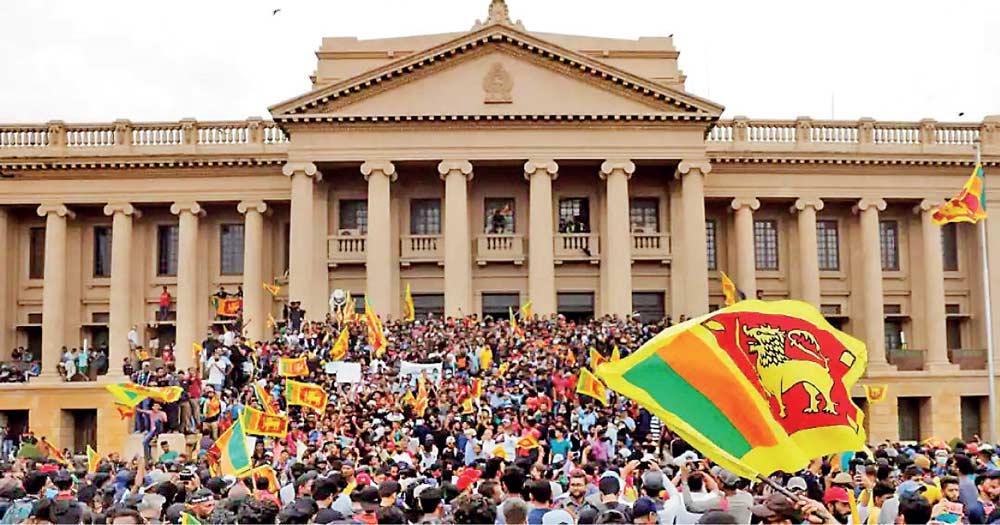
Youth protests took place in three Asian countries following Sri Lanka’s 2022 Aragalaya
 Except for Indonesia, in all other three countries governments have been toppled by youth uprisings during the last four years, though the trigger in each case was different
In all four countries social media acted as the communicator, propagandist and organiser for the protesters
The question arises whether the youth, especially the Gen Z, are taking over the political fate of countries, particularly those in South Asia with the recent regime changes and efforts to that effect in countries like Sri Lanka, Bangladesh, Indonesia and Nepal.
Except for Indonesia, in all other three countries governments have been toppled by youth uprisings during the last four years, though the trigger in each case was different. Yet, interestingly, the catchword of all four protest campaigns was corruption.
It was originally not a conflict between the state and the people in Nepal, but one between the government and Western social networking companies over regulation of social media in the country. In the context of misusing social media by millions of people across the world, the Nepalese government of Prime Minister K.P. Sharma Oli wanted to register those networks with relevant authorities. Only a few companies responded positively while other pushed the government to an awkward position.
The government responded to the tech companies by banning 26 of them within Nepal on September 4, unable to foresee the repercussions of this action as it was unprecedented. The youth who were addicted to social media as in any other country were enraged, and launched a protest campaign on September 8 in the Nepali capital Kathmandu, accusing the government of stifling social media platforms in order to cover up its corruption.
The protests met with a brutal crackdown by the police. Clashes followed where initially 19 young people lost their lives, making more people join the protest. Buildings of Parliament, the Supreme Court and houses of politicians, including two former prime ministers, were torched during which the wife of one former prime Minister sustained severe burn injuries and later succumbed to them.
Realising that the situation was out of control, the government lifted the ban on social media platforms and Prime Minister Sharma Oli was forced to step down. Subsequent to a brief period of anarchy, 73-year-old Sushila Karki, a former Chief Justice of Nepal who is regarded as having a clean image, was sworn in as the interim prime minister by President Ram Chandra Poudel on September 12.
The government and the protesters had strong arguments to back their positions. As the government contended, the social media is very badly handled by its users. Everywhere, some of these platforms are flooded with fake news, misinformation, disinformation, character assassination, hate speech, racism etc., especially when contentious issues are discussed. This calls for a need to have some sort of regulatory mechanism while, as the protesters accused, it also provides corrupt politicians an opportunity to choke them in the guise of regulation.
The Online Safety Act enacted in January last year in Sri Lanka was also opposed by Opposition parties and journalists as well as social media activists on the same grounds. In fact, it paves the way for the President to control social media platforms by appointing his stooges to the Online Safety Commission, the regulating authority, if he wants.
It is argued that the real winner of Nepal’s crisis were the social media companies who proved their power over a weaker governments. Viranjana Herath, the Chairperson of the ‘Media Law Forum’ in Sri Lanka in a Facebook post argues that the states of the Global South have been rendered helpless when it comes to media regulation which smacks of colonialism by several social media giants.
The crisis in Bangladesh has a different context. The issue that triggered the youth unrest last year was as old as the creation of the country in 1971. East Pakistan was rechristened as Bangladesh after its separation from Pakistan, then called West Pakistan, following a bloody war with Indian forces. Indians were supported by East Pakistan’s resistance force, Mukti Bahini. Since then, a third of state jobs have been offered to families of descendants of those involved in that struggle.
This quota system which was considerably changed in 2018 was reintroduced in June last year prompting the youth to fight against it. Protests which began in July turned into bloody clashes with the armed forces where over 300 protesters were killed. Although the Supreme Court largely changed the quota ratio, the protests had widened to embody a much deeper discontent with Prime Minister Sheikh Hasina’s government. Finally, Hasina had to flee the country to India and Nobel laurate Muhammd Yunus took over the country as leader of Bangladesh’s interim government.
In Indonesia, the recent protests erupted with reports that parliamentarians were provided with a huge housing allowance of over $3000. As clashes reported between the protesters and police, a street food seller was knocked down by an armoured police vehicle which turned the protests into a bloody riot.
President Prabowo Subianto who initially called the protesters terrorists, later backed down to withdraw the housing allowance for the Parliamentarians. Protesters demanded to dissolve the Parliament and impeach Vice-President Gibran Rakabuming Raka, a son of former President Jokowi Widodo. Five ministers were sacked. Although the violence subsided, tension still persists in the country.
There are parallels among the unrest in these four countries, -- Sri Lanka, Bangladesh, Indonesia and Nepal -- as if the latter three emulated Sri Lanka’s Aragalaya of 2022. Although all four manifested boiling frustration of the people over their economic hardships and corruption by the politicians, they all were triggered by a specific issue.
In Sri Lanka, it was the 13-hour power cut in 2022, while the job quota served as the trigger for Bangladesh’s unrest last year. Nepalese Gen Z sprang into action in response to the social media ban, whereas protests erupted in Indonesia following the reports of a housing allowance for MPs. Later, they rapidly changed into a cry for regime change which was materialised in three countries.
In all four countries social media acted as the communicator, propagandist and organiser for the protesters. No protest was predetermined, they all were spontaneous, and thereby without a central leadership. The spontaneity of all four protests made them apolitical, and left the protesters in a dead end after regime change in three countries, leaving the corrupt system to continue as before.
However, the Aragalaya in Sri Lanka produced a new government, though two years later, which seems to break from the past. In Bangladesh and now Nepal, too, regime changes occurred, people await a vague future while any regime change in Indonesia is uncertain in the current context.
04 Jun 2026 3 hours ago
04 Jun 2026 3 hours ago
04 Jun 2026 4 hours ago
04 Jun 2026 4 hours ago
04 Jun 2026 4 hours ago