09 May 2025 - {{hitsCtrl.values.hits}}
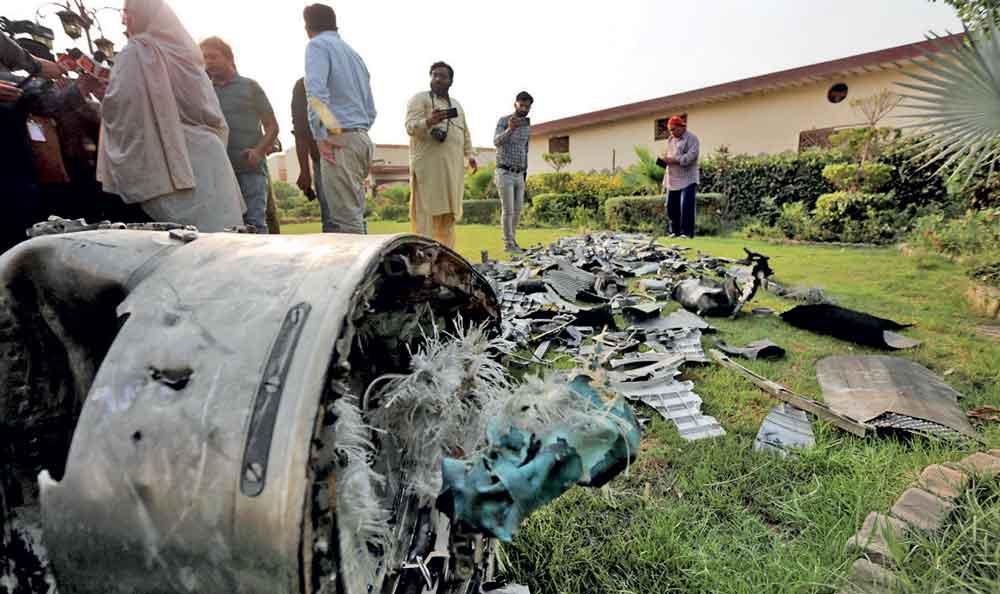
Journalists film missile fragments at the compound of an Islamic seminary after Indian strikes in Ahmedpur Sharqia, about 7 kilometers from Bahawalpur in Pakistan’s Punjab province, on May 7. AFP.
 The world cannot remain silent when two nuclear powers—India and Pakistan—are gearing up for war. Such a conflict is in the interest of neither the two countries nor the rest of the world. A nuclear war, in which there are no winners but only losers, will precipitate a disaster of apocalyptic proportions with devastating consequences for decades to come, not only for the two countries but for the surrounding region and even the entire world.
The atomic bombs the United States dropped on Hiroshima and Nagasaki pale into insignificance when compared to the destructive power of the modern nuclear weapons. The atomic bomb attacks on the two Japanese cities in August 1945 instantly killed nearly 300,000 people. The blasts generated temperatures of 3,000–4,000 degrees Celsius, vapourising people in and around ground zero. Survivors suffered from radiation sickness and faced long-term health issues, including cancer and genetic mutations.
The Hiroshima atomic bomb, nicknamed “Little Boy”, had a yield of 16 kilotons, but a strategic nuclear bomb has a yield range of 100 kilotons to 1.2 megatons (1200 kilotons) and beyond. In other words, a nuclear bomb with a yield of 1.2 megatons has 75 times more destructive power than the atomic bomb dropped on Hiroshima.
In an India-Pakistan nuclear war, tens of millions will die instantly if the targets are heavily populated cities, such as New Delhi, Mumbai, Karachi, and Lahore. Tens of millions will be wounded and suffer from burn injuries and radiation sickness. In such a war, help won’t come rushing in for fear of radiation. Besides, the infrastructure, including hospital buildings, will be in total collapse; vehicles, including ambulances, will have been reduced to burning wrecks.
Apart from colossal human casualties, a nuclear war spells an environmental disaster beyond imagination. The enormous smoke and soot from burning fires will cloud the sun to precipitate the dreaded nuclear winter that could lead to failed crops, mass starvation, disruption of monsoons and many other problems. In South Asia, almost every country will suffer the consequences. The disruption in the supply chain can have serious economic implications for the entire world.
Given this horror, should India and Pakistan go to war, and should world powers stay quiet without using their political clout to persuade the two countries to give peace another chance? Most countries have urged both India and Pakistan to exercise restraint. But shouldn’t they launch a full-scale diplomatic offensive aimed at defusing the crisis instead of limiting their diplomacy to mere perfunctory words?
Shouldn’t the world powers, especially the United States, revisit the formula they employed to defuse the 2019 conflict between the two countries after 40 Indian police officers were killed in Pulwama in India-administered Kashmir in a suicide bomb blast claimed by Jaish-e-Mohammed, a terror group now banned in Pakistan? Amid mounting public pressure for a fitting reply, India launched air attacks on what it called terrorist training camps inside Pakistan. The following day, during a dogfight, Pakistan shot down an Indian MiG-21 aircraft and captured its pilot. As the tension escalated, the US under the first Trump administration intervened and made peace. The US also played a peacemaker role during the 1999 Kargil war between India and Pakistan.
On Tuesday, soon after Trump announced that the US and Yemen’s de facto rulers, the Houthis, have struck an Oman-brokered peace deal, he was hinting at moves to de-escalate the India-Pakistan conflict that arose after a terrorist group gunned down 26 Indian male tourists—all Hindus—at Pahalgam in the Indian side of Kashmir, which New Delhi regards as an integral part of India.
Just like in 2019, attacks and counterattacks continued, and they escalated after India on Wednesday launched a pre-dawn attack on what it claimed were terrorist facilities in Pakistan.
India named its military operation after Sindoor. The word refers to a vermillion red cosmetic powder worn by married Hindu women along the part of their hairline. A woman’s sindoor—kunkumam in Tamil—is wiped away when her husband dies. Operation Sindoor is in honour of those who lost their husbands in the April 22 terror attack. India’s foreign secretary said Operation Sindoor was measured, non-escalatory, proportionate and responsible, implying India does not want to trigger a major war.
Vowing to hit back, Islamabad denied India’s accusation that the terrorists who staged the Pahalgam attack came from Pakistan. It claimed that Wednesday’s Indian air attacks killed more than 30 civilians, including children, and described the attack as an act of war. Islamabad also claimed that its Air Force shot down five Indian aircraft on Wednesday and 25 Israeli-made drones yesterday. It also said it destroyed the Indian brigade headquarters and several checkposts along the Line of Control that divides Kashmir. India, however, disputed the claims.
India and Pakistan have been arming themselves to the teeth in the past several decades. The two countries have bought or built high-performance strike aircraft capable of carrying nuclear missiles. They possess high-octane projectiles that can reach each other’s cities. According to Stockholm-based disarmament think tank SIPRI, India is the world’s second-largest arms importer—technically first if Ukraine’s war needs are discounted. India accounts for 8.3 percent of the global arms imports. Pakistan, on the other hand, is the fifth largest arms importer, representing 4.6 percent of global arms imports. In 2024, India’s total military spending reached $86.1 billion, making it the fifth-largest military spender globally, while Pakistan spent $10.2 billion, nine times less than India’s expenditure.
The asymmetrical military balance in favour of India has prompted Pakistan to maintain a policy of deliberate ambiguity with regard to its nuclear first-strike stance. Following the recent escalation, Pakistani leaders have said their country reserves the right to use nuclear weapons if attacked.
India, on the other hand, has declared a No First Use (NFU) policy. Pakistan’s ambiguity about the first use of nuclear weapons is its biggest defence against the its militarily more powerful neighbour. Such a stance serves as a deterrent to prevent full-scale Indian adventurism into Pakistan. Both Indian and Pakistani leaders are not so irrational or imprudent as to invite what nuclear disarmament advocates call mutually assured destruction (MAD).
Preventing a nuclear confrontation between the two countries is the critical issue at hand. World powers such as the US, China, Russia, and Japan should intervene directly without further delay to prevent further escalation. Moreover, they should urge the two nations to put in place confidence-building or conflict-avoidance measures or a mechanism to deal with similar crises peacefully in the future without resorting to brinkmanship. This is vital given the consequences of a nuclear confrontation would be calamitous and transnational.
04 Jun 2026 8 hours ago
04 Jun 2026 8 hours ago
04 Jun 2026 9 hours ago
04 Jun 2026 9 hours ago
04 Jun 2026 9 hours ago