06 May 2025 - {{hitsCtrl.values.hits}}
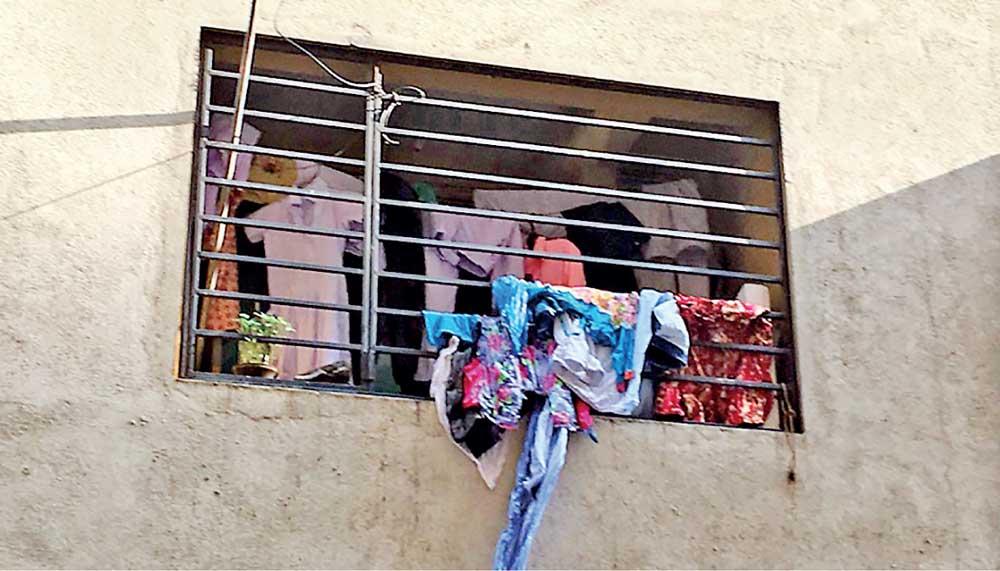
Drying clothes without a balcony – Muwadora Uyana
 Colombo’s working class— 50% of the city’s population—are central to its economy and vibrant culture, but have historically been marginal to Colombo’s development agenda. Following the end of the war, however, they came into sharp focus. The Urban Regeneration Programme (URP) classified 53% of Colombo’s population as living in ‘underserved settlements’ – a term strategically deployed to deliberately misrepresent working-class neighbourhoods as ‘off-grid’. Homes and communities were reconceptualised as ‘underutilised land’ occupying ‘economic corridors’ that needed releasing for investment and beautification.
The solution? Forced evictions of more than 50,000 working-class families and relocating them to state-built high-rise flats in the outer peripheries of Colombo. These relocations fractured community and family ties, disrupted schooling and livelihoods, and disregarded residential histories dating back to colonial days.
The 900 acres working-class communities occupied only amounted to 10 percent of Colombo’s landmass – that is, fifty per cent of Colombo’s population living in ten per cent of land. By further reducing the allocation to 300 acres, the URP’s priorities are clear - it values property over people. Malls, five-star-hotels, and luxury apartments are being constructed over the demolished homes of the working-class poor.
On the surface, urban regeneration may seem like a win-win: improve the city and provide better-quality housing. But years of research with affected communities since 2010 tell a story of stark injustice. As Colombo headed into the Municipal Council elections, we had to ask ourselves and the government we appointed: What kind of city were we building? Who was it for?
Right to the City
At the core of the Urban Regeneration Programme is a problematic assumption—that Colombo’s working-class poor are informal settlers without legal rights. This narrative has helped justify forced evictions. In reality, many families—including those in Kompanna Veediya(Slave sland) —hold title deeds and ownership ‘yellow’ cards that go back generations. Others have long-standing tenure and legal claims under Sri Lankan law. They are registered voters and have been paying utility bills and rates to the CMC from at least the 1980s.
Despite legal claims and historical ties to the city, the URP’s relocation scheme has not compensated these communities for demolishing their homes. Legal title is withheld until a loan of one million is paid over 25 years. Those with legal title – such as the residents of Malay Street relocated to Metro Flats – found themselves in houses whose original design had been drastically changed without even a balcony to dry their clothes.
Compensation, not Debt
The loans highlight a flagrant violation of justice. Instead of compensation, the working-class poor find themselves mired in debt owing to monthly loan payments and high utility bills. Their houses were not temporary shelters, but homes incrementally built and maintained over generations through personal savings and labour. The URP regard these investments as sunk costs, transforming families from homeowners to mortgage payers with uncertain tenure.
Rajeshwari, for example, a resident of Muwadora Uyana, migrated to the Middle-East as a domestic worker as she could not run her home-catering business from her flat. Her 15-year-old daughter discouraged by the long commute to her old school and separated from her caring neighbours dropped out of school in her mother’s absence.
Liveable Homes not Vertical Slums
Given rising real estate prices and exorbitant rents in Colombo, poor working-class communities adapted their homes to support growing families across multiple generations. By dividing and building vertically, these 1-2 perch plots accommodate multiple households. The URP’s “house-for-a-house” policy, however, does not take these living patterns into account. It treats each original structure as a single household, overlooking variations in household size, composition, and co-residency. As a result, multiple households are allocated just one flat, leading to overcrowding, loss of privacy, and family tensions.
For example, when Madhuri’s natal family was relocated from Mayura Place, the second room in the new flat was allocated to the oldest daughter. Madhuri and her young family moved three times in the space of one year due to high rents.
The design of the high-rise flats illustrate why the working-class poor are peripheral to state policies. They fail to meet basic standards for liveability– they are dark and poorly ventilated due to minimal windows and lack of green spaces. The children have no playground, and the elderly are house-bound as elevators are out-of-service. Unknown neighbours and lack of public spaces means there is no sense of community; only a heightened fear for one’s safety and security.
Colombo is our City
The residents of Kompanna Veediya believe that Colombo belongs to the working-class as much as to the middle-classes and the elite. In the Community Manifesto on Housing and Urban Planning they created, they call for healthy and liveable homes, caring communities, and an inclusive city.
Other stakeholders, including property developers and international investors, may have different interests. Policy decisions inevitably require trade-offs between competing interests. But the issue is not whether trade-offs exist, or who bears its costs. In Colombo, it is the working-class poor who have disproportionately borne the burden of development by losing their homes.
Around the world, urban regeneration is characterised by deepening inequalities, including gentrification. In response to citizen demands for transparency and accountability of public plans, urban planners are making efforts to incorporate community participation and inclusive design. In the UK, Scandinavia, and Singapore, laws require property developers to allocate part of their budgets for social housing and public spaces. In Argentina, Bolivia, Chile, Cuba, and Peru, strategic urban planning incorporates communities in their multi-sectoral consultations to reach common agreements on the future of cities. These efforts are not without its challenges but demonstrate a commitment to social justice.
Policy Priorities
At a minimum, the UDA must issue deeds without delay to compensate for lost homes. Future allocation of flats must be based on number of households living in the same premises. In-situ housing should be incorporated into property development plans for those communities who continue to live in their homes. The policy environment is complex, but a humane policy on social housing is imperative.
The local government elections were an opportunity for the NPP to align the priorities of Colombo’s residents with their broader goals of equity and inclusion. Communities that have lived, worked, and contributed to Colombo for generations deserve better than forced relocation into ‘vertical slums’. If people are the heart of Colombo, its future must be shaped with the people who have built and sustained it.
Blurbs
At the core of the Urban Regeneration Programme is a problematic assumption—that Colombo’s working-class poor are informal settlers without legal rights. This narrative has helped justify forced evictions. In reality, many families—including those in Kompanna Veediya(Slave sland) —hold title deeds and ownership ‘yellow’ cards that go back generations. Others have long-standing tenure and legal claims under Sri Lankan law. They are registered voters and have been paying utility bills and rates to the CMC from at least the 1980s. At the core of the Urban Regeneration Programme is a problematic assumption—that Colombo’s working-class poor are informal settlers without legal rights. This narrative has helped justify forced evictions. In reality, many families—including those in Kompanna Veediya(Slave sland) —hold title deeds and ownership ‘yellow’ cards that go back generations. Others have long-standing tenure and legal claims under Sri Lankan law. They are registered voters and have been paying utility bills and rates to the CMC from at least the 1980s.
CAPTIONS
Photo 1:
Women in Kompanna Veediya sit on their kandiyas for an evening catch-up
Photo 2:
Doing homework in the garden – Kompanna Veediya
Photo 3:
Incremental housing in Thotalanga
Photo 4:
Thai Pongal in a dark corridor – Muwadara Uyana
Photo 5;
04 Jun 2026 7 hours ago
04 Jun 2026 8 hours ago
04 Jun 2026 8 hours ago
04 Jun 2026 9 hours ago
04 Jun 2026 9 hours ago