06 Sep 2025 - {{hitsCtrl.values.hits}}
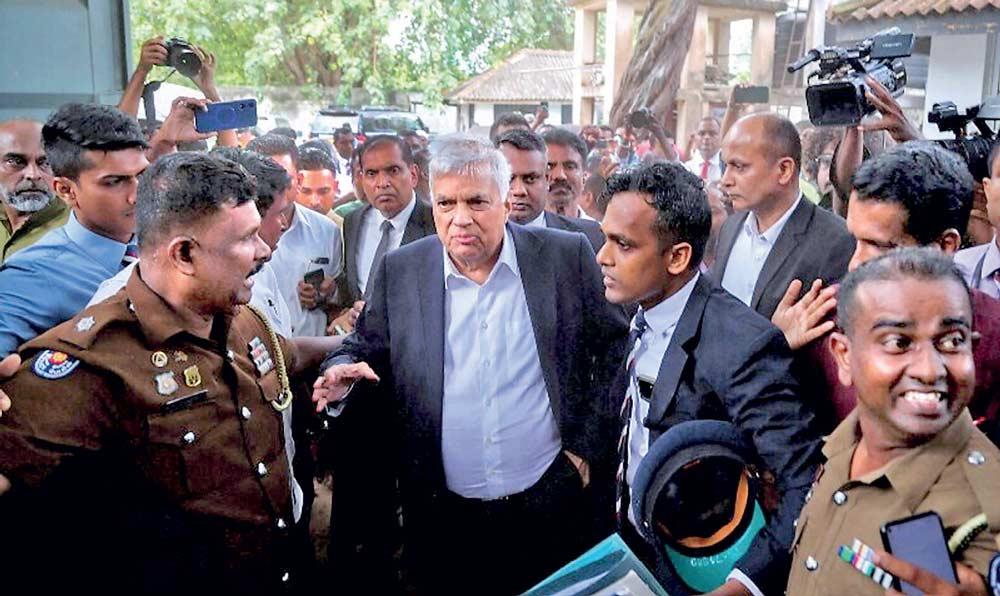
Ranil Wickremesinghe’s arrest has sent shockwaves through the opposition
The Opposition party leaders seem to be in a rude shock after the arrest and remanding of former President Ranil Wickremesinghe over allegation of using public funds for what the government leaders say was a private visit to Wolverhampton University in England where his wife Professor Maithree Wickremesinghe was awarded an honorary professorship in September 2023.
It is not just the shock that the long arm of the law has reached one of the few political untouchables for the first time, a former President, but the realisation of a possible similar fate that might befall them under the current administration of the National People’s Power (NPP).
Irrespective of the degree of acceptability of the allegation against the former President, his arrest brought the unwritten convention of political untouchability to an end which the former President of the Bar Association of Sri Lanka (BASL), Saliya Peiris,in a Facebook post subtly equated to Julius Caesar crossing the Rubicon in January 49 BC.
“Once the Rubicon was crossed, there was no turning back. It was a decisive moment of no return. It led to a civil war and ultimately to Caesar’s final victory. This event gave rise to the phrase ‘crossing the Rubicon,’ meaning to make an irreversible decision. In politics or governance too, there are such decisive moments. Such decisions must always be taken wisely, keeping in mind the long-term needs of the nation” Peiris stated.
The situation prompted the Opposition leaders to take a unified action to ensure that it was not the crossing of another Rubicon. They, some of whom wanted -- really or ostensibly -- to see Wickremesinghe behind bars for the 2015 Central Bank bond scam, rallied around him, describing the arrest as political vendetta and constitutional dictatorship. They seem to be driven by the fear of what may be in store for them, and not by principles or policies.
Almost all past governments have many skeletons of corruption and crime in their closets, and President Anura Kumara Dissanayake has always been vowing not to allow them to be swept under the carpet with the passage of time. There were times when media houses and journalists were attacked, some journalists killed, Parliamentarians murdered in broad daylight, and dubious local and justification found for foreign transactions running into billions of rupees including the Central Bank bond scam.
Emblematic cases such as the killing of journalists Lasantha Wickrematunga, D. Sivaram (Taraki) and Nimalarajan, attacks on journalists Upali Thennakoon, Keith Noyahr and Poddala Jayantha, killing of Opposition politician Kumar Ponnambalam, Parliamentarians Nadarajah Raviraj, T. Maheshwara and Joseph Pararajasingham, and attacks on Sirasa and Siyatha media houses occasionally come up during election campaigns, but only to be forgotten soon.
Most of these are considered to be crimes without criminals, and the government of the day in general always blamed for most of them. Hence, the concerns and apprehensions of the leaders of past governments following the arrest of former President is comprehensible.
Adding to this, a number of powerful former politicians were arrested by police and convicted by courts in connection with corruption, after the NPP came to power. Former Ministers Mahindananda Aluthgamage and Nalin Fernando were sentenced to imprisonment for 20 years and 25 years, former minister Rajith Senaratne was arrested, former state ministers Sashindra Rajapaksa and Nimal Lanza were arrested, and former Parliamentarian Ven. Athureliye Rathana Thera too, has been arrested.
Opposition politicians see a political vendetta in these incidents as these people have been arrested for incidents which took place long before, sometimes over a decade ago. However, allegations against these politicians had also been levelled long ago, and those cases had not been disposed. There is no time frame for any case to be disposed or dropped in Sri Lanka. And there is no reason for them to be dropped as many of these cases involve public funds or issues pertaining to law and order. There have been instances in the past where cases such as the Joseph Pararajasingham murder case were withdrawn by the Attorney General without citing any reason. A government that came to power primarily on the promise to eradicate corruption cannot be expected to do the same.
However, the NPP government might sometimes be fast-tracking the cases against the Opposition politicians as the very Opposition parties have recently been mocking government leaders, questioning the delay in “catching thieves” as they promised before the election. Then, President Dissanayake warned them not to murmur (kendiri gaanna epa) when thieves are being caught. At the same time, the government also seems to want to silence some of those who always annoy it even sometimes with obvious false allegations.
For instance, the statement allegedly made by Pivithiru Hela Urumaya leader Udaya Gammanpila recently might warrant investigation under the ICCPR Act. However, such statements by him are not taken seriously by many. Yet, he has become a thorn in the side of the government by making negative comments on almost every action by its leaders. He recently told the media that the number of crimes in the country have increased possibly because of weapons that might have been smuggled into the country in those containers controversially released without inspection in January. Nobody took that statement seriously, despite it being extremely serious. On the other hand, the number of shootings which took place last year was much larger than that of this year.
However, the actions against Opposition politicians including Wickremesinghe could be termed as political vendetta, firstly if the relevant allegations are proved false by a court of law. Secondly, the charges must be framed after the NPP assumed office. Therefore, it is too early to accuse the government of political revenge.
No leader of a party would have personally been involved in a crime despite them being accused of various crimes. However, where it might lead to if investigations into such crimes are continued is unpredictable. Therefore, the apprehensions of leaders of the Opposition parties could be comprehensible.
It is against this backdrop that the Opposition parties, prompted by the arrest of Wickremesinghe, are attempting to forge unity among them with a view to strengthen themselves. However, they do not seem to be clear as to whether it is a political alliance that would lead to a future election victory or a short-term working arrangement against the arrests that they need. Also, the question of leadership of an Opposition grouping is such a thorny issue in the current context that it might stand in the way of the very unity hoped for.
The UNP already has announced that it would remove the suspension of membership of those who defected from the party in 2020 when it split as the UNP and the SJB. The SJB would see this as an attempt to create an erosion of its membership. Hence, the factors that demand unity among Opposition parties seem to be weaker than those that reject such unity.
04 Jun 2026 3 hours ago
04 Jun 2026 3 hours ago
04 Jun 2026 4 hours ago
04 Jun 2026 4 hours ago
04 Jun 2026 4 hours ago