04 Mar 2025 - {{hitsCtrl.values.hits}}
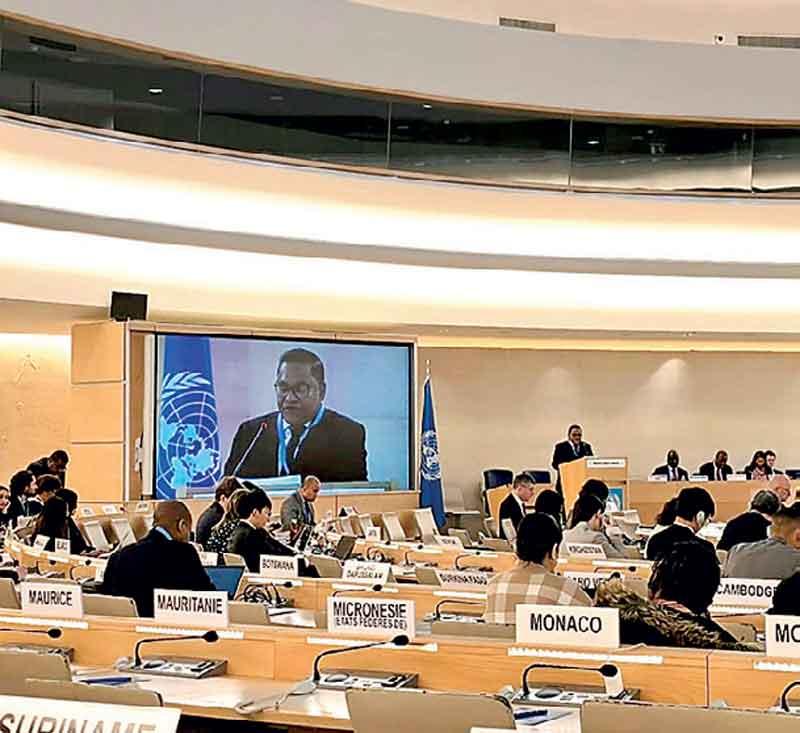
Foreign Affairs Minister Vijitha Herath addressing the High-Level Segment of the 58th Regular Session of the United Nations Human Rights Council (UNHRC) in Geneva
 Former President Ranil Wickremesinghe has strongly criticized the United Nations Human Rights Council (UNHRC) for what he perceives as selective and biased scrutiny of Sri Lanka’s human rights record. Wickremesinghe, who even ignored the Supreme Court’s ruling on local government elections and proceeded to postpone them, emphasized that while Western nations, such as Ukraine, faced no criticism for postponing elections amid conflict, Sri Lanka consistently upheld democratic principles—even during war.
 The UN human rights office (OHCHR) called on the Sri Lankan Government to urgently uncover the fates of tens of thousands of individuals subjected to enforced disappearances and to hold those responsible accountable
He highlighted the transformation of the Janatha Vimukthi Peramuna (JVP) from an insurgent group into a governing political party as evidence of Sri Lanka’s commitment to democracy. Despite these efforts, Wickremesinghe argued, the UNHRC continues to target Sri Lanka over alleged civilian deaths during the final stages of its separatist war, even though the LTTE committed extreme brutality. The Liberation Tigers of Tamil Eelam (LTTE) were responsible for thousands of deaths, including civilians, and acts of terror both within Sri Lanka and internationally, including the assassinations of Sri Lankan President Ranasinghe Premadasa and Indian Prime Minister Rajiv Gandhi. Yet, international scrutiny continues to focus almost exclusively on the actions of the Sri Lankan government during the war’s final phase, prompting critics to question why powerful Western nations like the United States and the United Kingdom are rarely held accountable for their own human rights violations. Critics have noted a glaring inconsistency in how the UNHRC applies its mandate, particularly in comparison to other global conflict zones.
UNHRC’s Unbalanced Focus
China has voiced strong criticism of the UNHRC’s politicization, with Ambassador Chen Xu defending Sri Lanka and condemning proposed sanctions and “preventive intervention” by the OHCHR, arguing these actions amount to interference in Sri Lanka’s sovereign affairs. He called for a fairer, more impartial approach to human rights, one that does not use international bodies as political tools. China’s position reflects concerns from many developing nations that human rights mechanisms are being manipulated for geopolitical purposes. Ambassador Chen commended Sri Lanka’s efforts in promoting human rights through domestic mechanisms, highlighting progress in economic development, living standards, and national reconciliation.
Several UNHRC delegates have raised concerns about the council’s selective application of its mandate. They argue that human rights investigations should be pursued impartially across all nations, not disproportionately targeting specific countries. One observer pointed out that while the UNHRC has relentlessly pursued investigations into Sri Lanka’s civilian casualties, it has shown little interest in similar cases in Gaza, Palestine, or other conflict zones where civilian deaths, including tens of thousands of children, have reached devastating levels. This double standard, critics argue, undermines the UNHRC’s credibility and raises questions about its impartiality.
As the 58th session of the UNHRC continues, Sri Lanka and its allies remain committed to challenging what they see as a biased and unfair system. Calls for a more balanced, objective approach to human rights scrutiny are growing louder, with many asserting that for human rights to be upheld universally, accountability must be applied equally, regardless of a nation’s political or economic power. The outcome of this debate will likely have lasting implications for the credibility and effectiveness of the UNHRC in the years to come.
The August 2024 OHCHR update urged the new government, following the September 21 elections, to urgently pursue an inclusive national vision addressing the root causes of the conflict. It called for constitutional and institutional reforms to strengthen democracy, devolution, accountability, and reconciliation. The High Commissioner also urged the Human Rights Council and UN member states to support OHCHR’s efforts to close the accountability gap in Sri Lanka, emphasizing the need for political will and conditions conducive to meaningful accountability and reconciliation.
The UN human rights office (OHCHR) called on the Sri Lankan Government to urgently uncover the fates of tens of thousands of individuals subjected to enforced disappearances and to hold those responsible accountable. This appeal accompanied the release of an OHCHR report emphasizing the need for the Government to acknowledge the involvement of State security forces and issue a public apology.
Undermines Global Human Rights Efforts
From the 1970s to 2009, Sri Lanka witnessed widespread enforced disappearances, allegedly carried out by the national army and paramilitary groups, while the LTTE was also implicated in abductions and child recruitment into their ranks. Despite successive governments ratifying the International Convention for the Protection of All Persons from Enforced Disappearance and establishing the Office on Missing Persons and the Office for Reparations, meaningful progress has been made. Few families continue to seek justice and accountability, yet a few individual cases of enforced disappearances remain unresolved.
Some survivors and families of victims seeking justice for enforced disappearances and conflict-era killings continue to face arbitrary surveillance and harassment by security forces. A 2024 UN report on enforced disappearances highlighted that, despite the war ending 15 years ago, progress on victims’ rights remains minimal, and the risk of recurrence persists. Mass graves, often discovered by accident, are rarely investigated to identify victims or perpetrators. The report unfairly alleges that communities in the north and east, predominantly Tamil, remain vulnerable to land grabs by the government and military, who construct Buddhist monuments on Hindu temple sites, potentially altering the region’s demographic makeup.
Human Rights Accountability
Sri Lanka’s ongoing economic crisis, which began in 2022, has deepened poverty and is widely seen as a consequence of mis-governance, corruption, and a breakdown in the rule of law. In response to public protests demanding reform, the government has imposed tighter restrictions on civic space. The Online Safety Act, passed in January 2024, raised concern about stifling free expression and potentially criminalizing legitimate speech. Furthermore, the government resumed the use of the Prevention of Terrorism Act (PTA) after lifting its moratorium in 2022, utilizing it to detain activists.
A new truth and reconciliation commission, launched in 2023, has faced criticism from UN experts for failing to meet international standards. As Sri Lanka approached the presidential elections in 2024, the human rights situation further deteriorated. To maintain the effectiveness of international human rights oversight, it is crucial to ensure stable, independent UN mechanisms during this uncertain period.
The ongoing criticism of the UNHRC’s selective scrutiny highlights broader concerns about fairness and consistency in global human rights governance. Many argue that its focus on certain nations while overlooking similar or worse violations elsewhere undermines its legitimacy. As calls for impartiality and even-handed enforcement of human rights standards grow louder, the credibility of international bodies hinges on their ability to uphold justice without political bias or geopolitical influence. Ensuring that all nations are held equally accountable for human rights violations is essential to maintaining trust in the global human rights framework and reinforcing its moral authority.
Writer can be contacted at –[email protected]
14 Jun 2026 1 hours ago
14 Jun 2026 3 hours ago
14 Jun 2026 4 hours ago
14 Jun 2026 6 hours ago
14 Jun 2026 8 hours ago