12 May 2025 - {{hitsCtrl.values.hits}}
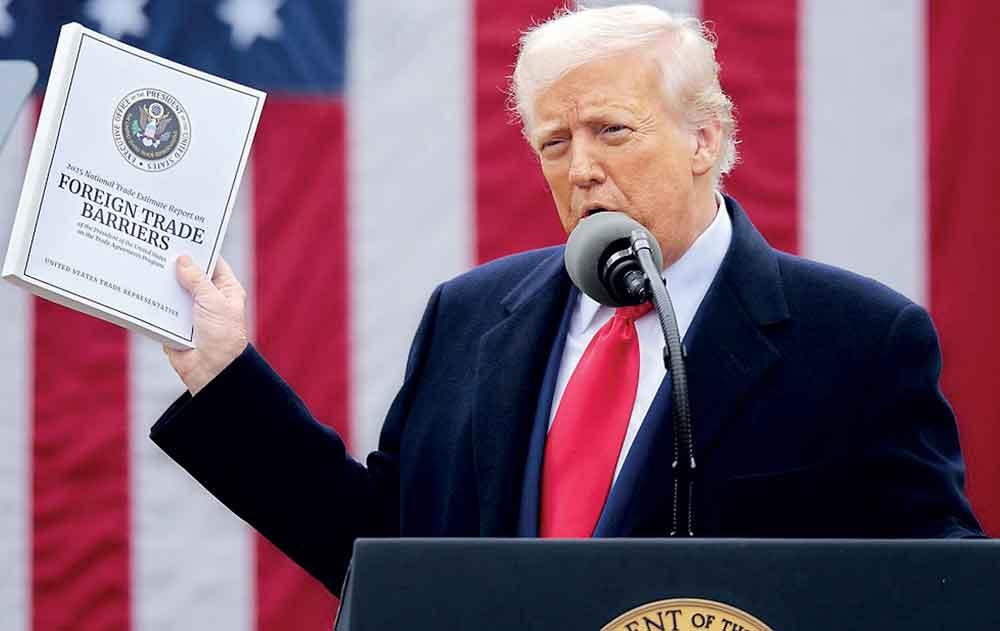
 Trump made it clear from the outset: countries with a positive trade balance against the United States would be subject to steep tariffs. Given the U.S. historically imports more than it exports — particularly from countries like China, Vietnam, India, Bangladesh, and Sri Lanka — this policy was bound to cause widespread disruption. Trump saw the global trade imbalance not as a result of economic strategy, but as exploitation. He vowed to stop what he called the world’s “ripping off” of America
 The infamous encounter between Trump and Ukrainian President Zelensky at the White House, where Trump publicly humiliated his counterpart, illustrates the way Trump uses theatrics to enhance his bargaining power. Zelensky, initially hesitant to sign a U.S.-Ukraine mineral treaty, eventually complied under pressure, highlighting the coercive undertones of Trump’s diplomacy
By Shehan Baranage
In ancient times, geographers named cyclones after women due to their perceived unpredictability. Today, if one were to name a cyclone after a political figure, it might well be called “Trump” — a nod to the erratic and often shocking decisions made by President Donald Trump since securing a second term in office.
One of the most attention-grabbing elements of Trump’s presidency has been his aggressive stance on trade, particularly the so-called “Tariff War” — a mantra repeated loudly from the day of his inauguration. The global response was immediate and intense: stock markets wobbled, world leaders panicked, and business communities from CEOs to small entrepreneurs braced for impact.
Trump made it clear from the outset: countries with a positive trade balance against the United States would be subject to steep tariffs. Given the U.S. historically imports more than it exports — particularly from countries like China, Vietnam, India, Bangladesh, and Sri Lanka — this policy was bound to cause widespread disruption. Trump saw the global trade imbalance not as a result of economic strategy, but as exploitation. He vowed to stop what he called the world’s “ripping off” of America.
As part of this policy, Trump even cut off U.S. foreign aid through an executive order, leaving thousands of workers jobless and disrupting critical humanitarian efforts — notably in Bangladesh, where U.S. funding had been sustaining over a million Rohingya refugees. A striking moment came when a White House spokesperson questioned, at a press briefing, why $57,000 had been spent on climate change programmes in Sri Lanka, revealing a new and unapologetic inward turn in U.S. foreign policy.
The Tariff War Begins
Trump initiated the tariff war with China, Canada, and Mexico. In response, both China and Canada imposed retaliatory tariffs on U.S. goods. While Mexico cooperated by deploying troops to manage border concerns, Canada’s response under Prime Minister Trudeau was less diplomatic, leading to economic tit-for-tat measures.
Though presented as a move to “bring jobs back to America,” Trump knew that reshoring production would not be immediate. U.S. production costs are significantly higher due to labour wages, regulations, and environmental standards. As a result, even if companies moved factories back to the U.S., the cost of goods would rise, likely leading to inflation — or worse, economic stagnation.
It raises the question: was the tariff war ever meant to be a sustainable policy? Or is it simply the first move in a broader geopolitical and economic strategy?
Deal-Making, Not Policy-Making
Trump is a businessman at heart. His administration has repeatedly highlighted his identity as a dealmaker, and this seems to be the true essence of his tariff strategy. By using tariffs as leverage, Trump has created pressure points that encourage other nations to approach the U.S. for relief — and in return, he demands concessions.
For example, countries seeking tariff exemptions might be asked to:
Allow U.S. exports tariff-free entry.
Host U.S. manufacturing plants with incentives like zero duties on raw materials and exports.
Enter strategic partnerships beneficial to U.S. economic or military interests.
One possible target is Sri Lanka, specifically Trincomalee Port and its oil tank farms, long eyed by the U.S. as a strategic asset in Southeast Asia. Trump’s approach may shift from purely economic deals to more strategic arrangements, especially if his recent mineral treaty with Ukraine is any indication.
The infamous encounter between Trump and Ukrainian President Zelensky at the White House, where Trump publicly humiliated his counterpart, illustrates the way Trump uses theatrics to enhance his bargaining power. Zelensky, initially hesitant to sign a U.S.-Ukraine mineral treaty, eventually complied under pressure, highlighting the coercive undertones of Trump’s diplomacy.
Global Economic Fallout
The ripple effects of Trump’s tariffs are already being felt. Major U.S. companies like Ford and General Motors have forecasted billions in losses due to disrupted supply chains. Both companies heavily rely on imported parts and raw materials, particularly from China.
Trump has also turned his gaze toward the entertainment industry, proposing 100% tariffs on all foreign-produced films and content. This would significantly impact Bollywood, which earns roughly 25% of its revenue from U.S. audiences, and could provoke major backlash from both the American entertainment industry and international creators. Hollywood, already reeling from a 40% drop in production over the past decade due to high labor costs, could suffer further — especially since many U.S. productions are outsourced to countries like India for cost efficiency.
These moves suggest a growing hostility toward globalisation, a reversal from the U.S.’s traditional trade policies. The irony, of course, is that these policies hurt not only America’s foreign partners but its own industries and consumers. U.S. citizens may soon find themselves paying $20 for a $10 movie ticket, or losing jobs as companies relocate or shrink due to rising operational costs.
A Strategic Pause
Trump’s 90-day pause on implementing new tariffs — except with China — is likely not a retreat, but a calculated move. He understands that full-scale tariff implementation would provoke widespread backlash, not only from foreign governments but from his own people, businesses, and political allies. As the midterm elections approach, Trump is wary of alienating the public or losing his grip on the Senate and Congress.
Moreover, Trump’s growing conflict with the U.S. judiciary — particularly after criticism of a judge who halted a deportation order — underscores a deeper tension within the American system. Despite appointing many of the Supreme Court justices, Trump has found that even they uphold constitutional independence over party loyalty.
Looking Ahead
Trump’s trade war might not be a war at all. It may be the opening act in a long negotiation — one where the “unpredictable” Trump uses fear and chaos as leverage to secure economic and strategic gains across the globe.
Countries like Sri Lanka must remain cautious. Today it may be tariffs; tomorrow, it could be demands for strategic port access or defense cooperation. Trump’s ambitions go beyond trade; they point to a shift in global power, where the U.S. reclaims dominance by pressuring smaller nations into dependency — economically, militarily, and politically. The traditional continuity of U.S. foreign policy — once stable regardless of party — has been replaced with a personalistic, transactional approach. “Trumpism” is not about party lines; it is about Trump himself.
If unchecked, this strategy may cause far-reaching economic and political instability. But Trump also knows the limits of his power — and the risks of pushing too far. His popularity is not immune to economic hardship. If inflation rises, if businesses close, and if everyday Americans suffer, the pushback may begin at home — from Congress, from his own party, and from the people.
He may dominate headlines, but he cannot override the foundational principle of democracy: a government by the people, for the people. History has shown — through leaders far more powerful than Trump — that the system eventually corrects itself.
04 Jun 2026 8 hours ago
04 Jun 2026 9 hours ago
04 Jun 2026 04 Jun 2026
04 Jun 2026 04 Jun 2026
04 Jun 2026 04 Jun 2026