05 Feb 2025 - {{hitsCtrl.values.hits}}
 Symbolism matters! The celebration of the 77th anniversary of independence was a display of our rich heritage and diversity. It was also a refreshing departure from the obsession in the past to flaunt antiquated Main Battle Tanks and a large contingent of military forces as if we were a predominant military power or one that faced an existential military threat whose people needed regular reassurances.
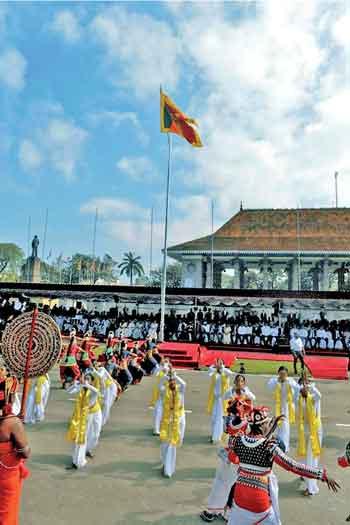 |
| A display of the country's rich heritage took centrestage at the 77th Independence Day celebration. Pic by Pradeep Pathirana |
Such displays in the past were meant to foster parochial nationalism, which in turn fostered the personality cult of the Rajapaksas. Even worse was when, during the Chandrika Kumaratunga administration, the military assets were transported from the Northern front to Colombo to parade in the Independence Day celebrations. Such acts of petty personal aggrandisement were exploited by the LTTE, including one well-documented attack carried out exploiting the military vacuum in the North as troops and armaments were on display in Colombo.
Sri Lanka is not a military power, but it has so much else to flaunt: its rich cultural diversity, its scenic places, its easy-going way of life, genuine hospitality and even cricket- and perhaps more than else, its insulation from the Subcontinent which it is broadly identified as a part.
Seeing is believing, and only when you visit this country can you reckon the pleasant contradiction. Such inherent attributes could be called Soft power, i.e., the power of positive attraction and persuasion in contrast to coercion. Sri Lanka should build on these innate strengths of its culture, people and geography. The government’s choice to highlight them should be lauded.
That may also be part of a wider change in governance. The NPP has made national politics more egalitarian and publicly accountable.
The 77 years of independence of the country is a mixed record card. However, the tendency, no less dangerous than the parochial nationalism in the past- is to characterize all that as a complete failure.
For a starter, had it been a failure as it is portrayed, the election of the current government with its manifest anti-establishment fervour and the past record of two armed struggles, would not have been possible. Even in Thailand, which in many ways is more liberal than Sri Lanka and recently became the first Asian country to legalize gay marriage, the monarchists revoked the election victory of the anti-establishment party that won an overwhelming majority. Political culture and institutions do not evolve overnight.
Second, Sri Lanka has done reasonably well in rolling out a welfare state that provides universal health care and free education. The average Sri Lankan may not fully appreciate these measures, and that lack of appreciation is a product of lopsided political empowerment, where successive governments made hand-outs as the preferred medium of winning elections.
The deficiencies in the welfare state were also due to its abuse by successive governments, who expanded it to appease every panhandler, effectively compromising the quality of service in healthcare and education.
Sri Lanka should rationalize its welfare state, prioritising education and health care while shedding the deadweight on unaffordable and retrograde subsidies such as fuel, electricity, transport and welfare measures that exist to win votes.
One could also agree that Sri Lanka has faired poorly in terms of economic development.
While an average of 4 per cent growth over the first four decades, and then around 5-6 per cent until the economic crisis, may appear decent, such numbers fail miserably compared to the successful high-growth East Asian and South East Asian economies.
An additional two per cent growth, which was a low-hanging fruit during the first four decades, when the governments did more to destroy private investment than to generate growth, would have doubled Sri Lanka’s current GDP.
While the first three decades of independence were a lost era in terms of economic development, the second half of the independence was robbed from us by two armed insurgencies in the North and the South.
Successive governments were captives of these nihilistic forces and their own idiosyncrasies. The common denominator of all successive governments was their shocking lack of urgency to create economic growth. Nor had people rewarded leaders who made a genuine commitment to economic development. That was also down to the unique doll-out political culture where elections were decided by an auction of non-existing resources. Often, lofty slogans such as poverty alleviation were used to justify the continuation of vote-buying economic policies.
The government should have a conceptual change in order to prioritise economic growth. However, it seems to be buried in the same dogma. At the recent Sri Lanka Economic Summit, the President was asked by the moderator about the measures to raise economic growth, which is estimated to be a meagre 4 per cent in 2025, even lower than the economic performance of the previous year. He replied that the emphasis is on poverty alleviation. The unpalatable truth is that no country that prioritised poverty alleviation over economic growth has achieved either. Successful Asian Tiger economies dedicated their resources to generating growth, which eventually benefitted all participants-- John F. Kennedy famously likened economic growth to the rising tide that lifted all boats.
The government should prioritise generating economic growth and mobilise its resources and the most capable personnel to handle government agencies meant for investment promotion. It should strive to provide universal tertiary education, be it universities or vocational training institutions, for all children so that they would be active participants in wealth creation.
Tertiary education is the best ticket for upward mobility and the best strategy for combating intergenerational poverty. Ultimately, there is no substitute for sustained long-term economic growth as the primary driver in eradicating poverty.
That was the missing link in the past 77 years.
Follow RangaJayasuriya on X
03 Jun 2026 03 Jun 2026
03 Jun 2026 03 Jun 2026
03 Jun 2026 03 Jun 2026
03 Jun 2026 03 Jun 2026
03 Jun 2026 03 Jun 2026