14 Jan 2026 - {{hitsCtrl.values.hits}}
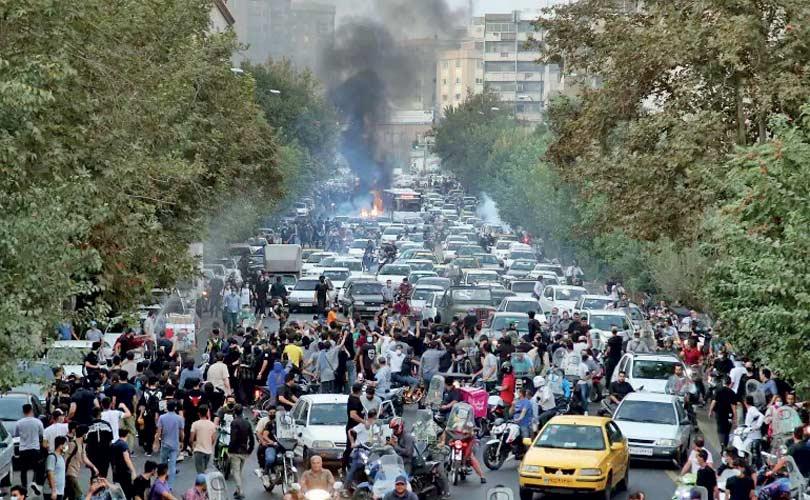
Protests in which hundreds are killed have become common in Iran
 The regime was a global pariah most of the time in its existence, though countries in our part of the world, including Sri Lanka itself, also have a habit of breaking bread with the most egregious violators of human rights of their own people
 As of early this week, the Islamic Republic of Iran had slaughtered over six hundred protesters, terrorising with brute force into submission another cycle of widespread protests against the repressive theocratic regime. The regime sources put the death toll as high as 2000.
As open-air morgues overflowed, Donald Trump, who threatened to ‘ start shooting’ if the regime unleashed violence against protesters, has failed to live up to his words, though he says the military option is not off the table.He has announced a 25 per cent tariff on the countries that conduct business with Iran.
The latest protests sparked on December 28 in the Grand Bazaar in Tehran after the Iranian Rial fell to a new low. The demonstrations quickly spread to other cities, with economic grievances soon replaced by calls for death to the dictator, Supreme Leader Ayatollah Ali Khameini and the overthrow of the theocratic regime. The regime initially responded with mixed signals, with its reformist president, Masoud Pezeshkian, acknowledging the economic grievances, while blaming the United States and Israel for destabilising the country.
However, lately, the state has resorted to its trademark brutality, gunning down hundreds of protestors in cold blood and arresting thousands of others.
The calls by exiled crown prince Reza Pahlavi for the public to take to the streets on Friday saw large-scale protests, leading to mass killings by the regime’s security apparatus.
Videos circulating on social media reveal graphic imagery of open-air morgues overflowing with the dead, and hospitals struggling with new admissions.
Zombie state
The theocratic regime in Iran is a zombie state, which has lost any semblance of legitimacy within the country and credibility abroad.
The regime has repeatedly cracked down on popular mass protests since it robbed an election in 2009, in favour of the regime’s favourite and then incumbent Mahmud Ahmedinejad and imprisoned his two main competitors, Mir-Hossein Mousavi and Mehdi Karroubi. Politics in Iran has historically been torn between the conservatives and reformists. Though the reformists had momentary victories, such as the election of Mohammed Khatami, the two-time president from 1997 to 2005, the regime has shifted further toward religious conservatives through highly choreographed and poorly attended elections.
Iran’s elections are a sham to begin with, as candidates being vetted by the clerics run the Guardian Council, which has historically disqualified reformist candidates. Over time, elections lost any semblance of legitimacy, and the latest presidential runoff, which elected reformist Pazeshkian, had the lowest turnout since 1979.
However, concessions no longer hold water; the façade has fractured. Though the conservatives had managed to suppress reformists at home, the regime had crumbled within and without.
The Iranian Rial had lost value from 40,000 Rials to a US dollar in 2028 to 1.4 million Rial to a US dollar. In 1979, seventy rials were equal to a US dollar.
Aberration
The theocratic regime in Iran was an aberration from the outset. Twin revolutions led by leftists and Shia Islamists ousted the modernising monarchy of Mohammad Reza Pahlavi. With the return of Ayatullah Ali Khomeini from exile in France, the Islamists displaced their leftist bedfellows and later massacred them. Ebrahim Raisi, the former president, was popularly known as the butcher of Tehran for his role in the violence.
The regime was a global pariah most of the time in its existence, though countries in our part of the world, including Sri Lanka itself, also have a habit of breaking bread with the most egregious violators of human rights of their own people (When Raisi was killed in 2024, the Ranil Wickremesinghe administration announced a day of national mourning for the butcher of Tehran.)
Iran has threatened to attack if Donald Trump stays true to his threat to use force. However, the military capabilities of the theocratic regime are severely depleted, though not its bravado.
Iran’s twelve-day war with Israel in June last year wiped out much of its military capabilities as Israeli jets enjoyed near complete air dominance in the skies over Tehran. Iran’s security doctrine, built on asymmetric warfare waged through its terrorist proxies or rings of fire, Hezbollah in Lebanon and Hamas in Gaza, are in tatters. The Revolutionary Guard-allied- militias in Iraq had mostly kept themselves out of entanglements. Houthis in Yemen remain an irritant, but their capabilities are limited.
Though many pundits argued that the Israeli strikes would reinvigorate the dwindling public support for the Iranian regime, such prophecies have proved to be out of touch with the local realities. The latest protests, coming barely six months after the war with Israel and America’s pounding of Iran’s underground nuclear enrichment facilities, are a case in point.
Interestingly, the regime itself resorted to pre-revolutionary symbolism to invoke Persian nationalism (in contrast to Shia religious zeal) in the aftermath of the war in a feeble attempt to bolster its legitimacy. The latest protests might suggest that the regime campaign had not fared any better than Iran’s air defence systems. And the Mullahs’ mass murder of protesters reveals the regime is incapable of reforming itself.
Donald Trump – despite his many actions which have severely compromised the rule-based post-Cold War world order, which America itself championed, has also shown remarkable aptness in using America’s overwhelming military capacity to achieve its ends, without entangling itself in prolonged military commitments. That might be a matter of political will, rather than astuteness. American strikes on Iran’s nuclear facilities effectively put off Tehran’s dangerous nuclear ambitions by years. Also, they set a precedent for his successors to follow through, while also setting a heavy retribution cost for the Iranian leaders should they continue with nuclear enrichment.
Even the most ardent, but commonsense, leftists and third-world champions would agree a regime run by myopic Mullahs should never have a hand on nuclear bombs.
Similarly, America’s arrest of Venezuela’s Maduro, who had repeatedly stolen elections, is a breach of international law. Still, it might lead to long-term democratisation and prosperity in Venezuela, the country which sits on the largest known oil reserves, yet plundered by an incompetent and thuggish regime.
If Donald Trump delivers on his threat, the clerical regime in Iran, which is already in its death throes, would collapse. Many pundits forewarn chaos similar to post-Saddam Hussein Iraq, while opting out that much of that chaos was orchestrated by Iran itself, which infiltrated the political void, and also by the demobilised Iraqi army and Ba’ath party loyalists who would otherwise have served as a buffer against Islamic fanaticism.
Ethnic fault lines in Iran may not be as fractious as Iraq, where a 10 per cent Sunni minority ruled roost in a majority Shia state.
Trump’s intervention, be it a decapitation strike on the regime leaders and its repressive apparatus, or a more cautious, carrot and stick approach, might finally end four decades of curse and herald democracy to Iran, of which citizens, unlike the regime, are, by far, the most liberal and least anti-semitic in the Middle East, according to many opinion polls.
If Trump could pull that off, he surely deserves a Nobel Prize.
Follow @RangaJayasuriya on X
04 Jun 2026 9 minute ago
04 Jun 2026 12 minute ago
04 Jun 2026 38 minute ago
04 Jun 2026 41 minute ago
04 Jun 2026 46 minute ago