20 Aug 2025 - {{hitsCtrl.values.hits}}
The ITAK Hartal was only partially successful
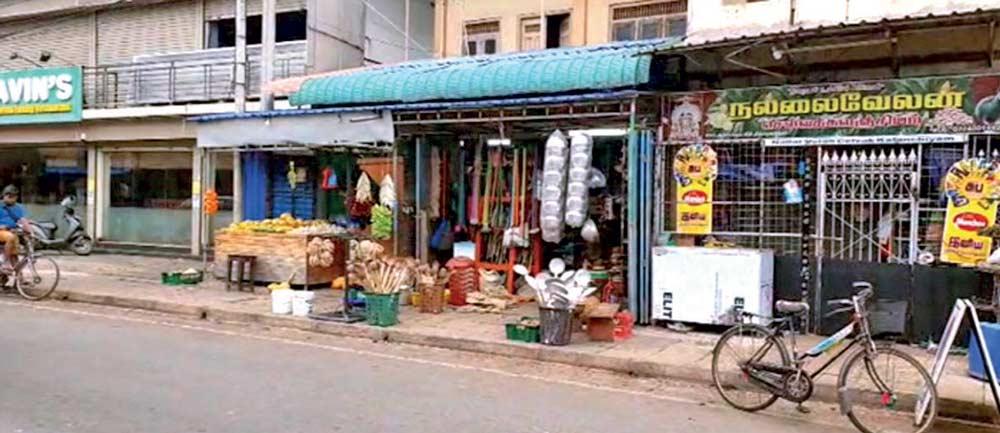
 Like a tiger on its prey, Illankai Tamil Arasu Kachchi (ITAK) pounced upon the tragic death of a young man in Mullaitivu and turned it into grand political theatre. Yet the mass hartal it organised in the North-East in protest, at best received a mixed response from its own constituency. The government offices and schools remained open throughout the North-East, while Shops were closed in Vavuniya, Batticaloa and some parts of Mullaitivu. Local merchants confronted ITAK party heavyweights who visited the scene; one spoke to television cameras about the success of the protest campaign, while shops behind him remained open. Protests had partial success in Jaffna while the ITAK accused NPP supporters of intimidation.
The 32-year-old victim was among four young men who allegedly entered an army camp in Oddusuddan, Mullaitivu. The deceased was said to have acquainted a group of soldiers in the camp who told him to remove discarded steel and iron from the camp that is slated to be closed down. Four youth had entered the camp through its rear perimeter via an adjacent lake and had encountered a different group of soldiers. The four men had run away; one was apprehended and later handed over to his family. Another went missing, and his remains were subsequently found in the lake.The ITAK has accused the military of the death. Three soldiers have been arrested in connection with the incident and produced before the court.
However, ITAK lost no time in politicising the tragic death. Among its other demands, it has called for the removal of military camps from the North-East.
It is not exactly the success or the failure of the hartal that matters. It is the wider political context under which it is taking place.The hartal came in the wake of the once predominant Tamil party facing a struggle for its political relevance. The NPP has eaten into a good chunk of its vote base, and its claim for a monopoly of Tamil political interests has suffered a heavy blow. A large swathe of the Tamil population is increasingly disenchanted by the ITAK style of politics, which has continuously failed to rise above race and effectively fed into a monstrous terrorist insurgency. The average Tamil man and woman wish to live like any other Sri Lankan and share the same travails as their peers, granted that they carry additional grievances and fears of a protracted war.
As it is faced with a struggle for political relevance, the ITAK is following a well-used script of Northern Tamil politics.Very early on in the history of that saga, a plethora of political parties competing for the Northern Tamil vote discovered an easy route to political domination: that was to appear more Tamil nationalist than their competitors.
The origin of this incessant rat race to the bottom of nationalism predated S.W.R.D. Bandaranaike’s making Sinhala the national language, though it has become fashionable to find fault with Bandaranaike’s policies for the genesis of the ethnic conflict.
Chelvanayakam-Ponnambalam split
Bandaranaike’s trademark polices, many of which were naïve and idealistic then, would appear misplaced and self-destructive in retrospect. But the early embers of the conflict were well within Tamil politics, which borrowed heavily from the most devastating traditions of subcontinental ethnic nationalism. The earliest split of Tamil politics came when S.J.V. Chelvanayakam split from G.G. Ponnambalam’s All Ceylon Tamil Congress in 1949 after Ponnambalam voted in favour of the Citizenship Act. Chelvanayakam, who aspired to be the Jinnah of Ceylon, went on to form ITAK, which advocated for federalism. Later, with their eyes on the upcoming General election of 1977, ITAK passed the Vadukkdodai Resolution for a separate Tamil homeland.
What followed is now history. That history did not end with Vella Mulli Vaiikal. Though it may sound politically incorrect now, until the next bomb goes off, it has a venomous propensity to breed another generation of suicide terrorists. That would not happen overnight, not even in next five or ten years, but two decades down the line in a different world where cost-benefit ratio of asymmetric war shifted, and under new geopolitical reality of a relatively prosperous, but equally tribal Tamil Nadu politics, that eventuality could hit home like the ambush that killed 13 soliders in 1983 and set the country on fire.
Bombs just don’t go off on their own. Before that, another phase of indoctrination should take place under a complacent and permissive political climate.
Incidentally, the ITAK hartal held on Monday comes in the wake of the 72nd anniversary of the grand Ceylon Hartal in 1953,which broadcast to the spineless of the local leadership to confront a credible threat to political stability, luring every other group with vested interests to join the fray, setting off decades of political instability and ineffectual governments.
Anyone who looks past the chequered Sri Lankan history might notice that Hartal, a seemingly peaceful, legitimate avenue of dissent, had dotted the political space before each escalation.
Hartals, whatever the peaceful intentions of protest, have not won political concessions. Instead, they have created fresh grievances and indoctrinated more young men. Organisers of Hartals are not oblivious to this byproduct, which indeed is their calculation.
As the traditional northern Tamil parties compete for votes, they would double down on their quest to appear more nationalist than their peers. As they face off an unexpected challenge from the NPP, it would overhype the peripheral grievances and orchestrate conflict with the central government. At one point, we would be back to where one who would be associated with any Southern-oriented party would be labelled as a traitor. None of this is meant to prop up fear psychosis. However, history does not repeat, it rhymes.
Success in Batticaloa
The success of a Hartal in Muslim majority areas such as Batticoloa was owed to SLMC backing the campaign. It is premature to establish whether it is an act of solidarity or a more personalised initiative to drive a wedge between the Muslims and the NPP for the same reasons -- to maintain the monopoly of the Muslim vote. However, a discerning reader should be able to read between the lines of a press statement by SLMC secretary Nizam Kariapper
“ We are outraged by the recent killing in Mullaitivu, reportedly carried out by members of the Sri Lankan Army. This brutal act is yet another reminder of the deep crisis of law and order within the very forces that are tasked with protecting the public.”
This reads like the pamphlets of the LTTE rump and its many apologists.
Then comes the moneyshot: “ Equally disturbing is the government’s attitude in granting visa-free entry to tourists from Israel, many of whom are members of the Israeli Defence Forces, a force widely condemned for violations of International Humanitarian Law in Gaza.”
History does not repeat itself, but it often rhymes. This is the same recipe as the Northern Tamil politics, except appearing more Muslim than others, and importing fresh foreign grievances to that end to lure the Muslim vote.
Again, History does not repeat itself, but it often rhymes.
14 Jun 2026 5 hours ago
14 Jun 2026 6 hours ago
14 Jun 2026 7 hours ago
14 Jun 2026 14 Jun 2026
14 Jun 2026 14 Jun 2026