16 Sep 2025 - {{hitsCtrl.values.hits}}
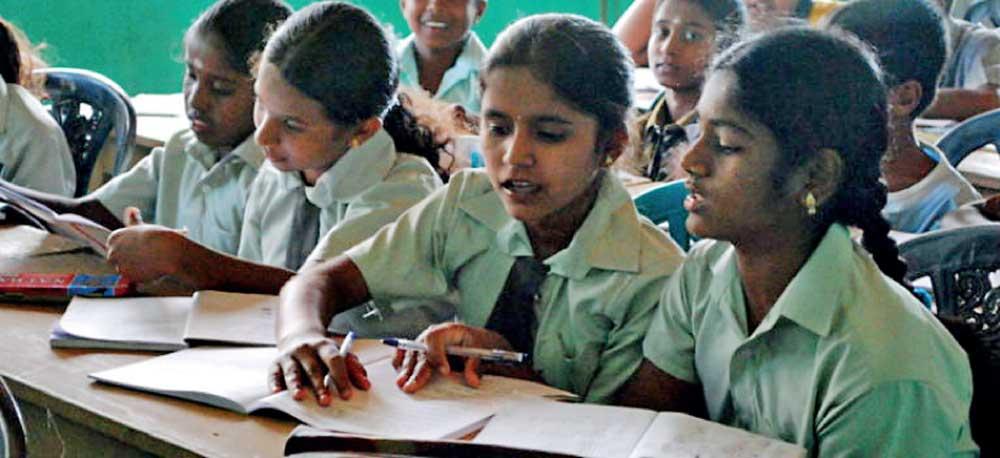
Another usual day in class, as the current government prepares for the controversial education reforms, starting January 2026 - FILE PHOTO
 Education occupies a special place in the minds of the public in Sri Lanka, thanks to the free education system which benefits the people from all walks of life. No other singular reform agenda evokes such animated interest and vociferous debate as the subject of education.
Proposing drastic changes to the education system without extensive consultation and substantial consensus from interested parties is akin to stirring the hornet’s nest. Predictably, the announcement of the education reforms with the first phase scheduled to begin in January 2026 by Prime Minister Dr. Harini Amarasuriya, who also holds the education ministerial portfolio, has caused quite the stir.
The government’s approach of putting the cart before the horse and steaming ahead with the reforms without a White Paper being presented for deliberation has left us groping in the dark, speculating about the full extent of the reforms based on partial and contradictory statements made by government representatives in the media and President Anura Kumara Dissanayake’s speech in parliament.
With no known committee or body being explicitly identified as the authors of the reforms, there is a blatant lack of transparency in this undertaking. The fragmented supply of information, lack of accountability and dizzying pace at which changes are being adopted have caused much bewilderment, including among educationists.
Transforming secondary education
Ongoing discussions are based on what was revealed in a bare bones PowerPoint presentation of 33 slides, available only in English, which was leaked via social media channels and thereafter uploaded on the Ministry of Education website is dated July 2025 and titled: “Transform Education: Transform Sri Lanka Education Reforms.”
Although the presentation indicates the proposed reform has five pillars, it outlines the specific details only under the first pillar – Curriculum Development, and does not provide any analysis, evidence or rationale for the proposed changes to the curriculum.
Among the list of curriculum changes, two significant proposals stand out:
1. Merging vocational and technical education with general education, and;
2. Tracking students into career-oriented study paths on the completion of Grade 9, when the average age of the student is 14.
The proposals suggest the requirements of general education – orienting students towards a holistic development of their physical, mental, emotional and spiritual growth – can be achieved by Grade 9.
The stated purpose of study in Grades 10 and 11 is for “career readiness.” In addition to the seven subjects to be tested at the Ordinary Level examination, a further learning category is added where students will be guided into specific career-based subject streams based on psychometrics assessing their “tendency to pursue further studies in a specific field” at this early stage. A transversal module outside of their specialised streams is also proposed, mandating students to complete 35 credits per term at the Ordinary Level. The vocational path has been introduced into the school curriculum from Grade 10 onwards, along with several changes to specialised streams of study at the Advanced Level, with a tilt towards technical subjects.
Sound Assumptions?
The aim of the curriculum change was articulated by Prime Minister Harini Amarasuriya in the media as ensuring children identify their career path by Grade 10 and receive the necessary guidance to pursue it. She levelled the accusation that due to the school system not adequately preparing students for employment, universities are compelled to develop their soft skills. The proposals assume the necessity of a bias for STEM subject combinations to achieve such a goal.
Currently, less than 10% of public schools in the country offer science and mathematics streams at the Advanced Level. Many schools do not have laboratory and technology facilities, and teachers to fulfil even the needs of the current curriculum. Given such drastic inequalities, the ambitious expansion of STEM subjects with the intent of transforming secondary education, by limiting its general education purposes and expanding vocational and professional goals, does not seem feasible.
In the past decades, we witnessed the pressure to subordinate higher education to align with the requirements of the job market, through the push for professional degrees and “modernisation” initiatives including soft skills, IT, and English language courses. For the first time, and bizarrely under the leadership of the NPP, the attempt is to transform schools into job training centres.
The merits of the proposed reform should be measured by the validity of its assumptions. The overarching assumption informing the NPP’s reforms, as also echoed in its manifesto, is that the deep economic challenges facing the country can be addressed through vocational and technical education. Envisioning Sri Lanka’s economy as drastically transforming from an agriculture-dependent labour market to one dominated by jobs in STEM fields, it assumes the future labour market is stable and predictable enough to narrow the scope and make early decisions about career paths.
In Sri Lanka, as is anywhere else, multiple and competing purposes of schooling exist. One may dominate over others at moments, shaping the outcomes of the system. There seems to be a growing conviction that the primary purpose of schooling should be to prepare students for employment. Even so, the success or failure of the education reform rests on the soundness of its underlying assumptions.
New or old reforms?
The little that has been revealed of the NPP government’s education reform has made it evidently clear that there is no significant departure from the reforms proposed under previous governments. By the Education Ministry’s own admission, it is an effort to bring to fruition the reform process that began in 2019 during the Sirisena-Wickremesinghe government, styled the “National Curriculum Framework for Secondary Education in Sri Lanka,” followed by the “Reimagining Education in Sri Lanka” report by the Presidential Taskforce on Education appointed by Gotabaya Rajapakse in 2020, and further modified in the “National Education Policy Framework” in 2023 by Ranil Wickremesinghe’s regime.
Pilot testing was carried out in selected schools in 2024 with detailed curriculum frameworks presented by the National Institute of Education in the “1st Interim Report Piloting of the Curriculum Transformation.” The implementation phase which was to begin in 2025 was delayed due to the change in government.
As pointed out by scholars including Prof. Praba Manuratne, the assumption of a mismatch between education and employment has dominated the policy discourse as far back as the infamous “Education Reforms Proposals” of 1981 presented by then Minister of Education, Ranil Wickremesinghe.
The entry of international financial institutions (IFIs) influencing the policy landscape further entrenched the view. The World Bank dominated the funding for reforming the education sector. Currently, the Asian Development Bank (ADB) provides a greater chunk of funding for education reform, including the ‘Secondary Education Sector Improvement Programme” (SESIP) project beginning in 2020, which is a results-based lending programme with the stated aim of transforming secondary education by strengthening science, technology and commerce streams to align with the global economy.
Agendas driven by IFIs are set, not by education experts, but by economists who have guarded the roost since the turn in the global education policy field towards adopting ‘Human Capital Theory.’
Although the theory has been debunked, its influence has continued via IFIs in countries in the Global South.
The World Bank’s 2019 report, “Sri Lanka Human Capital Development: Realizing the Promise and Potential of Human Capital,” outlines an elaborate plan within a human capital framework. Its rosy forecast of growth for Sri Lanka’s economy did not even contain a hint of the worst economic crisis to hit the country soon after. It is by such shortsighted ‘experts’ our education policies are being determined.
Agreements for the loans granted by multilateral agencies for the education sector typically have project cycles that run from 10 to 15 years, locking successive governments into agendas they often eschewed during their tenure in the opposition. The NPP government seems to be caught in a similar trap, of having to endorse education reforms that they rightly once shunned as fit only for the “dustbin.”
Exacerbating the problem this time around, is the NPP’s easy embrace of the tyranny of the “experts,” where the President made a case in parliament to leave education reforms to the experts.
Squandered opportunity
There is wide consensus that a comprehensive reform of the ailing free public education system is necessary. However, as with all reform processes, competing and contradictory interests exist in the public education system. A democratic government cannot circumvent this challenge. The role of the government should be to engage the public, be transparent about its own positions and their rationale, but be flexible to seek consensus through dialogue. No government is better placed to do so than the NPP with its overwhelming majority in parliament and popularity among the masses. However, disappointment over the NPP resorting to stealthily implementing the very reforms it opposed while in the opposition is palpable. The opportunity to initiate a comprehensive education reform process longed for by most Sri Lankans, that can steer the free education system towards socially just outcomes, is being squandered.
The writer is a PhD candidate in education at the University of Massachusetts in Amherst, USA.
Although the theory has been debunked, its influence has continued via IFIs in countries in the Global South.
The World Bank’s 2019 report, “Sri Lanka Human Capital Development: Realizing the Promise and Potential of Human Capital,” outlines an elaborate plan within a human capital framework. Its rosy forecast of growth for Sri Lanka’s economy did not even contain a hint of the worst economic crisis to hit the country soon after. It is by such shortsighted ‘experts’ our education policies are being determined. Agreements for the loans granted by multilateral agencies for the education sector typically have project cycles that run from 10 to 15 years, locking successive governments into agendas they often eschewed during their tenure in the opposition. The NPP government seems to be caught in a similar trap, of having to endorse education reforms that they rightly once shunned as fit only for the “dustbin.”
Exacerbating the problem this time around, is the NPP’s easy embrace of the tyranny of the “experts,” where the President made a case in parliament to leave education reforms to the experts.
Squandered opportunity
There is wide consensus that a comprehensive reform of the ailing free public education system is necessary. However, as with all reform processes, competing and contradictory interests exist in the public education system. A democratic government cannot circumvent this challenge. The role of the government should be to engage the public, be transparent about its own positions and their rationale, but be flexible to seek consensus through dialogue. No government is better placed to do so than the NPP with its overwhelming majority in parliament and popularity among the masses. However, disappointment over the NPP resorting to stealthily implementing the very reforms it opposed while in the opposition is palpable. The opportunity to initiate a comprehensive education reform process longed for by most Sri Lankans, that can steer the free education system towards socially just outcomes, is being squandered.
The writer is a PhD candidate in education at the University of Massachusetts in Amherst, USA.
04 Jun 2026 3 hours ago
04 Jun 2026 3 hours ago
04 Jun 2026 4 hours ago
04 Jun 2026 4 hours ago
04 Jun 2026 4 hours ago