25 Oct 2025 - {{hitsCtrl.values.hits}}
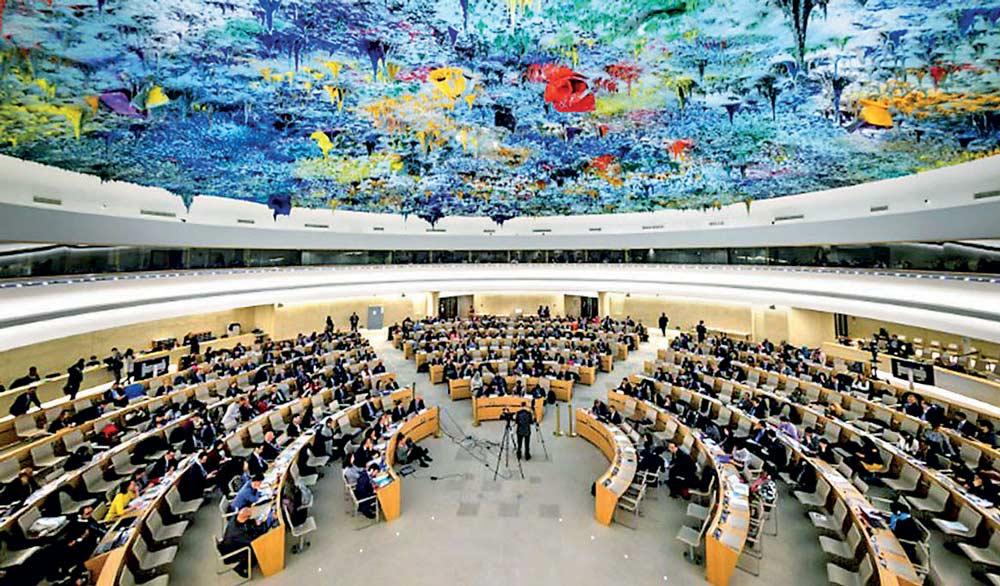
The National People’s Power (NPP) government’s approach towards the United Nations Human Rights Council (UNHRC) resolutions on Sri Lanka is somewhat different from that of the previous governments. Governments under Rajapaksas, Mahinda Rajapaksa and Gotabaya Rajapaksa, rejected the resolutions brought during their tenure and unsuccessfully sought to defeat them by garnering support from Muslim and African countries, apart from Russia and China.
Sometimes they became a laughingstock in this endeavour, as happened in 2021 when the then Foreign Minister Dinesh Gunawardena argued the resolution of that year, despite it being passed, was a failure, as Sri Lanka had the support of the majority of the council members when the abstentions and votes against the resolution were taken together.
President Mahinda Rajapaksa followed a confrontational approach towards the UNHRC from the beginning. He ignored the 2012 and 2013 UNHRC resolutions, resulting in the then UN High Commissioner for Human Rights Navanethem Pillay getting another resolution passed in the council in 2014, which provided for an investigation by her office on the rights violations in Sri Lanka.
The report of the investigation, which was an overall fact-finding process, accused both the armed forces and the LTTE of human rights violations such as abduction and killing of civilians, using children for the armed conflict and endangering civilian life in the war theatre.
It was through another resolution adopted in 2015 during the so-called Yahapalana Government that a mechanism was contemplated for the investigation of individual violations. The government under President Maithripala Sirisena and Prime Minister Ranil Wickremesinghe cosponsored all three resolutions presented in the UNHRC in 2015, 2017 and 2019. The 2015 resolution which the other two resolutions were based on provided for the establishment of a hybrid accountability mechanism to look into the human rights violations allegedly committed during the war between the armed forces and the LTTE, with the participation of judges and lawyers from the Commonwealth countries.
However, President Sirisena, backpedalling on his commitment towards that resolution, told the BBC in January 2016 that he would not agree to any involvement of foreign judges. Indicating a contagious effect of his remark, a month later, Prime Minister Wickremesinghe too told the Commonwealth Parliamentary Associations Asia Regional Seminar that the Sri Lankan constitution would not permit foreign judges to sit in domestic inquiries that would deal with alleged atrocities committed during the armed conflict.
It was as if they had not studied the Constitution before they had decided to cosponsor the resolution. Interestingly, the country cosponsored another resolution two years later, which was based on the previous resolution.
The NPP government, on its part, rejected the latest UNHRC resolution as it did last year, claiming it believed that “external action will only serve to create divisions” among various communities in the country. However, not bothering about the resolutions being passed uncontested, the government did not call for a vote on them. Foreign Minister Vijitha Herath told Parliament that calling for a vote at the Council, while being fully aware that it will be defeated, was a waste of both public money and time and would create an unnecessary problem.
The resolution currently before the NPP government is not totally new; it is one based on the 2021 resolution, which provided for the establishment of a repository of information and evidence on human rights violations in Sri Lanka to be used in future legal actions against perpetrators of such violations. Before the adoption of that resolution, the then UN human rights chief Michelle Bachelet called on the member countries of the UNHRC to take legal action in their own countries against Sri Lankan rights violators. The evidence collected in the repository is supposed to be used in these legal proceedings. She also recommended them to “explore possible targeted sanctions such as asset freezes and travel bans against credibly alleged perpetrators of grave human rights violations and abuses”.
Although any connection with these actions is not clear, the Canadian government in January 2023 imposed sanctions against two former Sri Lankan presidents, Mahinda Rajapaksa and Gotabaya Rajapaksa, and two former soldiers for “gross and systematic violations of human rights”. The UK government followed suit in March this year, targeting former Army Commanders Shavendra Silva and Jagath Jayasuriya, former Navy Commander Wasantha Karannagoda and former Eastern leader of the LTTE Vinayagamurthy Muralitharan alias Karuna Amman, who was later accused of running a pro-government paramilitary group, on the same grounds.
However, upon the human rights chief’s request to the member states to initiate legal action against Sri Lankan rights violators in 2021, Amnesty International expressed its doubts about such action by those countries. Now the UNHRC itself seems to be not happy with its own strategy in respect of Sri Lanka. The UN High Commissioner for Human Rights, in his latest report, says that although the repository of information and evidence on human rights violations established in 2021 now contains 105,000 items, his office was not aware of any individual who has been publicly prosecuted and tried for international crimes related to the conflict.
On the other hand, he states that Sri Lanka has not accepted the jurisdiction of the International Criminal Court (ICC), and no inter-State complaints have been brought by any of the State parties before the International Court of Justice (ICJ) or relevant United Nations treaty bodies. Besides, he laments that imposition of targeted sanctions by some member states against Sri Lankans allegedly involved in serious human rights violations, remains “limited in scope and cannot of themselves substitute for criminal prosecutions and trials, essential to delivering justice”.
Against this backdrop, the Sri Lankan Tamil leaders who have been banking on the international community, especially on the UNHRC and India, for the past four decades seem to have been left high and dry. Earlier, in 2017, India indicated to them that the merger of Northern and Eastern Provinces was no longer viable. And during the visits to India by President Ranil Wickremesinghe in 2023 and his successor Anura Kumara Dissanayake last year, India had dropped the 13th Amendment to the Constitution from their joint statements with Indian Prime Minister Narendra Modi.
07 Jul 2026 9 minute ago
07 Jul 2026 19 minute ago
07 Jul 2026 32 minute ago
07 Jul 2026 38 minute ago
07 Jul 2026 1 hours ago