11 Mar 2025 - {{hitsCtrl.values.hits}}
Despite the technical readiness and international support for solar energy in Sri Lanka, bureaucratic hesitancy persists within key state agencies regarding the 70% renewable target
 The Asian Development Bank (ADB) conducted a valuable workshop on the way forward for Sri Lanka towards an enhanced renewable energy (RE) penetration in its energy mix recently, on January 30, 2025. The workshop was well attended by persons representing the entire cross-section of the energy sector in Sri Lanka. The programme included presentations by ADB and several eminent experts on renewable energy with valuable insights and hands-on experience on the transition from fossil fuels from all over the world.
The Sri Lankan perspective was presented by the Ceylon Electricity Board (CEB), Lanka Electricity Company (LECO), Public Utilities Commission of Sri Lanka (PUCSL) and Sri Lanka Sustainable Energy Authority (SLSEA), including the representation of the private sector developers focusing on the development of renewable energy.
The 70% Goal
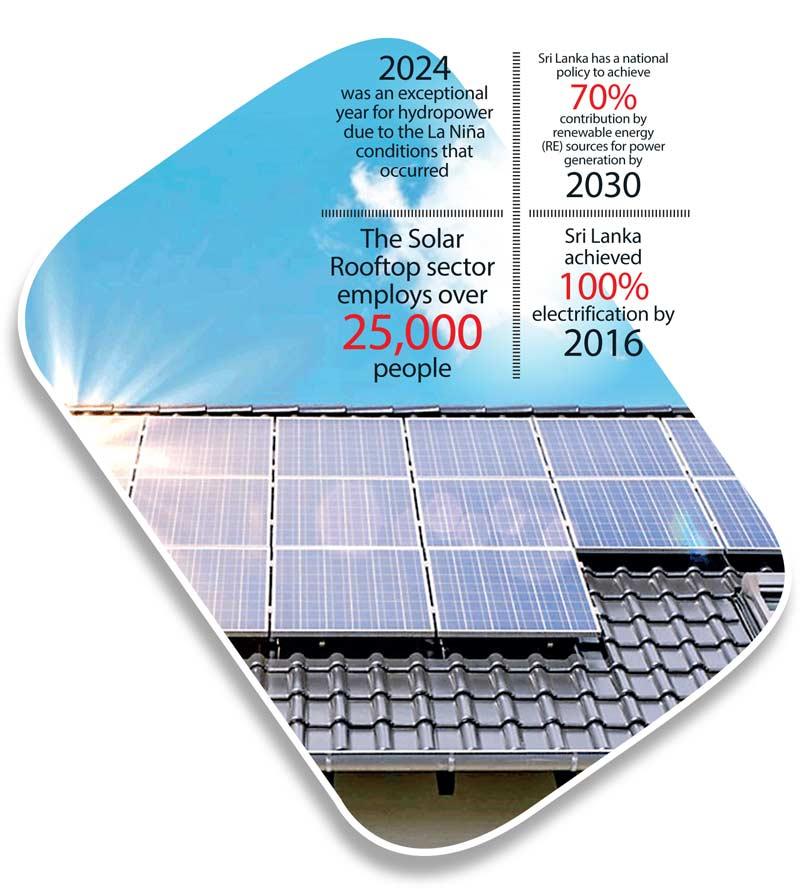
It was very significant to note that the ADB and all the foreign experts wholeheartedly supported and had confidence in the achievement of the Sri Lankan national policy on achieving the 70% contribution by renewable energy sources for power generation by 2030 and the longer-term objective of zero-emission energy economy by the year 2050. The experts applauded the progress achieved so far and considered the 70% target a highly achievable goal without question.
In total contrast, the presentations by the state sector agencies, including the CEB, who have responsibility and authority as well as the delivery of electricity services, were conspicuous by their negative prognostication, even to the extent of questioning the national goal being practically achievable.
The question to be asked is whether this is a tacit admission of their complete lack of vision and self-confidence, or pure incompetence. Some may even conjecture if there could be any other undisclosed agendas. Or for whatever reason for them to even go to the extent of contesting an approved national policy goal. Is this one more instance of a continuing lack of governance by the relevant ministry in charge?
Keynote Address by Chairman CEB
Perhaps it would be useful to review in detail the veracity of the claims cited as to why this cannot be achieved. In this regard, the presentation by the Chairman of the CEB in his keynote address is of interest.
Sri Lanka is proud of its achievement of 100% electrification by 2016, which perhaps is not yet achieved by our neighbours. The CEB should be congratulated and commended for this achievement as it was gained entirely due to their efforts and the Government’s vision. However, a little cloud has appeared to mar this shining achievement, due to over a million low-end consumers’ power being cut off due to their inability to pay the bills after the massive hike in tariff in the years 2023 and 2024. Hopefully, at least half of them have been reconnected by now, and we could hope to regain that pinnacle.
On the other hand, the other flag being flown is that Sri Lanka was nearly 100% dependent on renewable energy for power generation, mainly by hydro-owned entirely by the CEB, till about the year 1995. This has now dwindled to a mere 50%, which is still being held aloft as an achievement in comparison to other countries. Should this downfall not be viewed more as an embarrassment, as it was entirely due to the bad planning and actions by the CEB of opting to venture into imported expensive oil and coal, creating massive pressure on our balance of payments? While the more abundant sources such as wind and solar were not yet viable, there was no attempt to seek the enhanced use of indigenous sources like Mini Hydro and Biomass, whose technologies were already mature. The later circumstances, which added 212 mini-hydro plants with an energy contribution of 1379 GWh versus 4573 GWh from major hydro plants (CEB statistics for 2023), provide evidence of the lack of this vision.
At least now, when it is proven that Sri Lanka has ample Indigenous renewable sources, adequate manyfold to meet the demand even beyond several decades in the future, coupled with the maturity of technologies and commercial viability, it is indeed a major cause for concern when the CEB and even Ministry of Energy officials are doubting the ability to achieve the mere addition of 20% to reach the national policy target. Perhaps they have ignored the fact that we have surpassed this goal on several days in the past few years, no doubt aided by ample rainfall. The year 2024 was an exceptional year for hydropower due to the La Niña conditions that occurred. This will not prevail, and we will revert back to a normal pattern very soon, resulting in a high fossil fuel presence in the grid once again.
In contrast, the private sector developers, mostly small and medium scale enterprises and “Prosumers” in the rooftop solar photovoltaics (PV) sector, have shown the way. They have been facilitated by the very visionary and progressive programmes of feed-in Tariff provided for Non-Conventional Renewable Energy (NCRE) and the Surya Bala Sangramaya (SBS) under the Sustainable Energy Authority. They have already demonstrated a clear way forward. Thus, it will bridge the gap in hydroenergy to be expected every year during the dry months of January to May by alternate renewable energy sources. In particular, the exponential growth of rooftop solar PV, much accolated by the foreign delegates, provides the answer by the maximum contribution for this task. It has now surpassed a cumulative capacity of 1500 MW or 25% of the current installed capacity in the national grid. Also, the contribution of energy is over 1650 GWh, being 11% of the annual demand.
The usual lamentation heard of the volatility and non-firm nature of solar and wind was once more trotted forward as the excuse. The presentation of the Chairman of the CEB even used the data from the Hambantota Solar Project of the SLSEA to illustrate this. He failed to recognise that while any single variable renewable energy power plant can have intermittency, this normalises out when looking at the generation of multiple plants with geographical distribution – something CEB’s own staff has published in scientific journals.
What has the CEB done over the past 10 years in this direction? They have already been given nearly 2000 MW of wind and solar capacity, which can help meet the 70 % RE target given to them by 2030. Even with the massive pool of qualified engineers, they are shying away from accepting this challenge. All the utility has to do is introduce a feed-in tariff for Solar + Battery (or tenders for utility-scale installations) to solve all problems, which they and the Ministry have sadly missed out on. On top of this, the CEB Chairman has a delusion that Solar Rooftops can be tendered by the utility.
Reluctance to accept already proven technologies
As was the claim from the conclusion of the panel discussion, the grid-scale battery technology is far in the future and expensive to deploy. It is time that the CEB opened their eyes and looked at what is happening all over the world and even in our neighbour, India. One retired CEB General Manager further spoke about the environmental damage done by the batteries. India is recycling more than 90%. It is high time the government issued firm orders to the CEB assigning the total responsibility of achieving the 70% goal, creating annual targets and ensuring accountability. They are the custodians of Billions of Rupees worth of assets belonging to the people and can no longer be permitted to continue with the current irresponsible and regressive programmes, much to the detriment of the entire nation. No doubt, the consumers and private sector developers would willingly contribute with no financial burden on the CEB or the treasury in achieving this goal.
The daily generation mix published by the CEB always carries a footnote that “Solar Roof Top PV and 1 MW solar not included”. Despite the rapid growth and the substantial capacity already achieved, there appears to be no moves to bring this contribution to be recognised due to the most backward system control operations. As one delegate remarked, “The system control is in darkness in bright daylight.”
One has to wonder, despite the lamentation of Solar and Wind being variable, why eminently reliable and firm indigenous renewable resource, which also has multiple social benefits, viz: Bio-Mass energy, are being ignored. The draft long-term generation plan for 2025-2044 projects only 105 MW of Biomass power, whereas the ADB and Japan International Cooperation Agency (JICA) have estimated a potential of 2500 MW, and the SLSEA has reported a detailed potential of 795 MW for development by 2035. The Chairman’s presentation cited Biomass energy as “not reliable due to ‘supply chain uncertainly, ’” which displays his total ignorance of the sector and the willful actions of the CEB, which prevented any developments from 2016 to 2022. The biggest supply chain uncertainty lies within the CEB. The completed projects were not grid-connected for months due to a lack of availability of equipment. I always tend to think whether this is due to improper planning or willful sabotage of the RE integration.
There was much hype during the presentations on the future of the energy sector being “People-Centric” and designed for the benefit of the consumers. How can such claims be believed when the development of the two sectors, which have actively demonstrated these attributes, are being sidelined and obstructed at every juncture? The rooftop solar PV and Bio Mass energy are well-proved modes of transfer which benefit the community at large. It was estimated that the Solar Rooftop sector employs over 25,000 people right now and has the potential to multiply this number rapidly too.
The Chairman’s presentation, in particular, laid much stress on the losses made by the CEB over the years, claiming that the PUCSL has not granted the tariff sought by the CEB, totalling up to Rs 502.6 billion by the year 2021. What he failed to mention is that the Sri Lankan treasury picked up such debt to the tune of: Rs 307 billion in 2023 by converting them to equity. Rs 288 billion owed by CEB to the Ceylon Petroleum Corporation (CPC) and unpaid dues to the IPPS. The treasury planned to take over 70% of this debt in June 2023.Further assistance is planned to re-capitalise the two State Banks to which the CEB owes many more billions.
When one says funded by the treasury, it means funded by the people. The chairman was kind enough to confirm that the debt is now reduced to Rs 170 billion.
It is also necessary to compare the financial status recently displayed by the former General Manager, which is shown in Figure 1.

Isn’t there a clear disparity between the numbers above? What is more important is that CEB could make profits even without the recent massive hikes in consumer tariffs as shown in year 2013 and year 2015.
The Cost of Generation
It is often pointed out that the utility has the right to receive a level of tariff adequate to cover its cost of generation. However, the conditions under which they claim this right are never mentioned. The Electricity Act clearly says that it is “to regulate tariffs and other charges levied by licensees and other electricity undertakings, to ensure that the most economical and efficient service possible is provided to the consumers”.
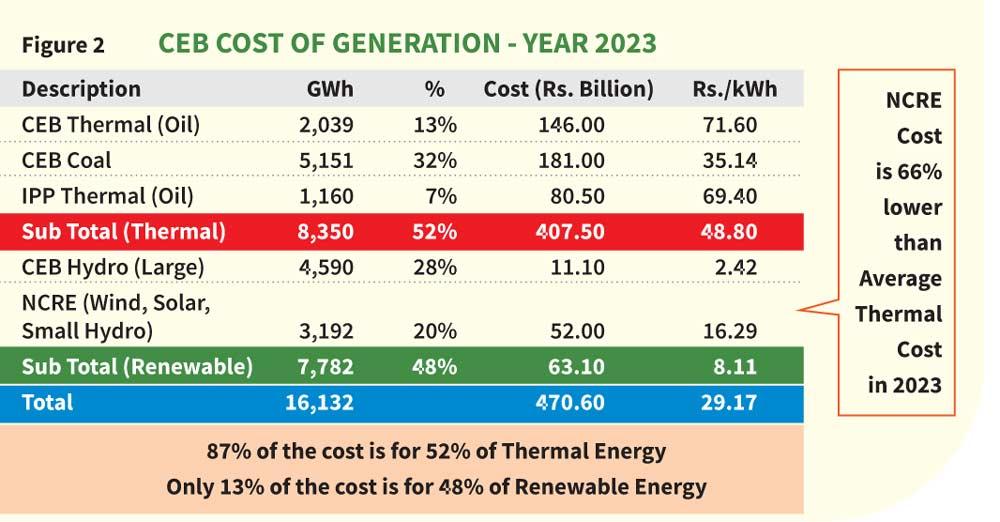
The question to be asked is, has the CEB generated power efficiently and economically? The analysis of the generation cost structure for 2023 is now available and answers this question.
Accordingly, the much-desired further reduction in the average cost of generation, and thereby the consumer tariff, can be achieved only by reduction and eventually, the elimination of the use of oil for generation. The gap thus created will have to be filled with indigenous renewable energy. Replacing oil with LNG does not solve the problem, and if current LNG procurement plans are executed, it would increase electricity costs rather than decrease them.
It does not require much intelligence to see that this calls for maximum facilitation for Sri Lankan developers to enhance and accelerate this development. This has to be done by a direct change of attitude of the officials of the CEB, SLSEA and the Ministry to provide this facilitation. It was clear from the presentations and comments during the panel discussions that this is far from the reality as of now. The mere statement of announcing that “WE WANT TO GO 100% RE!” is meaningless. We should know as citizens of this country how one plans to achieve the 70% mark in 2030 first and who is accountable for it. While this masterplan is in place, the officials can devise the plan for 100% and how to achieve it. CEB’s continued sabotage of the sector has serious implications for Sri Lanka, which is on the verge of losing a vital World Bank low-interest funding plan for renewable energy, signed by none other than President Anura Kumara Dissanayake.
The only ray of hope came from the directors of the ADB, who were quite firm in their support for achieving the 70% RE target and the straightforward advice which was given: to not chase after any more fossil fuels, which were termed as ‘Missed Buses’ by the former General Manager of the CEB. The countrymen should be happy that we missed that bus. Had we got onto the ‘Sampur Coal bus’, we would be paying high prices continuously for 40 years and making another living hell on the eastern coast as well.
The new bus we must not miss is the Indigenous Renewable Energy to be developed by local entrepreneurs and “Prosumers” and not to buy our own Solar and Wind power from foreigners for Dollars.
The writer is the Secretary of the National Chamber of Commerce and a Managing Director of Regen Renewables (Pvt) Ltd.
03 Jun 2026 9 hours ago
03 Jun 2026 9 hours ago
03 Jun 2026 9 hours ago
03 Jun 2026 9 hours ago
03 Jun 2026 03 Jun 2026