11 Dec 2025 - {{hitsCtrl.values.hits}}
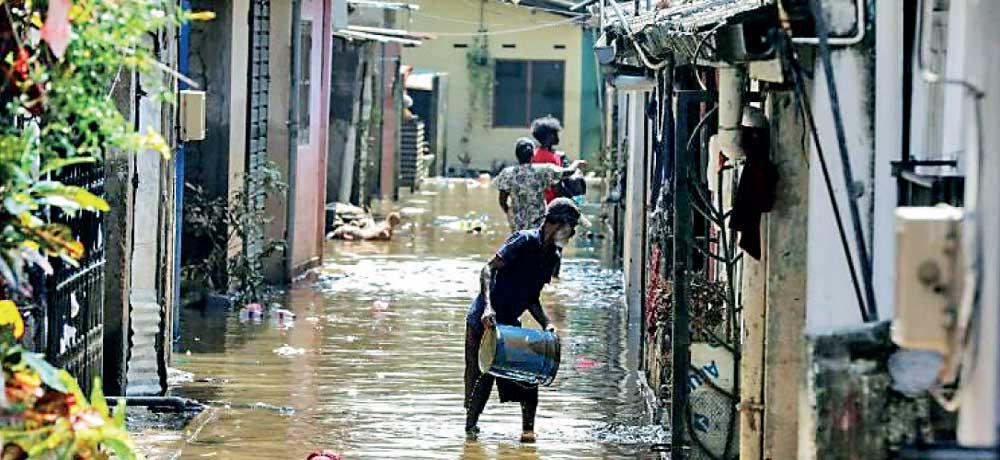
Even in urban areas, evacuation at quick notice can cause problems
 The world’s worst cyclone-hit countries are mainly in South and Southeast Asia – Bangladesh, India, Vietnam, the Philippines, Indonesia and Malaysia. Now Sri Lanka and Thailand too, are in that sombre list.
The Bhola Cyclone killed an estimated 300,000-500,000 people in Bangladesh back in 1970. India, Vietnam and the Philippines too, have suffered tremendously from cyclones. But all these countries are far more strong economically now than Sri Lanka. Bangladesh is much stronger than us after years of stagnation, and Vietnam is now an export hub. The Philippines, long considered a basket case, now exports semiconductors, electronic equipment, electrical machinery and transport equipment, copper, nickel and garments. Cyclones can affect all these industries, but these countries have a greater capacity to rebuild, and none of them are undergoing a preceding economic catastrophe as we do.
Cyclone Ditwah badly mauled our agriculture. In some ways, we were lucky. Tea represents roughly 11-18% of our total exports, about half of our total agricultural exports. Cyclone damage to tea estates would have been catastrophic. Paddy cultivation and other crops suffered heavily. Significant damage to coconut plantations would have been a nightmare as it’s an essential ingredient in our cooking.
Cyclones can devastate countries big or small. But size matters in this sense. Statistics show that almost 20% of the country (1.1 million hectares) was inundated. It’s the landmass percentage which reveals our real vulnerability as a small island nation, not the number of hectares. We have such different landscapes packed together into 65, 610 sq km, creating a fascinating topology – from beaches to rainforests and a more salubrious climate starting from just 500 meters continuing up to 2500 meters, all this within a few hours driving time.
But the same wonderful geographical variety which made Sri Lanka such an alluring tourist hotspot is now shown to an Achilles’ heel after Cyclone Ditwah, the way it flooded paddies and towns and wiped out hillside homes. We can take Hurricane Katrina which devastated the American city of New Orleans in 2005 for comparison. New Orleans is about 906 sq km in total area, roughly half land and half water, and had a population of 400,000 at the time. Katrina killed 1,392 people and cost an estimated US$125-186 in damages.
New Orleans is a city in the state of Louisiana, and the size of Louisiana is 135, 382 sq km, more than twice the size of Sri Lanka, and Louisiana is only the 31st largest American state. The hurricane destroyed 82,000 low income houses in the state, but much of the damage was in New Orleans. We can now see why size matters. Also, the US has the financial clout to repair the damage without asking for foreign aid.
Coming closer home, all the countries cited above are much bigger than Sri Lanka – Bangladesh (up to 148, 460 sq km, roughly the size of New York State, of which 130,000 sq km is land), India, huge by comparison (3,287 million sq km), Thailand (third largest country in South East Asia with 513, 120 sq km), Vietnam (331,212 sq km) and Indonesia (the world’s largest archipelagic nation with 1.9 million sq. km).
All these countries are much bigger than us, so big it’s hard to imagine a single natural disaster wrecking almost the whole country as Cyclone Ditwah did to Sri Lanka.
What can be done? We can have all the resolve, all the determination to rise above circumstances and flourish. But we need money alongside the resolve. Miracles are not going to happen. The government should look for foreign aid, but in this globally volatile situation with regional wars, and with many rich countries in the West facing domestic economic crises, it’s hard to image a massive influx of aid money. The government of Sri Lanka will be hard put to compensate all flood victims and rebuild all damaged infrastructure including roads and railways with domestic finances. It may resort to taxing citizens even more at a time when people are extremely hard-pressed. No one expects the IMF to show any leniency, and the debt servicing will have to be done. It’s hard to imagine creditors waiving off loans or offering grace periods.
There is a role that Sri Lankan expatriate communities can play in fund raising. So far, little is heard of in this regard. There are significant numbers of Sri Lankans in Western Europe, Australia, the US and Canada. They can launch a common fund to help Sri Lanka. Every rupee counts and each dollar donated comes to more than 300 rupees. This is where true feeling for the country lies, and not in just talking about how we can recover with great resolve. The resolve is there, but we need the money.
One should not be too pessimistic, but cyclones can turn us into hard-edged realists. For the most part, it’s the physical damage that has been assessed over the past two weeks, not the psychological part. People who have lost their homes, families, neighbours, friends and pets along with vehicles and belongings, rightly feel disoriented, devastated and without a future. Unlike those in low-lying flooded towns, many of those who lived in higher elevations won’t be allowed to rebuild and resettle where they used to live. They will have to get used to new locations. If they are re-located in apartment buildings, they will suffer from a kind of culture shock, because having your own home, however humble, is different from living in a cramped flat with strangers as neighbours. Most of those forcibly removed from low-income neighbourhoods in Colombo and forced into flats suffered from this sense of alienation and dislocation.
As for disaster warnings and evacuations, one must keep in mind that, even in many urban towns, it isn’t easy to move a family at short notice. Fear of theft is one factor which keeps people rooted to their homes. This country has enough police on every major road and intersection to check the documents of every passing motorist, but never enough personnel to patrol evacuated areas and keep them safe. If roads are impassable, boats should be provided. Also, in case of low-income residents with disabled, sick or very old family members, it isn’t easy finding transport to move them, and not enough ambulances are available to answer every call.
When it comes to remote villages in hilly areas or the arid zone, difficulties are even greater. Access roads are terrible and even non-existent. Patients can be seen transported on chairs over streams.
Cyclone Ditwah, while causing such destruction, also reminded us of what was neglected during an era of frenzied highways, airport and port building. The poor of this country are now paying the price.
19 Jun 2026 11 minute ago
19 Jun 2026 15 minute ago
19 Jun 2026 19 minute ago
19 Jun 2026 22 minute ago
19 Jun 2026 25 minute ago