05 Mar 2025 - {{hitsCtrl.values.hits}}
 The controversy sparked by Asoka Handagama’s biopic ‘Rani’, about the lives of Richard De Zoysa and his mother Dr. Manorani Saravanamuttu, is so one-sided that I feel duty-bound to make the following comments. I hate getting embroiled in controversies. They consume much-needed energy wasted in arguments which go nowhere. But, as someone who knew Richard and Dr. Manorani well enough to visit them at their home during 1984-86, I need to say the following, as there are many who feel that both mother and son are not accurately portrayed in Handagama’s ‘Rani’.
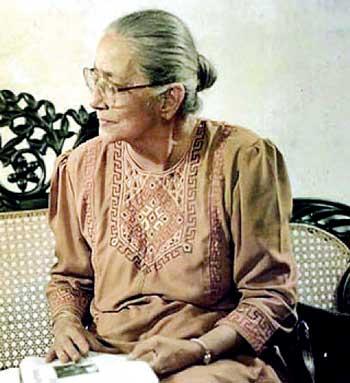 |
| Dr Manorani Savaranamuttu |
This is not a film review because I haven’t seen the film yet. The reason is that, after having a mentally and physically traumatic time after 2021 (the pandemic, followed by the country’s crash, and a death in the family), I would find it very hard to stomach any injustice done to two good friends (and a very decent man and woman), in this film.
But I’d be doing an injustice to Richard and his mother if I didn’t see the film and follow up with my thoughts on that. Until then, this is a portrait of the Richard and Dr. Manorani I knew four decades ago.
I said the controversy is one-sided because Asoka Handagama has a huge following, including some leading intellectuals, in his camp, ready to defend him. The critics are few. This looks like a culture war, with the film’s supporters in the ‘Sinhala medium’ camp and critics mostly from the ‘English medium’ camp, one notable exception being film critic Boopathi Nalin, who declared boldly that ‘it’s Handagama who murdered Richard’ (YouTube).
The first public criticism of ‘Rani’ in English was made by Chandri Pieris, choreographer, actor, journalist and a close friend of Richard (Chandri acted in Mountbatten, a 1990s British production about the partition of India in 1947).
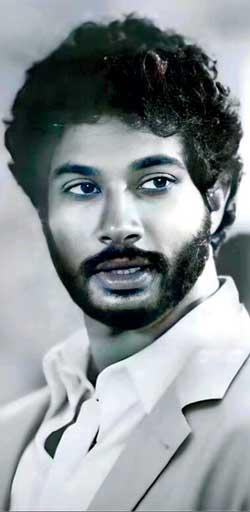 |
| Richard De Zoysa |
He criticised the film for many inaccuracies, including portraying Richard’s mother as a hard-drinking, chain-smoking socialite. He said there was a glaring lack of research in other areas, such as the way Richard and Dr. Manorani addressed each other at home or in public. Chandri further says Richard could not drive a car, or dance well and kept falling off his motorcycle, hence, he was not a good rider.
Chandri should know since he was part of Richard’s inner circle, like film and stage actor Peter D’Almeida, who was related to Richard’s family. I wasn’t part of this inner circle, being a stranger to Colombo’s social networks (which I still am), but I can vouch for the fact that neither Richard nor his mother drank or smoked heavily.
This may seem like a minor detail; at any rate, Handagama and his followers seem to think so. But a biopic needs to get those details right. Artistic license is not an excuse for wild exaggerations. ‘Shakespeare in Love’ is such an example. It’s not a biopic but a fictional version of Shakespeare’s early days as a dramatist in London.
I will discuss that aspect in detail once I view ‘Rani’. This is not an attempt to elevate Richard and his mother to sainthood. But I want to say what I saw and felt correctly. I think I first met Richard at the British Council, introduced to me by its cultural affairs officer, Dr. Rajiva Wijesinha. I was a fledgling, unknown writer. After reading my play ‘Chang Er’ based on a Chinese legend, Richard loved it and rushed it to the National Arts Council competition in 1984. It bagged the first prize for drama.
He followed this up with a play reading at the British Council. He had a tremendous enthusiasm for good writing, and our friendship was spontaneous. It was tacitly understood between us that his sexual preferences were different from mine. I am tolerant of thorny issues such as sexuality, religion and race, and Richard was the same.
I believe he was bisexual rather than gay. Once, he took me to the Lionel Wendt’s Art Centre Club on his Kawasaki trail bike and introduced me to his girlfriend. I don’t think it was a show put on for my benefit. I thought she was passionately in love with him. But I didn’t like the atmosphere there and never went back. It’s Richard’s innate qualities, generous spirit and artistic talent that interested me, not his sexual preferences. He possessed not just physical but also moral beauty.
I enjoyed spending time at the small upstairs flat he shared with his mother at that time, at Tickle Road, Colombo 8. That modest house is still there, unchanged, painted in the same pink-lilac colour. The setting was almost spartan. My parents moved to Colombo in the mid-70s. Richard and Dr. Manorani were the first and only Colombo high society people to open their doors and welcome me. They were always gracious, never nosy about my background and modest about theirs. Richard’s mother once told me that her grandfather was entrusted with handing over the keys of Singapore (then a British fortress) to the victorious Japanese in 1942. This wasn’t said with an air of self-importance. It was just one of those things.
I didn’t even know she was such a good stage actress until I saw her and Richard acting together in a Greek drama staged at the British Council in 1988 or 1989. I met Richard’s father, Lucien de Zoysa, only once, and learnt only much later that he was a dramatist. They were all very modest about their achievements. Dr. Manorani was beautiful even then, and elegant, but not coquette and certainly no socialite. Neither mother nor son cared much for money, and Dr. Manorani helped many poor people with diagnoses and treatment. She drove an old car.
Richard carried a packet of cigarettes with him, but he wasn’t a heavy smoker. I saw his mother smoking only once, and never saw her drinking. They didn’t keep alcohol in the house and never had wild parties. They never used bad language. I can describe them as very gentle. If these facts are distorted in this film, that’s being unfair and uncouth, and I’m going to check that out.
After 1986, Richard and I drifted apart due to a mistake on my part. After Lester James Pieris’ ‘Yuganthaya’ was released, Richard asked me to comment on his performance as Marlon, the radical, firebrand son of industrialist businessman Simon Kabalana. I thought his performance was lacklustre, and told him so. I said, ‘It lacked fire.’ Those were my exact words.
I deeply regret this, but I couldn’t have lied to him. His acting style was more British, in the manner of Lawrence Olivier. Richard was a brilliant Shakespearean actor, on par with Olivier. Though Richard managed to bridge the Sinhala-English culture gap better than anyone else from that esoteric Colombo English arts circle, he simply didn’t know how to play Marlon. I think he’d have done better in Sinhala films, given time – but four years later, he was dead.
When I realised he was badly hurt by what I said, it was too late. There was no enmity, we simply drifted apart. The country was in trouble again with the JVP rebellion starting in earnest, and I got married in 1987 wondering whether we would have to postpone the wedding due to regular JVP ‘curfews’. The first big bomb blast by the LTTE in Colombo happened in the same year. I didn’t have the time to think about Richard.
He may have drifted into radical politics at this time. I don’t know, since we never talked politics. I had no idea at all of his political leanings. It came as a seismic shock to hear he was abducted and killed. I have no idea if he was a JVP member, bona fide. All this is still very murky. Personally, I doubt it, though he helped one top-level JVP member to find a safe house (according to reliable sources). But was this politics, or compassion? When I think of him, it’s his feeling for the downtrodden that comes to my mind, not any political dogma.
He was deeply involved in human rights issues, and I think this was more likely the reason for his murder. But my own theory is that he needed a bigger stage than the arts, and that’s why he drifted into dangerous waters. Richard was a visionary of sorts. He adored the English romantic poet Lord Byron, a passionate, fiery man who left for Greece at the height of his fame to help the Greeks against Turkish domination, and died there.
Ernesto Guevara could have lived comfortably in Cuba after the revolution, but he chose to fight and die in Bolivia. He too, had a larger vision. Like Byron and Che, I think Richard too, was a visionary romantic. Unfortunately, Sri Lanka’s political landscape was neither visionary nor romantic then, nor has it been ever since.
Richard’s mother succumbed to her grief. Defying death threats, she bravely spoke up for mothers of the disappeared, with regular visits to a village in Maho, populated almost entirely by grieving mothers. But her own wounds never healed, and that’s why she died at 71, when she should have lived much longer under normal circumstances.
14 Jun 2026 28 minute ago
14 Jun 2026 2 hours ago
14 Jun 2026 4 hours ago
14 Jun 2026 5 hours ago