18 Oct 2025 - {{hitsCtrl.values.hits}}
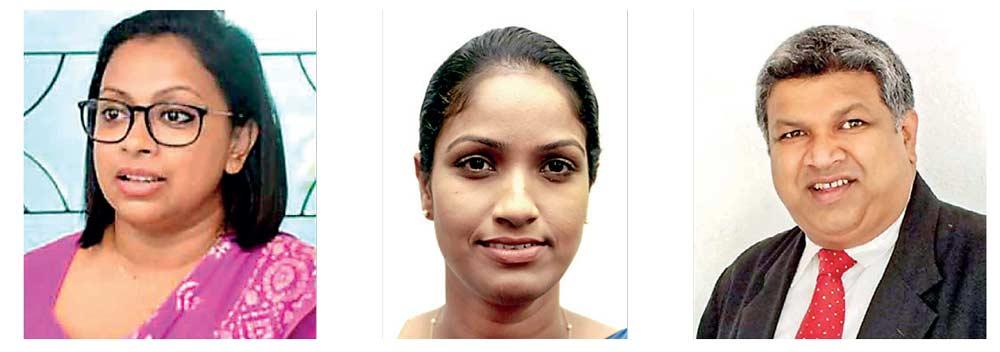
(left to right) Dr. Kaushalya Ariyaratne, Nilanthi Kottahachchi and Harshana Nanayakkara are some of the NPP politicians attacked on social media
 In spite of these incidents being not viewed as something that could negatively impact the freedom of expression and media freedom until lately, some journalists have expressed apprehension over them this month
Unlike leaders of other political parties in the country, the National People’s Power (NPP) leaders have been lodging complaints with the Criminal Investigation Department (CID) on defamation against them, especially in social media, for over a year.
They began to do so even before the last Presidential election as the mudslinging against the party was being intensified by the other major parties, particularly when the possibility of their party’s victory was becoming more and more evident. Sunil Handunnetti, the current Minister of Industries, had on August 30 last year made a complaint alleging that another party was preparing to publish a misleading document under the name of his party leader, Anura Kumara Dissanayake.
The current Health and Media Minister Dr. Nalinda Jayatissa told media in September 24, last year, that his party had lodged another complaint with the CID over a public statement made by Samagi Jana Balawegaya Parliamentarian Thushara Indunil. According to Dr. Jayatissa, the latter had stated before the Presidential election that the NPP was planning to set fire to the houses of the opponents if it won the Presidential election.
Following the controversy over the doctorate allegedly held by the first Speaker of the NPP government, Asoka Ranwala, the opposition started to ridicule other such title holders of the party, claiming that the NPP was a bunch of fake intellectuals. When they targeted the Energy Minister, Engineer Kumara Jayakody, he approached the CID on December 16 with a complaint.
The doctorate hullabaloo
During this doctorate hullabaloo, Justice Minister Harshana Nanayakkara was in for a rude shock when he was told that his name in the Parliament website had been tagged with a doctorate, despite him not having a PhD. Though this was not a huge issue, and happened in an isolated context, an embarrassed minister requested the CID to initiate an investigation into the matter.
Meanwhile, two new female MPs of the NPP, Nilanthi Kottahachchi and Dr. Kaushalya Ariyaratne, the current Deputy Minister of Media, were irked in December by social media posts which were highly pejorative to their personal lives. They also wanted to initiate legal action and approached the CID.
Although we occasionally read numerous stories about court rulings and orders in respect of complaints made by ordinary people with regard to derogatory statements made in social media against them, nothing was heard of any follow-up actions regarding these complaints lodged by the above-mentioned NPP politicians.
In spite of these incidents being not viewed as something that could negatively impact the freedom of expression and media freedom until lately, some journalists have expressed apprehension over them this month. Two more complaints by two ministers during the past few weeks seem to have prompted them to think differently. One compliant had been made on behalf of Trade and Commerce Minister Wasantha Samarasinghe after several derogative social media posts and alleged AI generated pictures published targetting him and his Public Relations Officer Nimodhi Wickremesinghe, while the other was made by Plantation Minister Samantha Vaidyanathan regarding social media posts targeting his son.
The journalists argue that repeated complaints of this nature made by ministers and Parliamentarians over harmful social media contens is tantamount to an attempt to bring in again the criminal defamation law that was abolished some twenty years ago. They claim that this trend ultimately would end up in shrinking of the space now available for media freedom and freedom of expression.
Their suggestion is that those who are affected by such media statements or social media posts must resort to civil litigation without involving the CID. In spite of their apprehension and the suggestion being justifiable, the issue is not so simple for one to believe that civil litigation would always be a remedy, given the disastrous impact of social media and Artificial Intelligence on people’s lives. Besides, at a time when everything has been politicised, defamation against one person, or a leader might have a drastic impact on society at large.
The fact that freedom of expression, especially media freedom, is an inextricable component of democracy is undeniable. Yet, media is not always innocent and social media is always prone to harm the security, dignity, and family bonds of individuals and the future of children.
Mainstream media is mostly institutionalised with various laws and regulations governing them, while codes of practice such as the one compiled by the Editors’ Guild of Sri Lanka and various media institutions guide them. The institutions such as the Press Complaints Commission of Sri Lanka (PCCSL) monitor the ethical practices of media, especially the print media. All these devices act as a restraining mechanism for mainstream media.
Not relevant to social media
However, none of these are relevant to social media. The user policies and Community Standards of social media companies have proved themselves to be insufficient to discipline their vast range of users, requiring state intervention for a regulatory mechanism. Although this was the professed purpose of the Online Safety Act promulgated by the previous government, it is prone to be a device in the hands of the ruling party, as the Act empowers the President to appoint members to the Online Safety Commission which is supposed to regulate the system.
Even the criminal defamation law was dwarfed by the actions taken by several past governments to stifle the media. During those governments, journalists such as Wimal Surendra, Lasantha Wickramathunga, H.E Dayananda, Richard de Zoysa, Pradeep Ekneligoda, Mailvaganam Nimalarajan and Dharmaratnam Sivaram were either killed or disappeared. Hundreds of others were brutally attacked and injured.
From a perspective of media freedom, the best way to seek redress for defamation is to file a civil case by the victim, which involves only damages and compensation instead of a prison sentence. However, in most civil cases, there is a possibility of vast disproportionality being created between the offence and the sentence. For instance, a derogatory statement might ruin the future of a child or the family life of a person which cannot be compensated for financially.
Social media is not an altogether genuine platform. Many people use fake accounts to express their views, especially to insult or harm others and spread fake news, disinformation and misinformation. A victim of such a derogatory post or a comment cannot identify the perpetrator without the assistance of state investigative bodies such as the Cyber Crime Unit of the CID or the Police Children and Women Bureau, to initiate a civil case. Against this backdrop, the journalists face a huge challenge in protecting media freedom while addressing these concerns.
04 Jun 2026 8 hours ago
04 Jun 2026 9 hours ago
04 Jun 2026 04 Jun 2026
04 Jun 2026 04 Jun 2026
04 Jun 2026 04 Jun 2026