29 May 2025 - {{hitsCtrl.values.hits}}
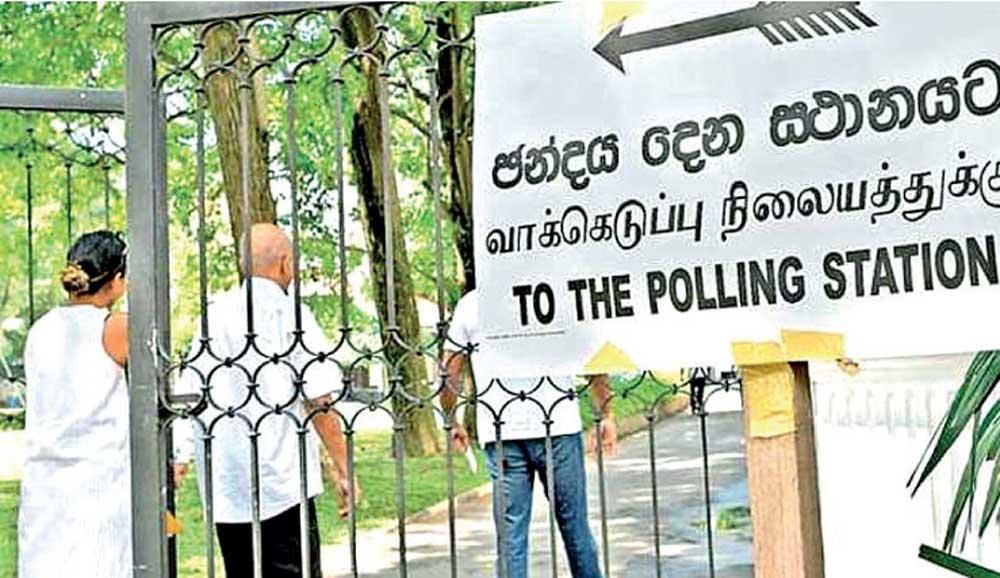
The participation of voters at a low 61% amplifies the fact that sovereign voters have detested the heavily politicised LG machinery for the last several years
By Bernard Fernando
I was energised to pen this piece after having read with interest several articles in the press. One of them was an article by veteran journalist Kusal Perera which exposed the manoeuvers by power hungry political party leaders abusing the very objectives of the LG machinery, to achieve their selfish and ulterior political motives, underscoring the need for ‘System Change’.
Furthermore, political parties delaying the submission of names of their selected nominees up to the time of penning, have added insult to injury, pointing again to the flaws of the system.
On ground, the participation of voters at a low 61%, amplifies the fact that Sovereign voters have detested the heavily politicised LG machinery for the last several years as they are compelled to consider local politicians as Middlemen/Brokers rather than as Representatives/ Facilitators of the people.
Ways to rationalize ‘Representative Democracy’
After the addition of nine Provincial Councils (each consisting of 2 or 3 Districts) armed with 455 politicised PC Members and 9 mini- Parliaments, as a new gigantic layer to the Political Administration system in 1988, an alternate proposal was floated to establish District Councils in line with Public Administration through Government Agents (now District Secretaries). The proposal still remains in a state of flux. Kusal Perera notes with concern that the real objective of LG bodies to closely deal with day-to-day affairs and future needs of the people in the localities, from ‘womb to tomb’, was continuously subverted by selfish political leaders.
Thereupon, writer’s ‘Out of the box’ proposal titled ‘An alternate system for Local Government Elections based on the ‘Grama Rajya/Gam Sabha’ concept appeared in the press, 28 years ago in April 1997. As usual, it also ended up in the dust bin of successive governments which continued to exploit the LG system for political advantage with enhanced vigour drawn from some 8,327 politicised members. This too was forthrightly exposed by Kusal Perera.
Thereafter, a comprehensive package of ‘Political and Electoral reforms/System changes’ including the methodology and benefits of depoliticising LG Machinery was presented by the writer in 2017 on the invitation of Mr. Mahinda Deshapriya (then Chairman of the National Election Commission). It was well received by an audience consisting of Mr. Deshapriya himself and a host of his senior officers at their Auditorium.
Since then, this writer’s updated proposals have continued to appear in the press and they have been submitted from 2017 to 2023 to the Election Commission and all Cabinet, Parliament and President-appointed Committees, PAFFREL and CMEV and some concerned academics too.
Members of all specially appointed Committees of the successive government seem to have turned a blind eye to specific and sanguine ‘Sovereign voter based proposals’ which challenged the survival of unsuitable, selfish, corrupt and traditional, politicians. Incidentally, the writer could read only the Parliament Select Committee report that was published towards the end of the ‘Aragalaya’. Obviously it had not included any of writer’s crucial proposals. One wonders whether at least an Executive summary of other Committee reports have been released to ordinary public domain through the Press.
It is also evident that cunning and corrupt politicians surreptitiously ensure that sovereign voter proposals that are inimical to their survival are kept in the back burner till an Election comes round the corner, allowing them to blare out the stock excuse - ‘’This is not the time to make changes to the Constitution or the Acts governing the Political and Electoral systems!”. Thus, it is abundantly clear that due to poor political literacy leading to lethargy of the sovereign voters, the politicians over the years have created a juggernaut that cannot be breached by the so-called ‘Sovereign Voters’.
Unfortunately, the new government too despite its super- power, went ahead with the same old unproductive LG Elections perhaps due to political expediency, investing Tax payers’ money exceeding Rs. 10 Billion and generating negative returns in the eyes of the voters. The people at the periphery are now waiting in the wings with the hope that the large incoming force of 8,463 Politicians of different hues will not resort to Political bias and corruption from now onwards!
What next?
The writer has placed much confidence on the new government to embark on the said ‘Voter based System Change’ packages as they have already complied with some of them, by life-example. Thus, for future action, the writer wishes to submit below a summary of his updated ‘System Change’ proposal, for a completely depoliticised LG Machinery with methodology and benefits. It envisages the use of ‘Jana Sabhas’ formulated by ‘National Movement for Social Justice’ (NMSJ) or any other ‘Sabhas’ established at the popular, smaller and easily accessible ‘Grama Niladhari Division’(GND) level, to field Independent candidates at LG Elections, in line with the ‘Grama Rajya/GamSabha’concept. It envisions the active involvement of ‘Sri Lanka Institute of Local Government (SLILG) established by a Parliamentary Act in the year 1999, to suitably train and guide the new category of Independent Representatives/Facilitators of the people and Local Government Officials accordingly.
People-based ‘System changes’ to achieve real objectives of LG Machinery
1) At the next LG election, allow each Jana Sabha’ (JS) to nominate 03 (01 Male, 01 Female and 01 youth below 35 years of age) honest, impartial and socially acceptable candidates with high integrity residing in the GND, so that the one garnering the highest no. of votes at each GND level will become the JS Representative/Facilitator taking up their Needs/Issues/Proposals with LG authorities at Divisional Secretary Office (DSO) level.
2) Each Divisional Secretary shall be empowered to conduct the Election in his/her Division in the presence of polling agents from the JS of the area.
3) The Office bearers at ‘Pradeshiya Sabha’, Urban and Municipal council level shall be elected by the respective JS members by vote.
4) The 14,000 + JS Representatives may be paid a monthly allowance that ensures a lesser total outlay compared to that of the existing cadre of 8,653 politicized members.
5) For this purpose, the next Delimitation exercise can begin forthwith, with the intention of equalizing the 22 Electoral Districts with 25 Administrative Districts thereby streamlining the system for all official purposes and deliver the services to the people in a practically convenient manner.
Benefits
i. The LG machinery will achieve its real objectives and surely become more meaningful and effective, than the existing wasteful and corrupt LG system mainly serving the politicians.
ii. Local People will receive impartial, uncorrupt and specific services avoiding administrative bottlenecks thereby saving transaction costs.
iii. Cuts in wasteful expenses, will save local LG resources and the environment.
iv. With the removal of politicised LG Elections, the tax payers will save billions of Rupees and the country will save millions of Man- hours wasted on the Election Day alone.
v. Creates a nursery for genuine ‘Country first’ Political Professionals replacing the current breeding ground for corrupt politicians.
vi. Creation of a robust ‘People-based governance’ under an ‘Intensive Bottom-up’ approach linking the people at the periphery with National policy making at the top will become a historic reality.
Envisioning a robust representative democracy
As aforesaid, the Politicians as the so called ‘People’s Representatives/Facilitators’ are still being considered by the people as ‘Middlemen/Brokers. Therefore, the new government is urged to go beyond ‘life examples’ of its members and expedite the passage of the ‘Voter system changes to our Political and Electoral systems’ to erase such perception in the minds of the people.
Accordingly, elections for National Parliament and Provincial Councils (PC) need to be held purely on ‘Proportionate Representation’ basis where the number of seats will be allocated according to Party vote percentages at National/District level signifying that all voters in North, South, West and East would cast their vote only for the party of their choice.
Towards such end, the optional ‘Preference Voting ‘mechanism, and complex Mixed Member Voting (MMV) system have to be replaced by public cleared, Electorate level, merit based nominee sub -lists compiled as District merit lists for registration during Nomination periods.
As a result, our flawed ‘Representative Democracy’ will be transformed in to a robust Representative Democracy where all Voters will carry a ballot paper giving ‘equal value‘, untainted by Race, Religion or Caste.
We can then call ours, a country where ‘Sri Lankans’ are its citizens.
The writer is the former Deputy General Manager – Bank of Ceylon and can be contacted at [email protected]
20 Jun 2026 11 minute ago
20 Jun 2026 1 hours ago
20 Jun 2026 3 hours ago
20 Jun 2026 3 hours ago
20 Jun 2026 4 hours ago