18 Dec 2025 - {{hitsCtrl.values.hits}}
In other more developed and technologically advanced countries, people were evacuated from high-risk areas long before environmental disasters struck, but sadly this has not been the practice in Sri Lanka
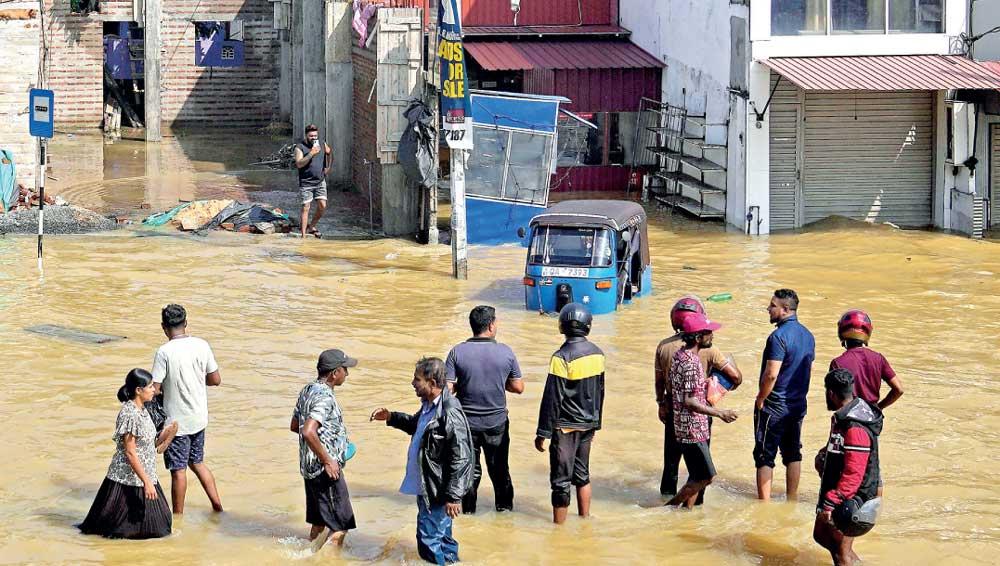
 Unsuspecting Sri Lankans often fall prey when getting into land deals. There are still some visuals of billboards circulating on social media platforms which carry advertisements of lands for sale in areas which are prone to floods. There is a billboard, submerged two thirds by flood water, which states that the land on sale is the best available in the area. The question posed now is whether the fourth generation of children is ready to let go of land in areas vulnerable to suffer from adverse weather conditions and move to safer and more developed areas?
Irrespective of what religion or faith people practise, Sri Lankans, as a whole are known to respond promptly when disaster strikes. From another perspective, does that quality also reflect badly on Sri Lankans? Well according to another school of thought, this quality also highlights that Sri Lankans are reactive and not proactive. In other more developed and technologically advanced countries, people have been evacuated from high-risk areas long before disaster struck. This is because people responded promptly and positively when warnings and options were given.
Prof. Mohamed Mahees, a lecturer at the Department of Sociology, University of Colombo, appearing on the ‘Nuga Sevana’ Programme telecast on Rupavahini on December 11, 2025 spoke about the flawed thinking of people with regard to purchasing property and relocating. He explained how the minds of middle and low income earners work with regard to choosing homes and their habitats. According to him there are people who cannot afford to purchase lands and build houses in safe upmarket residential areas, hence they settle in lands which are cheap and readily available in areas vulnerable to environmental disaster. Their reasoning is ‘We have to only negotiate a few months of floods and even during such times we will be looked after by people who donate food and water’. This issue of people living in low lying areas, vulnerable to floods, has been a hot topic of discussion and even prompted a stage drama producer in the likes of R.R. Samarakoon to produce a drama in the name ‘kelani palama’ (1978). The drama underscores the plight of people living near the Kelani Bridge when the water surges beyond manageable levels during adverse weather.
According to Prof. Mahees, people have shifted near vulnerable areas and it’s not the other way around. People have gone near water resources like lakes and rivers and settled there. Hence they are exposed to the risk of facing the wrath of the river when it overflows. Before Cyclone Ditwah, we saw the strange movement of animals; most of them migrating to other safer havens. Animal read danger situations before humans do. We humans have to learn the lesson of letting go of land from animals and birds.
If we study the history of Sri Lanka’s town culture, these towns were created by settling people without giving considerations to environment threats and challenges. Now the third and fourth generations of families have moved away from high-risk mountains and flood prone areas. This is not because of environmental threats, but mainly due to better opportunities to pursue education in areas closer to central Colombo.
There is a renowned short-film producer from Polonnaruwa who moved to a location close to the Colombo-suburbs. On his way to dropping his children to school, one of them had complained that the drive from home to school was too long. The father had responded, “I travelled over 200 metres and brought you from Polonnaruwa to this new home. It’s your duty to travel the next 20 kilometres and settle down in a location in Colombo”. The new generation of Sri Lankans is moving away from their hometowns, but leaving behind their parents and grandparents.
How people view disaster is very interesting. According to academic research, people are vulnerable to floods and landslides due to scientific reasons (Building hotels on mountains loosens the earth in the area), human movement (farming communities leaving the dry zone and settling near lakes, tanks and rivers) and due to curses, as reasoned by those who believe in astrology and voodoo magic. This a country which doesn’t give the television time given to an astrologer to a scientist, who can predict weather patterns scientifically! This is a country which doesn’t ask the elections candidate what his/her plans are for climate change! While giving all the respect to the academic predicting changes to weather, this writer also wishes to highlight the knowledge that aged farmers carry regarding the environment and weather. There are farmers who are observant about the height at which the Baya Weaver (wadu kurulla in Sinhalese) builds its nest. If this bird builds its nest at a height six feet from the base of a tree, a farmer takes it as a warning of possible floods in the area. But is the knowledge of such farmers tapped by scientists and government officials?
Most religions practised in this island teach devotees to invite simplicity to their lives. To enjoy the bliss of simplicity and have lesser burdens we have to inculcate the habit of giving. Despite the solid religious teachings that are available, it is the mobile phone companies that teach us the best lessons in discarding expensive appliances and moving on in life. Remember the Motorola A 7 60 and the Blackberry series of mobile phones? These popular phones that boosted the image of individuals went out of the market between 2003 and 2016 due to the emergence of the smartphones that came with the touchscreen concept. The Blackberry phone was a luxury enjoyed only by CEO’s, company chairmen and successful entrepreneurs while the common worker used the old phones that had keys to press. There was a clear ‘class’ difference with regard to the type of mobile phone that was used by people those days. But the advent of the smartphone cut the class barrier long before the floods arrived and gave the message that all humans are equal. If the smartphones can dictate terms to wealthy humans that they must discard their treasured mobile phones when an update to the next series in the smartphone is essential, the floods gave a similar harsh message that luxury homes built on lands vulnerable to catastrophes have to be vacated during adverse weather.
Mobile phones and landslides have put everyone in their ‘place’, but unfortunately the folks in Sri Lanka are learning this lesson at snail’s pace.
20 Jun 2026 38 minute ago
20 Jun 2026 2 hours ago
20 Jun 2026 3 hours ago
20 Jun 2026 3 hours ago