05 Feb 2025 - {{hitsCtrl.values.hits}}
It is true that this ‘citadel’ of critically approved songs has been attacked by a group of young musicians known as ‘the Bakery’. But this is of a radical left-wing political nature
 In the second part of this series based on Eric Illayapparachchi’s seminal essay on the Sinhala song, we start with his views on the ‘Subhavitha-Peechang’ (distinguished-cheap) conflict which dominated it for so long.
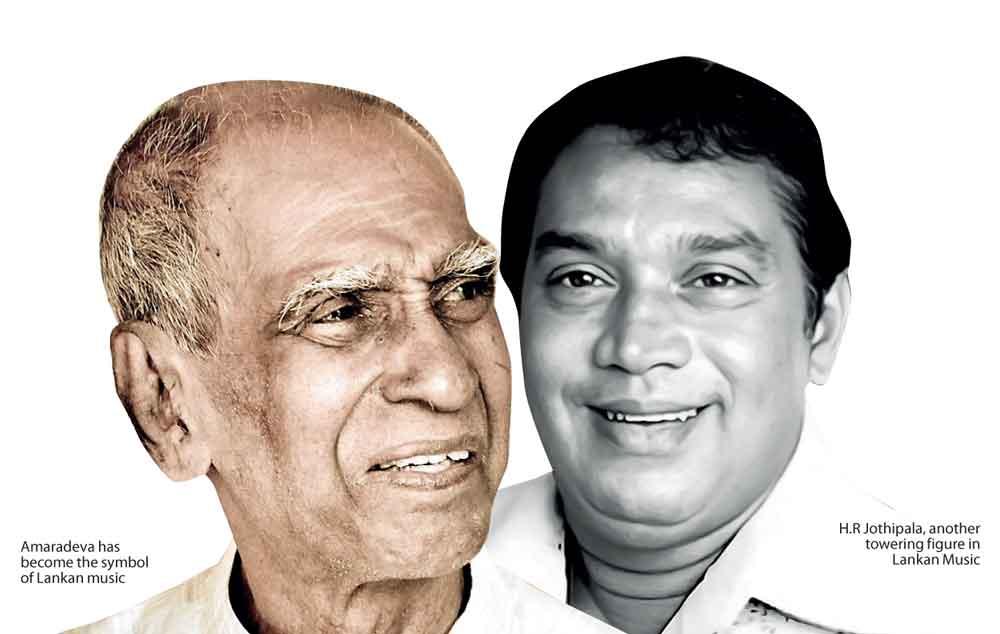
Two towering figures come to mind immediately in this context—singers W. D. Amaradeva and H. R. Jothipala. The writer quotes Roland Barthes, Edward Said and musicologist Daniel Barenboim to illustrate his points, defining this Subhavitha-Peechang conflict as Apollonian-Dionysian. Apollonian represents higher levels of thought, the classical and the logical, while Dionysian encompasses indulging in sensory pleasures and ‘lower’ tastes (entertainment).
As Edward Said puts it: “This Apollonian-Dionysian conflict—either you are Apollonian, or Dionysian, is a common misunderstanding. As Friedrich Nietzsche put it in his argument: One needs the other”.
W. D. Amaradeva, the towering figure in the Subhavitha camp, is regarded as the nation’s icon when it comes to the Sinhala song. He is the ‘modern mythological sign’ in the post-independence era of Sinhala music. To use the terminology of Roland Barthes, he is our ‘contemporary myth,’ and is given the highest accolades such as the ‘soul of national music.’ Just as Albert Einstein became a symbol of the highest achievement in science, the Eiffel Tower, a symbol of France, and the Isurumuniya sculpture is a symbol of love, Amaradeva has become the symbol of Lankan music.
Heavy use of adjectives (and superlatives) is a common practice among announcers during stage events, and this is true of radio, television and other media, too. An announcer’s quality is measured by the adjectives he or she uses. This proliferation of adjectives serves to exalt the singer or musician on display while putting the audience on the defensive into a ‘traumatised’ state of mind brought about by awe of the former’s musical prowess. The announcer will even use Sanskrit terms if he or she thinks that Sinhala adjectives aren’t good enough.
The result is a stark division of songs into two opposing camps – those elevated by critical approval and this barrage of adjectives are grouped in one ‘frame’ while the rest are pushed out. But, while creativity and artistic freedom thrive outside this frame, the ‘quality’ songs trapped within tend to stagnate. While ostensibly a part of the literary stream, it actually becomes a cancer that afflicts poetry and other modes of literary expression.
It is true that this ‘citadel’ of critically approved songs has been attacked by a group of young musicians known as ‘the Bakery’. But this is of a radical left-wing political nature. If the outcome of any such assault is to be meaningful, it (i.e. music used as a weapon) will have to draw from sources such as already-established music from the capitalist world (if one makes a historical comparison with the assault on the Bastille during the French revolution). If not, it must draw inspiration from the assault on the Winter Palace (Russian Revolution) and the resulting Prokofiev-Shostakovich and Brechtian musical tradition. Rock music, a product of the Western capitalist musical tradition, is an example of such an evolution (many rock musicians were influenced by Western classical music).
The crisis faced by our national music cannot be overcome by any other means. The use of elevated language serves only a very limited purpose in this context, something our announcers and critics have failed to understand. By focusing on the lyrics and praising that component of the song at the expense of other components such as melody, rhythm, instrumentation and composition, they have painted themselves into a muddy corner.
The result is an unfortunate division of the Sinhala song into the Subhavitha camp, with the rest (pop, baila etc.) lumped together as Peechang and dismissed. As Eric Illayapparachchi puts it, this highly charged adjective usage has been able to build a considerable civil power around the music it elevates (and its creators, too). But that too, functions within the same ‘entertainment culture’ promoted by television, FM radio stations and other popular media, this popular ‘entertainment economy’ co-existing with the ‘libido-driven’ economy.
In a country that can only boast of a broad-based folk music tradition with no known court music or religious music tradition, nor any string instrument tradition written down and passed down the generations as is the case with Europe, India, China, Japan and Cambodia—where such musical traditions still being practised—the influence of linguistic hegemony over music is far greater. In such a case, it is inevitable that both adjectives and lyric writing would become ogres that consume music rather than nurture it.
Eric Illayapparachchi takes the evolution of modern art (painting, sculpture) in France to further illustrate his point. He states that the above-stated ‘destructive element’ is applicable when it comes to the Dadaist and Minimalist art movements which originated in Western Europe after the First World War. He takes the example of France, which led the ‘Second Renaissance’ in art with 19th-century movements such as Impressionism and Expressionism, which knocked the established realist painting and sculpture off their pedestals and established the foundation of modern art.
But these in turn were challenged by radical movements such as Dadaism and Surrealism. Making a comparison with the art of a country still trapped in ancient or medieval forms of artistic expression, Eric states that when such radical art forms are introduced to such a context (which has not benefitted from the ‘transition’ that France, for example, experienced with Impressionism), the results are far from desirable.
This does not mean that artists cannot experiment and create art in such a context. But it would tend to push artists and their work towards a nihilistic, vandalistic sphere instead of offering the public an elevated artistic experience.
This, in effect, results in a clash of cultures. This is very much evident when we turn to our music, music appreciation and music criticism.
15 Jun 2026 15 minute ago
15 Jun 2026 36 minute ago
15 Jun 2026 41 minute ago
15 Jun 2026 54 minute ago
15 Jun 2026 59 minute ago