01 Apr 2025 - {{hitsCtrl.values.hits}}
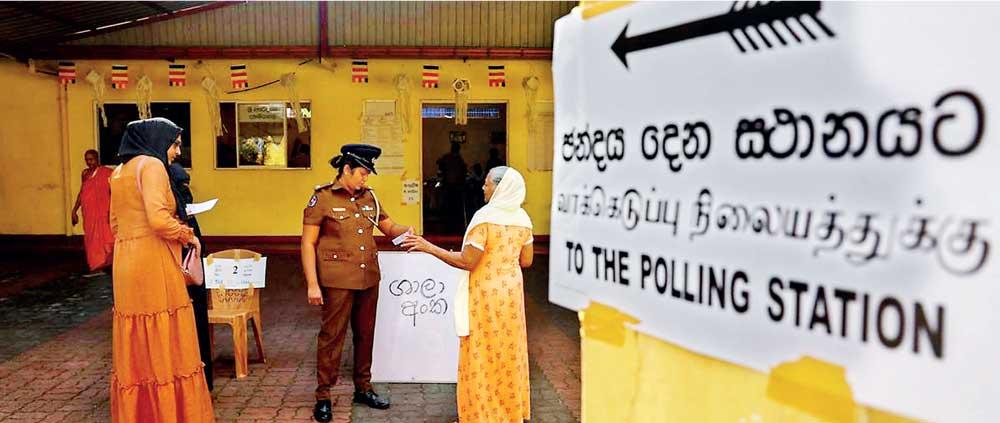
Grammar matters: As officials scrutinise voter documents, it can be argued that similar scrutiny should apply to the language of our electoral laws
 In my final year of the Power Systems Course, I had a close friend who was the best in that subject in class. I learnt from him, but he failed at it and did not graduate with us because it was a core subject.
I heard from seniors and our Head that his English handwriting and grammar were so bad that local examiners, knowing what he knew, gave him full credit for what he wrote, but British re-scrutineers to whom all our final papers went, urged that our examiners make a strict textual reading of what he wrote and not read our expectations of what he wrote. So he was marked down and failed. The choice was ours, but rejecting the advice would have been bad for our accreditation.
In my recent paper, ‘Neglect Of The Tamil Community: Time For NPP To Take Note & Change Course’,I said that many non-citizens are improperly disqualified from contesting Local Government Elections. My friends say I am wrong. One such friend won a case and successfully disqualified a dual citizen through the courts. But if I am right, the current nomination lists would be crazy-wrong. Moreover, many qualified candidates would have been dissuaded from contesting. We cannot hold elections on a wrong understanding of the laws.
The dominant view is that one has to be a citizen of Sri Lanka to be an electoral candidate. This arises from a published note from the Election Commission of Sri Lanka, which says non-citizens cannot contest at the local authority elections.
A note from IFES says likewise: According to Articles 88 and 89 of the constitution, “citizens of Sri Lanka who are: 1) 18 years of age or older; 2) registered in ‘the appropriate register’ of electors; and 3) are not subject to any of the disqualifications identified in the law are eligible to vote in the election”.
Whatever the election, the names in the one voters’ register are the same, except that for local government elections where the names are associated with Wards. So the phrase “the appropriate register” is misleading.
I concluded that this needs re-examination, especially after a German citizen was disqualified this time.
I provide that re-examination here.
Sinhalese Farce with the Official Language
My good friend and elder, the late Prof. Selvadurai Mahalingam, D.Sc. (Eng.) London, Ph.D. Sheffield, who worked at Peradeniya when Dr. Colvin R. de Silva worked on the 1972 Constitution, told me this. Colvin’s language forte was English, not Sinhalese. But in Srimavo Bandaranaike’s time, they had to make a show of support for the Sinhalese. So Colvin would work from Colombo Monday to Friday on the text of the constitution and come to Peradeniya every weekend to work with the Professor of Sinhalese who would translate Colvin’s text into Sinhalese. Then to make a show of fealty to Sinhalese, it is stated in Article nine of the “made in Sinhala Constitution” that:
9. (1) All laws shall be enacted or made in Sinhala
(2) There shall be a Tamil translation of every law so enacted or made.
10. (1) All written laws, including subordinate legislation in force immediately prior to the commencement of the Constitution, shall be published in the Gazette in Sinhala and in Tamil translation as expeditiously as possible under the authority of the Minister in charge of the subject of Justice.
(2) The laws so published shall be laid before the National State Assembly at the meeting following the date of such publication.
(3) Unless the National State Assembly otherwise provided vices [sic.], the law published in Sinhala under the provisions of subsection (1) of this section, shall, as from the date of such publication, be deemed to be the law and supersede the corresponding law in English.
Since, as claimed in Section 1, nothing was “made in Sinhala”, is that horrid “made in English” constitution that dethroned the minority rights of the previous Section 29 and imposed Buddhism, not void?
The current constitution in Article 23 has something less brazen. We are improving, but we are not there yet.
Today’s World: A Pretence to English Competency
Nonetheless, our laws are written in such bad English that they permit anyone to read the laws as they like, vitiating our democracy. Ungrammatically written laws mean nothing.
We live in this world some 50+ years after Colvin wrote his Constitution “in Sinhala”. Even though Colvin played his theatrics to show off his nonexistent skills in Sinhalese, what he wrote in English is generally flawless as to his intentions and grammar. But a new class of people without skills in English have to show that they work flawlessly in English because in our society, not knowing English has terrible social consequences. As the higher courts work with laws in English, I see even Supreme Court judgments in bad English. We go by what is often obvious to us as to what the justices intend. Professional courses like Engineering are taught and examined in English. It is not always clear that what is written is the same as what is intended by the student intended to say. We grade it any way we like it. So it is with courts.
Today, there is hardly anyone except a small handful who can write our laws in correct English to the level of accuracy required. The few who could have retired in recent years, particularly in Engineering and the judiciary. Sri Lanka is in such horrible social, educational and judicial crisis with respect to command of English, that many of us who lack competency in English cannot concede that they lack English skills so they go ahead, undaunted, getting their pen to paper to write the most important laws and student notes to be crafted. The result is a redoubtable “cacographic mess,” or “chicken-scratch writing” in defiance of the requirements of orthography. Since we all make mistakes, such important documents need multi-person inputs that require good orthography together with subject knowledge. The pharmacopoeia defining the make-up of medicines requires seven proofreaders, but I see this done here with laws by just one person, or indeed someone who has subject knowledge but is corrected by a language expert who lacks the subject expertise, such as a young person recently graduating from a Western university.
The result, in relation to the subject of this article, is the Constitution of Sri Lanka and the Local Authorities Elections Ordinance (Chapter 262), the latter having been amended in a hurry without even letting all Commission Members make input (although the copy online by IFES states it was amended on 30 March 1989, well after which amendments were made when I was on the Commission).
The Sources on Citizenship Restrictions
On qualification or disqualification to vote or be a candidate, there are two sources: The Sri Lankan Constitution and the Local Authorities Elections Ordinance.
Article 88 of the Constitution says, with my emphases:
“Every person shall, unless disqualified as hereinafter provided, be qualified to be an elector at the election of the President and of Members of Parliament or to vote at any referendum, provided that no such person shall be entitled to vote unless his name is entered in the appropriate register of electors”.
That is, he may vote for the President and for MPs or at a Referendum. Is he then qualified to vote for the President, and MPs, but not at referenda? I can argue no. It defines the qualification to vote for the president and MPs or at referenda, not at both. What does the word ‘or’ imply? A young graduate recruited from America without subject knowledge would pass it. And what does it mean by appropriate register of electors? (A cut-and-paste job from the Ordinance to the newer constitution?) It means nothing because we have only one register of electors, not different ones for Presidential and parliamentary elections and referenda. (As mentioned above, LG elections designate Wards for the voters).
Let us move on to Article 89 of the Constitution, which says:
“No person shall be qualified to be an elector at the election of the President or Members of Parliament or vote at any referendum if he is subject to any of the following disqualifications, namely,
a. If he is not a citizen of Sri Lanka;
b. etc.”
I suggest that a disqualification has to be noun-like “a) He is not a citizen of Sri Lanka,” not a conditional clause like “If he is not a citizen of Sri Lanka” which implies an incomplete sentence, for example, “If he is not a citizen of Sri Lanka by virtue of having been stripped of his citizenship.”
Besides, a dual citizen is a citizen. The way dual citizenship is conferred is by using the phrase “Restoration of lost citizenship”. So are dual citizens not citizens?
The other authority, albeit of less authority than the Constitution, is the Local Authorities Elections Ordinance (Chapter 262). It says in Article 9(1):
“No person shall at any time, be qualified to be elected under this Ordinance, or to sit or to vote, as a member of any local authority, if such a person at that time:
a. Is not a citizen of Sri Lanka, or if he is by virtue of his own act, under any acknowledgement of allegiance, obedience or adherence to any foreign power or state.
b. etc”
Does “under this Ordinance” mean he may be entitled to be elected under another ordinance?
Clause A seems like a poorly framed afterthought to cover dual citizens. But it seems to have taken us out of the frying pan into the fire!
Does “obedience or adherence to any foreign power or state” cover dual citizens? Does it make any Roman Catholic disqualified because he acknowledges obedience to the Church under the Pope, the head of the Vatican, which is a state? I believe that under this pernicious clause, all Roman Catholics who submitted their nominations for the upcoming Local Government Elections are disqualified.The Vatican (the Holy See) has diplomatic relations, established in 1976, with us. The Holy See maintains a nunciature (embassy) in Colombo. We cannot have laws we do not mean and are there as a booby trap, an IED, for the convenience of xenophobes to be sprung one day when they choose.
Conclusion
The current nominations are in a mess. I fear that the courts’ ruling so would be a national calamity. Judges would take the easy way out, as did my Power Systems examiners, ruling based on what they think the lawmakers intended rather than what they actually wrote. Welcome to Sri Lankan Democracy and Grammar.
The writer is a Former Member of the Election Commission.
07 Jul 2026 2 hours ago
07 Jul 2026 3 hours ago
06 Jul 2026 06 Jul 2026
06 Jul 2026 06 Jul 2026
06 Jul 2026 06 Jul 2026