14 May 2025 - {{hitsCtrl.values.hits}}
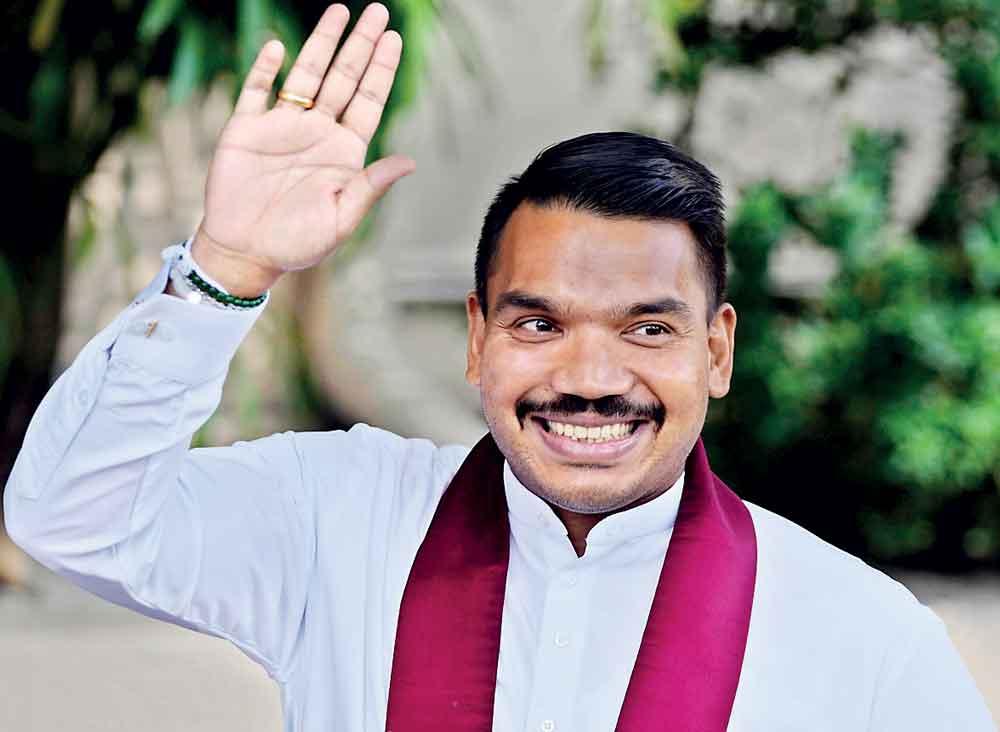
Namal ‘Sans Family’ the key to electoral success? As he gained 610,000 more votes in the recent election, if he keeps this momentum, he will be able to pull off surprising wins in future elections
 When a candidate wins the presidency, especially a newcomer, it creates a temporary wave of excitement that influences the next election. This is why the snowball effect of that candidate, in which the parliamentary results are twisted to their favour, can be observed
The Malimawa government started with a strong win in Parliament, but it now faces a shaky future as voter support moves back toward the middle
 The analysis of electoral trends demands thoughtful consideration of which comparative baselines yield the most meaningful insights. When examining the recently concluded Local Government (LG) election results, compelling evidence suggests that the 2024 presidential election results provide the most appropriate analytical foundation—significantly more so than either parliamentary elections or the previous 2018 LG elections, where SLPP demonstrated convincing dominance.
 When someone wins the presidency, especially a newcomer, it creates a temporary wave of excitement that influences the next election. Voters jump on the bandwagon of the winning side, even if they wouldn’t normally support that party. This snowball effect twists the parliamentary results that follow. The “Two-Thirds” outcome doesn’t really show what voters think long-term—it’s just catching the overflow from the presidential win. The impact was even stronger because these two elections happened less than two months apart—the closest timing in history. Voters barely had time to catch their breath before heading back to the polls. Result: NPP’s unrealistic gain from 42% to 61%.
Parliamentary Results Anomaly
The 2024 parliamentary results represent a statistical anomaly that should be treated with caution in analytical frameworks. This psychological momentum creates a distorting effect on voter behaviour that does not accurately represent long-term political sentiment. The ‘Two-Thirds’ result in Parliament is what data experts would call an unusual case, caused by a clear outside factor—the close win in the presidential election and the way it affected voters’ thinking.
Using the presidential results as a comparative baseline acknowledges the evolution of voter preferences since 2018 without introducing the statistical noise present in the parliamentary data. This approach recognises that political landscapes naturally shift over time—the 2018 data represents a political reality that has undergone significant transformation. Comparing current LG results with such dated information risks missing critical developments in voter sentiment and party positioning.
Analytical integrity demands we recognise this distortion rather than incorporating it uncritically into our understanding of electoral trends. By using the presidential results as our primary comparative baseline, we acknowledge the dynamic nature of voter preferences while filtering out the temporary enthusiasm that colored the parliamentary outcome. This approach provides the most nuanced and accurate understanding of the current political landscape.
Historical examples of this bandwagon effect abound in electoral politics worldwide. Following François Mitterrand’s presidential victory in France in 1981, his Socialist Party secured an unprecedented parliamentary majority just one month later, gaining 155 seats—a surge that partially reversed in subsequent elections once the victory euphoria dissipated. Similarly, after Barack Obama’s 2008 presidential win in the United States, Democrats expanded their congressional majorities significantly, only to experience substantial losses in the 2010 midterms after the initial enthusiasm had faded.
 The parliamentary performance of the JVP/NPP greatly benefited from fleeting enthusiasm, resulting in what statisticians describe as a “measurement bias” instead of indicating a true shift in political alignment
In the Indian context, Narendra Modi’s 2014 victory created such strong momentum that his BJP party swept state elections held shortly afterwards in Maharashtra and Haryana, performing significantly better than in regions where elections occurred after this honeymoon period had ended. This pattern repeated after his 2019 reelection, with the BJP dominating in immediate post-victory elections before facing setbacks in later contests.
The JVP/NPP’s parliamentary performance benefited substantially from this temporary enthusiasm, creating what statisticians term a “measurement bias” rather than reflecting a fundamental shift in political alignment. Including this data point without acknowledging its unique contextual factors would significantly skew any longitudinal analysis of political trends.
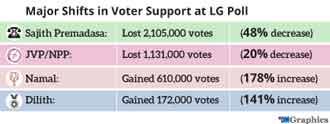
The dramatic shifts in voter support between elections demonstrate the classic pattern of post-victory enthusiasm followed by a return to more stable voting patterns:
These substantial swings confirm that the parliamentary “Two-Thirds” outcome represented temporary enthusiasm rather than durable political sentiment. The steep declines for Sajith and AKD in the Local Government elections show a natural correction from artificially inflated parliamentary numbers. Meanwhile, the dramatic gains for Namal and Dilith suggest a consolidation of support among those who originally backed these candidates but temporarily shifted during the parliamentary enthusiasm wave.
The presidential election results give a clearer picture of real political support. In comparison, the Local Government election shows a return to that level of support, while the parliamentary results now seem like an unusual case, boosted by how close the presidential election was and the excitement it created. This pattern suggests that, over time, presidential results are a better guide than parliamentary ones for predicting future elections.
The big changes in voting across these three elections show that the political situation is unstable. Although the Malimawa government started with a strong win in Parliament, it now faces a shaky future as voter support moves back toward the middle. Support for the Malimawa government has already dropped sharply from its early high. They must accept that this isn’t just a short-term dip—it may be the start of a steady decline. If the current trend continues, they could lose another 20% of their support before the next election.
The government is at a turning point. To stop the slide, they need to shift from campaign talk to real action. Every broken promise makes voters more disappointed, especially those who supported them only because of the presidential victory. Time is running out to show real results.
For the SJB, the next step is even clearer. They must bring in new leadership—not just for improvement, but to survive. Losing over 2 million votes (almost half their support) shows that voters rejected not just their ideas, but their leaders. Only a fresh, energetic leader who can rally their loyal voters and attract undecided ones can help turn things around.
Namal sans ‘FAMILY’ went up by an impressive 178%—
He gained 610,000 more votes—making him the most successful candidate in recent elections. If he can keep this momentum going, he has a real chance of pulling off a surprise win in future elections.
Several things are working in his favour. Many voters are fed up with the main political parties, which gives Namal an opening. As support for the Malimawa government falls and the SJB continues to struggle with weak leadership, Namal’s position keeps getting stronger.
His big jump in votes shows he’s attracting support from outside his usual group of voters—something very important for anyone trying to beat the odds. If he can keep growing his support while the other two main parties lose ground, the numbers may start to favour him. But to stay on track, Namal needs to turn this short-term support into a long-term movement. He must clearly explain his plans for the country and win over middle-ground voters by focusing on national issues. With elections being so unpredictable lately, old ways of predicting results may not work. Namal could be the kind of unexpected success that these models fail to see coming.
The writer can be reached at
[email protected]
05 Jun 2026 2 hours ago
05 Jun 2026 2 hours ago
05 Jun 2026 2 hours ago
05 Jun 2026 3 hours ago
05 Jun 2026 3 hours ago