03 May 2025 - {{hitsCtrl.values.hits}}
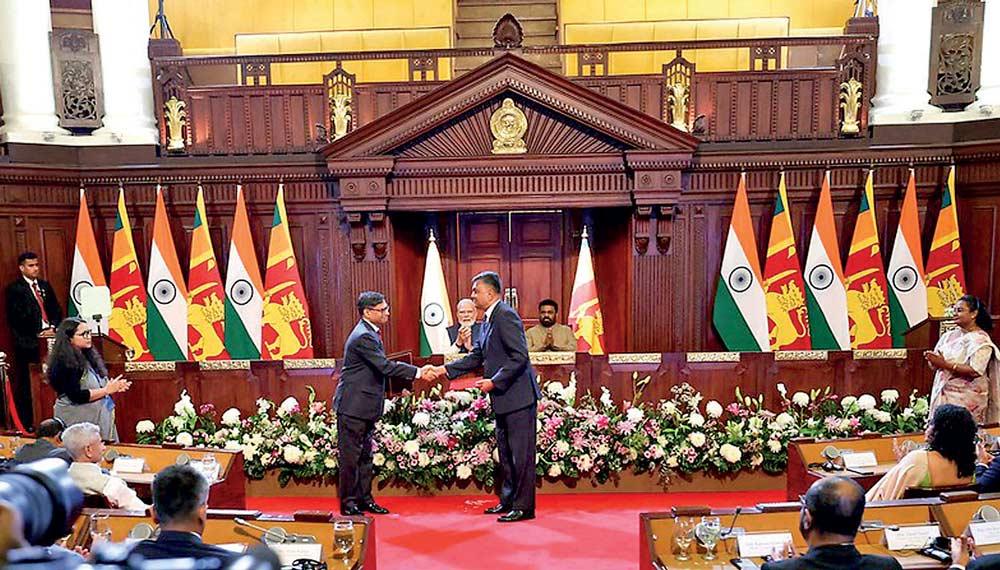
Pictured here is the event presided by President Dissanayake and Indian Prime Minister Narendra Modi where Sri Lanka and India signed seven MoUs on several key sectors
 The issue concerning the MOUs with India has also turned to be a blow on the credibility of the NPP as the ministers have been repeatedly refusing to reveal them to the people, giving conflicting reasons
The professed moral high ground of the National People’s Power (NPP) is being seriously questioned in respect of some of its actions such as the using the Prevention of Terrorism Act (PTA) against suspects and the Memoranda of Understanding (MOUs) with India signed last month
PTA has been used twice by the authorities against suspects during the first six months of the NPP administration - first against the suspects who allegedly acted in a manner inimical to the security of the Israeli tourists in Arugam Bay in the Eastern Province and later against a youth who has allegedly pasted a sticker condemning the Israeli atrocities in Gaza on a trash bin at a shopping mall in Colombo.
The detention of the youth triggered strong public backlash and protests. Early April, demonstrators gathered in Slave Island demanding his release. Thousands of stickers in support of Palestine were distributed during the protest, with participants voicing concern over the suppression of free expression and the use of counter-terror laws against peaceful activism.
The justification of the incident by the police and the ministers raises more questions. Police said that the investigation conducted after the sticker incident revealed that the 22-year-old Mohamed Rusdhi had been subjected to some motivation due to using the internet and other methods and there was a reasonable suspicion that he was susceptible to committing a terrorist act. Cabinet spokesman Dr. Nalinda Jayatissa who is also the media minister had also echoed this police version at a media briefing.
What puzzles any one is why the authorities conducted an investigation over an incident which is not unlawful. More importantly, the position of the man on Palestine issue does not seem to be different from that of the leaders of the NPP. The authorities used the PTA against the youth despite the JVP having opposed it from the day it was passed in Parliament in 1979.
The issue concerning the MOUs with India has also turned to be a blow on the credibility of the NPP as the ministers have been repeatedly refusing to reveal them to the people, giving conflicting reasons. Ironically, these MOUs were signed on April 5, a day very special for the JVP as it was on an April 5 that the party’s first insurrection was launched in 1971 and since then the party holds an event on April 5 each year in memory of those who sacrificed their lives in that insurrection.
The seven MOUs were signed during the visit by Indian Prime Minister Narendra Modi to Sri Lanka and many people in the country are concerned especially about the MOUs on defence affairs and power connectivity between the two countries. When the journalists requested details of the Defence MOU, Minister of Foreign Affairs, Foreign Employment and Tourism Vijitha Herath told them that there is nothing new in that but only the existing collaborations between the two countries have been formalised by it. If that is the case, the government’s hesitancy to reveal the MOUs is more puzzling.
Minister Herath, when the Opposition MPs wanted the MOUs be tabled in Parliament stated that only the treaties are required by the Constitution to be tabled for the consent of the House. He also had stated that anyone who needs to obtain a copy of any of the seven MOUs could do so through a Right to Information (RTI) application.
If the government is prepared to reveal the MOUs upon request, they are not deemed as secret documents. Then why does the government leave the people in suspense and give ammunition to the Opposition by not voluntarily revealing them? Even the Indo-Sri Lanka Accord of 1987 which was very sensitive and had far-reaching impacts on Sri Lankan politics was presented in Parliament.
At one point, the Cabinet Spokesman, Minister Nalinda Jayatissa told journalists that the government needs Indian government’s consent to reveal the MOUs to the people. This falsifies Minister Herath’s statement that anyone can obtain a copy of the MOUs through an RTI application. And also, it raises the question whether Indian Government needs Sri Lanka’s consent to make the MOUs public to Indian people. This was the most serious statement a minister has made on these MOUs, as it negates the sovereignty of the people.
Sri Lankan people, especially the majority Sinhalese are always wary of the Indian connection, whether it is a defence pact or land connectivity or power connectivity, probably due to loathsome memories of the invasions of the country by Indian leaders, especially by South Indian leaders centuries ago. Politicians since Independence have exploited this wary attitude in the people towards India time and again, for their political ends.
The JVP also used this wariness towards India during both their insurrections to conveniently bolster their actions. The theory of Indian expansionism presented by the party before the first insurrection had largely been based on ancient invasions of Sri Lanka by the South Indian rulers. The JVP founder leader Rohana Wijeweera’s book titled “Solution to the Tamil Eelam” published during the party’s second insurrection in the late eighties had depicted the Indian intervention of the day including the Indo-Lanka Accord of 1987 as a reincarnation of the ancient South Indian Chola invasions.
It is against this backdrop that the JVP/NPP ministers have been attempting to justify the veiling off of the MOUs signed between India and Sri Lanka. Hence, the government is playing into the hands of the Opposition while denying the people of their sovereign right to know.
Needless to say the vote base of many Opposition parties that ruled the country some time back has eroded drastically while the NPP is flying high. Though the government has failed to literally keep some of the popular promises, it has managed to maintain and strengthen the economic stability that was recovered during the past few years, thanks to the programme of the International Monetary Fund (IMF). The government has stopped corruption at the highest level of governance with unprecedented commitment.
However, the country that plunged into an abyss of economic crisis four years ago has not come out of the woods yet. It is the IMF, in a practical sense that still runs the economy. A small policy slip might drag the country into square one again. It is in such a context that the government is playing with sensitive issues, while depriving the people of their right to know.
05 Jun 2026 2 hours ago
05 Jun 2026 2 hours ago
05 Jun 2026 3 hours ago
05 Jun 2026 3 hours ago
05 Jun 2026 3 hours ago