27 Sep 2017 - {{hitsCtrl.values.hits}}
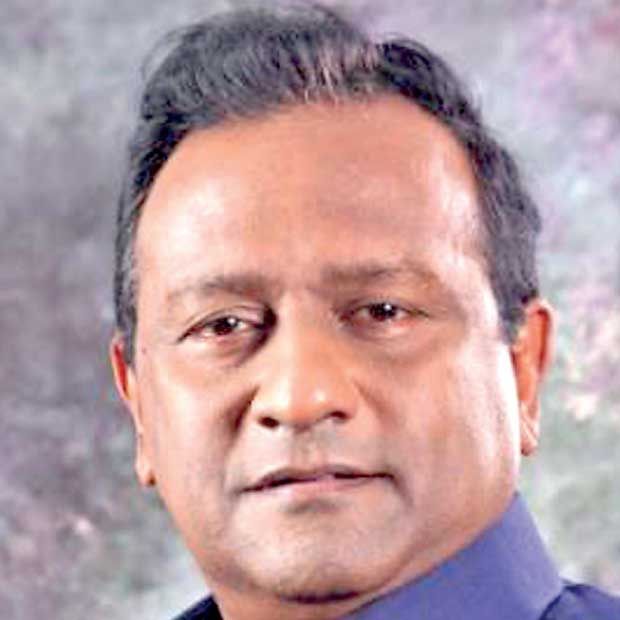
The following are excerpts from a speech made by Rear Admiral (Retd) Sarath Weerasekera at a side event on September 24 during the UNHRC sessions in Geneva
Is the resolution 30/1 legal? Certainly not. Let me briefly explain as to why the resolution is illegal. On 26 th March 2014, the UNHRC by resolution A/HRC/25/1 requested the High Commissioner to undertake a comprehensive investigation into “ serious violations and abuses of human rights and related crimes” allegedly committed during the period 2002 February to 2011November in Sri Lanka.
The final report of the investigation, widely known as the OISL report, was released on 16th September 2015. On 29th Sept 2015 the UNHRC by resolution A/HRC/30/1 endorsed without reservation the conclusions and the recommendations of the OISL report. The said resolution was sponsored by USA and co sponsored by the Government of Sri Lanka and adopted by the council by consensus, without debate.
We have proved beyond any reasonable doubt that the OISL report is seriously flawed and full of contradictions, omissions, lies, obfuscations and half-truths and fails to establish its primary claim, that the state, is responsible for war crimes and other serious crimes allegedly committed during the relevant period. We have handed over the relevant document to the High Commissioner in March this year.
First of all let me state that the investigation against Sri Lanka, authorized by UNHRC in March 2014, itself is again illegal. The council’s authorization of the investigation was based purely on a recommendation for such an investigation made by the High Commissioner and we have proof that the High Commissioner had no rational basis to make the said recommendation at the time she did.
We defeated the most ruthless terrorist organization in the world on 19th May 2009 and the first resolution passed in Geneva was a positive one praising the Sri Lankan Government for bringing peace and condemning the LTTE for using human shields. However 17 nations led by Germany called for a special session, 8 days after we won the war and charged the Government of committing war crimes and demanded that the perpetrators be punished. But the majority of countries in the council, specially the nations in the South, rejected it and adopted a positive counter resolution as mentioned above.
That resolution welcomed the conclusion of hostilities, the liberation of tens of thousands of its citizens that were held by the terrorists and bringing permanent peace to the country. It was obviously a set back to the separatist Tamil diaspora and other critics, so they attempted to recover through other means.
The then Secretary General Mr. Ban Ki Moon arrived in Sri Lanka just four days after the defeat of the LTTE to look into “ accountability” . When the LTTE held 3,50,000 civilians as human shields in Jan 2009, Ban Ki Moon never came here to prevail on LTTE to release them. When UNICEF was confirming that LTTE were recruiting child soldiers on a large scale he did sweet nothing. But he visited Sri Lanka one week after the war, in May 2009, and wanted us to initiate an accountability process. It is like, after the killing of Osama Bin Laden by the US Marines, Ban Ki Moon going to USA and asking Barak Obama to initiate an accountability process!
Also it should be mentioned that what we had in our country was a Non International Armed Conflict as the LTTE was fully qualified to be called a non state actor of an armed conflict
The above mentioned failure of the then UN Secretary General was also mentioned in the report titled “ UNSG POE report on Sri Lanka”, submitted to UN by the Charles Petrie Committee. It concludes that events in Sri Lanka mark a great failure of the UN to adequately respond to early warnings to the detriment of hundreds of thousands of civilians. UN failed to conceive and execute a coherent strategy in response to early warnings and subsequent international HR and humanitarian violations against civilians. Ban Ki Moon has subsequently admitted that failure. He said in Sept 2nd that had the UN being more actively engaged more lives could have been saved.
But as mentioned above, soon after we defeated the LTTE and brought peace to the country, Ban Ki Moon came and signed a joint statement with the President. The last two sentences of the statement were “The Secretary General underlined the importance of an accountability process for addressing violations of international Humanitarian Law and International Human Rights Law. The Government will take measures to address those grievances”.
Mr. Ban Ki Moon used the said two sentences as a basis and appointed the Panel of Experts known as Darusman Committee to appraise him whether war crimes had been committed in Sri Lanka. This action of the Sec Gen was highly illegitimate and in fact illegal under the UN Charter. The Sec Gen had appointed three outsiders to the POE Committee. But article 100 of the UN Charter categorically states that the Sec Gen shouldn’t receive instructions from any other authority external to the Organization.
As per article 97 and 98, the Sec Gen is the Chief Admin Officer of the UN and should perform tasks entrusted to him by the Security Council, the General Assembly or the Trusteeship Council. None of these organs had given instructions to the Sec Gen in this regard , but yet he appointed the POE on his own.
The Sec Gen also violated Article 2 (7) of the UN Charter which says,“Nothing contained in the present Charter shall authorise the UN to intervene in matters which are essentially within the domestic jurisdiction of any state or shall require the members to submit such matters to settlement under the present Charter.”
Hence by appointing the POE the Sec Gen had violated his own rules!
The Panel of Experts then concluded that there were credible allegations that violations of International Humanitarian Law and International Human Rights law did occur and recommended an international investigation. The POE then became the basis for the demand for an international investigation in subsequent UNHRC resolutions against Sri Lanka.
The POE Report charged the Government (GOSL) of war crimes on false facts obtaining evidence and facts from biased and separatist elements. Referring to the POE report of the UNSG, the International legal luminaries, Sir Geoffrey Nice QC and Rodney Dixon QC, who have both worked in international tribunals and worked for ICC in Hague, say that the findings in respect of the alleged criminal violations fall well short of the legal standards and all the evidence virtually unsourced. So how can a sovereign country be forced to abide by a resolution drafted based on the basis of such a report?
The Darusman or the POE Report failed to make a prima facie case with regards to any of the violations of humanitarian law and the Sec Gen exceeded his authority in commissioning the report too. It was never placed officially at the HRC and hence the Sri Lankan Government never got an opportunity to officially respond to it. When the Sec Gen first announced that he would commission the report, senior diplomats from a number of prominent countries expressed grave concerns about the dangerous precedence the Sec Gen was about to set. Russia, through its UN ambassador, even raised objections in the Security Council.
Russian Ambassador Vladimir Mikaylov, when asked on what grounds the objections were made, said “On the grounds that it was not a UN Report. On the grounds that it was not done in accordance with the regulations and procedures of UN. From the very beginning it was told that the report was purely for the Sec Gen. So if it was for the Sec Gen why did they have to publish it?
So based on this illegal Darusman Report there were resolutions in 2012 and 2013 and it should be noted that just prior to the March 2013 Resolution, a group of 14 nations including Russia, China, Venezuela and Iran made a joint statement expressing their dismay and frustration at what was being done to this country. Referring to mandating the UNHRC to provide advice and technical assistance to Sri Lanka they said such recommendations are arbitrary, intrusive and of a political nature!
Finally the resolution 25/1 was passed in 2014, requesting the present High Commissioner to undertake a comprehensive investigation into alleged war crimes. It was hardly a unanimous decision where 23 countries voted in favour, 12 against while12 abstained. The OISL report of the present High Commissioner is the result of that investigation.
Meanwhile, the countries that voted against and abstained, including India and Pakistan, made strong statements condemning the investigation. Ambassador Dilip Sinha said, “It has been India’s firm belief that adopting an intrusive approach that undermines national sovereignty and institutions is counter productive. Moreover any external investigative mechanism to monitor national processes for protection of Human Rights of a country is not reflective of the constructive approach of dialogue and cooperation envisaged by UN charter”.
Ambassador Zamir Akram of Pakistan said, “No self-respecting country would agree to the intrusive measures advocated in this resolution. It is inconsistent with the principles of the UN charter which calls for respecting the sovereignty and territorial integrity of states. This resolution is about politics and not human rights. It is also a crass example of hypocrisy and double standards”.
Also it should be mentioned that what we had in our country was a Non International Armed Conflict as the LTTE was fully qualified to be called a non state actor of an armed conflict. The applicable laws governing Non International Armed conflict are those that are governed by protocol additional to the Geneva Convention of 12 th Aug 1949. That is International Humanitarian Law and not International Human Rights Law.
Now what does Article 3 of this protocol say ? Article 3.1 sates “Nothing in this protocol shall be invoked for the purpose of affecting the sovereignty of a state or the responsibility of the Government by all legitimate means, to maintain or reestablish law and order in the state or to defend the national unity and territorial integrity of the state”.
So we exercised our sovereignty to defend the national unity and territorial integrity of the state, in keeping with the norms of non International armed conflict.
Now let me quote article 3.2; “Nothing in this protocol can be invoked as a justification for intervening, directly or indirectly, for any reason whatever in the armed conflict or in the internal/external affairs of the High Contracting party in the territory of which that conflict occurs”.
Therefore the High Commissioner’s entire report recommending the establishment of a special counsel to investigate allegations of HR violations, a judicial system comprising foreign judges, asking to devolve power as per 13th amendment etc are contemptuous intimidation and amounts to intervention in the internal/external affairs of Sri Lanka in violation of the above article.
So the High Commissioner too in addition to the Secretary General, had violated his own rules!
Resolution 30/1 which persuades the Government to establish an office of missing personnel, establish a judicial system with foreign judges etc. is mainly based on the OISL Report making a case of war crimes against the state.
Now let us go through the charges levelled against us (Sri Lanka) in the OISL Report and see whether they are based on true facts. For, if the OISL Report is false then the resolution per se which is based on the OISL Report should in actual fact, become null and void.
1. Indiscriminate shelling of civilians:
In the Darusman Report the number killed during the last days of war has been mentioned as 40,000. If that figure was correct it is safe to presume that war crimes may indeed have been committed and that civilians may have been indiscriminately targeted. To be dead one has to be born. Therefore anyone who claims 40,000 dead must be able to provide details of names, addresses, school records, birth certificates etc. They must produce some evidence that who ever they claim to be dead actually lived! The Presidential Missing Person’s Commission mandated to investigate between 1983 and 2009 had only 16,179 including 5000 names of missing soldiers. What happened to the 40,000 supposed dead? Why aren’t their names logged?
There is a UN Country Report completed in 2009, during the conflict itself, that gives an estimate of the number killed between 2008 Aug to May 13 th2009 as 7721including LTTE cadres. That number is also very close to the one calculated by the Census Department of Sri Lanka. Hence as the war was over by 19th May, if the 40,000 number killed was correct, then nearly 32,000 have to perish within 6 days. The last battle was in a very small area, so if the Army was supposed to have killed 32,000 people the soldiers would have had to bury them. In the thick of fighting, the soldiers had no time to carry 40,000 dead bodies.
Even if you throw them to sea or lagoon they (Bodies) should emerge! Where are the dead bodies or at least the skeletons? How did Sri Lankan military kill 32,000 whilst saving 295,000 innocent Tamils?
We must also bear in mind the conditions under which the last phase of the war was fought where the LTTE had taken about 300,000 civilians as hostages when the army began to close in on them. The POE Report also states that the ‘tigers’ were killing civilians who were trying to escape. And even when civilian casualties rose significantly, the LTTE refused to let people leave, hoping that the worsening situation would provoke an international intervention and a halt to the fighting.
The former head of the Women’s Wing of the LTTE’s Political Office Thamilini Jayakumaran, states in her book ‘Under the shade of a sharp edged sword’ how the tiger girls were ordered to shoot their own people who were fleeing.
Muralidar Reddy, an Indian journalist, was part of a group of embedded reporters in the battle field. He has had the opportunity to speak to the civilians emerging from the battle field. There isn’t the slightest indication in his articles that he heard the civilians say that Government troops were carrying out massacres. Reddy’s impression also appears to have been that the civilians were glad to cross over to Government lines. They were running towards the Sri Lanka Army, presumably expecting to find safety. Would they have been running towards the army if they felt that the army had been massacring civilians over the past days? It doesn’t make sense.
David Gray, from Reuters, was in the war zone. He has observed the soldiers were feeding the civilians with their rations. If these soldiers, whom Gray saw, were in the habit of attacking civilians indiscriminately, why would these soldiers be feeding the civilians?
Hence can a reasonable person conclude that the Government is guilty of indiscriminate killing of civilians as charged in the OISL Report?
2.Denial of humanitarian assistance
The other charge levelled against the Government is deliberately denying humanitarian aid being sent to the north which is a war crime. Here we say that the Panel was deliberately obfuscating the truth by completely ignoring highly reliable sources and witnesses including Neil Buhne, the UN Resident Coordinator in Sri Lanka at the relevant period.
In order to provide food and medicine to the North the Government had established a mechanism called Consultative Committee on Humanitarian Assistance. That committee comprised all the Government officials in the relevant ministries and Mr. Robert Blake, who was the US Ambassador to Sri Lanka and the representatives of ICRC, WFP, UNICEF, WHO, ILO, FAO, UNHCR etc.
To make it very short, with regard to providing essential items to North during the war, Mr.Neil Buhne, the UN resident Coordinator had commented that the Sri Lankan Government should be presented with a Gold medal for her commitment in that regard. Mr. Amin Award, the representative of UNHRC, had expressed the view that Sri Lanka was a role model to the rest of the world in the manner in which the Government of Sri Lanka had handled the humanitarian crisis created by the LTTE using civilians as human shields in the theatre of war.
With all these comments and statistics, the OISL has seen it fit to pronounce unequivocally that the Government of Sri Lanka, during the period in question, followed a deliberate policy of depriving civilians in the conflict zone of humanitarian assistance.
Likewise all other charges mentioned in the OISL Report and levelled against Sri Lanka were based on false facts. We have proved this beyond any reasonable doubt in our report titled “A factual Appraisal of the OISL Report” which we handed over to the HRC office in March this year.
The purpose of the OISL Report is to make a case for war crimes against the state. This report was never properly assessed by any professional agency of the UN and it is asserted that the report is deeply flawed, and biased against Sri Lanka. Hence UNHRC, in allowing resolution 30/1 to be adopted without a vote and without debate has been negligent in its duties and obligations under the UN Charter and hence illegal. Therefore we request to impose a moratorium on the UNHRC from pursuing any further measures with respect to Sri Lanka based on resolution 30/1 till the OISL Report is fully investigated.
14 Jun 2026 2 hours ago
14 Jun 2026 2 hours ago
14 Jun 2026 3 hours ago
14 Jun 2026 4 hours ago