12 Mar 2026 - {{hitsCtrl.values.hits}}
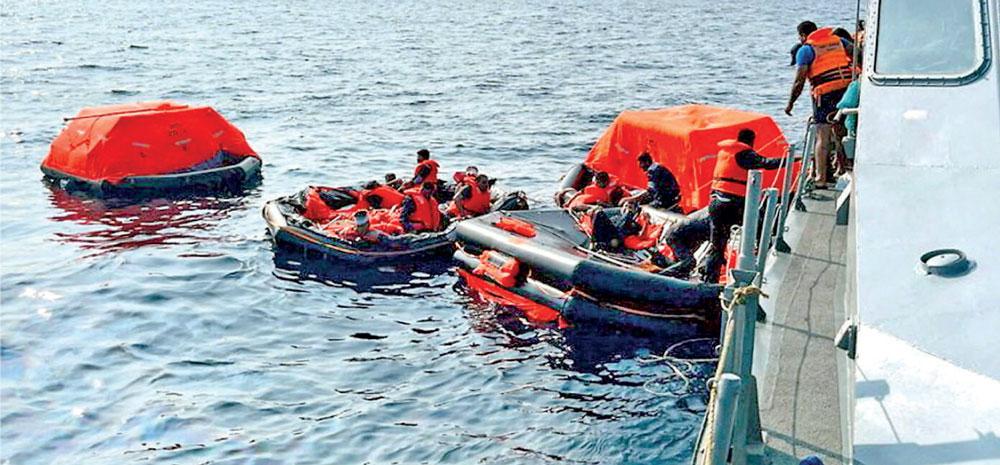
Sri Lanka Navy personnel assist Iranian sailors during a rescue operation
Pic credit: Sri Lanka Navy
 Sri Lanka’s prudent handling of the two Iranian warships – IRIS Dena, which sank off Sri Lankan waters, and IRIS Bushehr, which was granted sanctuary – was a rare example of a small nation, not just, navigating a looming geopolitical conundrum, but also making political capital out of it, by playing safe and playing right in accordance with International Law.
At 5.08 in the morning of March 4, the Sri Lankan Coast received a distress call from IRIS Dena, a Moudge-class guided missile frigate of the Iranian Navy, 19 nautical miles (22 miles) off the Galle Port, beyond Sri Lankan territorial water spanning to 12 nautical miles, but within Sri Lanka’s maritime search and rescue zone. The Navy dispatched the first ship at 6 a.m. and the second at 7 a.m. The Naval vessels that reached the scene rescued 32 Iranian naval personnel in lifeboats. A large oil slick was visible in the nearby sea, indicative of a sunken ship. During the subsequent rescue operations, the Navy salvaged 87 bodies, and the rescued sailors were admitted to Karapitiya Hospital.
Later in the same day, the US Defence Secretary Pete Hegseth announced that the United States had sunk the Iranian vessel in international waters. At the media conference he played a periscope video of the attack on the ship, which was split into two after being torpedoed by US Charlotte, a US Navy Los Angeles-class submarine.
‘A quiet death,’ he said.
Iranian authorities later announced 104 naval personnel had been killed, and 32 had been rescued.
On the same day after the sinking of IRIS Dena, another Iranian vessel, IRIS Bushehr, a Bandar Abbas-class fleet supply ship, requested permission to visit Colombo Port, citing engine malfunction.
After negotiations with the Iranian captain and Tehran, Sri Lanka granted refuge to the vessel. A total of 208 personnel (including 53 officers and 84 cadets) were evacuated. They are currently being held at the Welisara Naval Base under humanitarian supervision. The ship was taken under Sri Lankan custody and is expected to dock in Trincomalee Port.
The Government has granted the Iranian sailors a one-month visa.
India later announced that a third Iranian vessel, Hengam-class amphibious landing ship, ISIS Lavan, was docked in the port of Kochi on March 4 after the US attack on the sister vessel. The three Iranian vessels, IRIS Dena, IRIS Bushehr, and IRIS Lavan, participated in the International Fleet Review and MILAN 2026, the 13th edition of the Indian Navy’s flagship biannual multinational maritime exercise in Visakapattam. The two events were held concurrently, involving delegates from 74 countries and 85 warships, from February 15 to February 25.
The Indian Foreign Ministry later announced the three vessels had departed on February 25, but sought permission to visit the Port of Kochi on February 28 ( when the US and Israeli attacks on Iran began). The request was granted on March 1, and IRIS Lavan docked in Kochi on March 4. The attack on IRIS Dena in the international waters had raised legal concerns. The Iranian Foreign Minister has claimed the ship was in the region on the “invitation of our Indian friends, attending an international exercise” and “It was ceremonial. It was unloaded. It was unarmed.” In times of war, the world’s oceans are split into three de facto legal zones: neutral waters, which include the territorial waters of uninvolved states, international waters, and belligerent waters.
The 1907 Hague Convention XIII prohibits States from engaging in hostilities in neutral waters. States universally recognise that prohibition is customary in character. However, beyond the neutral waters, the restraint on the naval operations is subject to operational considerations of the warring parties. Nonetheless, the US attack in the Indian Ocean, 2000 miles away from the theatre of the war, has obviously expanded the conflict. Alarming, it set a precedent that other nations could follow in a future conflict.
Regional implications are also significant. The submarine attack in the Indian Ocean, in India’s backyard, of a vessel that was a host of the Indian Navy weeks ago, was a major slight on India’s claim for a sphere of influence.
The Sri Lankan Government’s quiet diplomacy over the international dispute was praiseworthy. The Government claimed its decision was based on the country’s international obligations under international law.
“No civilian should die in wars. Our approach is that every life is as precious as our own. We jealously guard our non-aligned policy while ensuring that humanitarian values and the saving of lives remain our top priority,” the President said in X.
First, the episode is also a case study of how neutrality and non-alignment are exercised and advanced without offending either of the belligerent parties. That is a refreshing change from the past episodic fervours of non-alignment, which were often used as a cloak for anti-American and anti-Western policies that served the huge egos of the local leadership. That foreign policy approach peaked during Sirimavo Bandaranaike’s reign, 1970-77, its residue often pollutes the Sri Lankan foreign policy, for politicians tend to be short-sighted and populist and bureaucrats in this country were not exactly the realists.
Second, the quiet diplomacy was also possible owing to the good offices Sri Lanka maintains with the United States, whose commander of the US Pacific Fleet, Admiral Steve Koehler, was in Colombo from February 19 to 21. Interestingly, most of the Sri Lankan naval vessels ( SLNS Samudura, SLNS Gajabahu, SLNS Vijayabahu and the latest P 628 (former USCGC Decisive) ) were gifted by the United States.
Third, this is a case in point where a small state ( which Sri Lanka is) played a role bigger than its size in an international conflict by invoking its international obligations under international law. That is, while most states, including our neighbour India, sought to maintain distance and radio silence, owing to concerns about offending the United States. New Delhi chose to break the silence only when it appeared that the cost of silence to the international image is substantial. Fourth, the episode highlighted Sri Lanka’s role as a key maritime nation and its commitment and capacity to uphold the international maritime regime, a major public good in the international system. Sri Lanka’s maritime search and rescue zone is 27 times the land size of the country. However, its blue water capacity is largely concentrated in the United States, a gifted former US Coast Guard cutter, two Indian-built OPVs, and a frigate gifted by China and an OPV gifted by India.
Sri Lanka should invest in its naval capacity, rather than relying on donations. Upgrading naval capabilities should constitute a major flank in a program for military modernisation. An overwhelming 90 percent of the defence budget is spent on recurrent expenses, mainly salaries, rations, and uniforms. However, by 2029, marking the 20th anniversary of the end of the Eelam war, the vast majority of military personnel would have completed their service. The Government should use this leeway to allocate around 30 percent of the defence budget on research and development (R&D) and modern weaponry. Countries such as Turkey, Israel, and India offer opportunities for cooperation in R&D. The failure to do so will, in the long term, not only dent the capacity to uphold the country’s obligations but also undermine national security. Fifth, Sri Lanka should explore avenues to capitalise on its growing role as a maritime nation and a provider of maritime public goods, as evidenced by the recent episode, to advance the country’s economic interests, woo investment, and position itself as a lynchpin of prosperity and stability in the region.
(Follow Ranga Jayasuriya on X)
14 Jun 2026 6 hours ago
14 Jun 2026 8 hours ago
14 Jun 2026 9 hours ago
14 Jun 2026 14 Jun 2026
14 Jun 2026 14 Jun 2026