04 Mar 2026 - {{hitsCtrl.values.hits}}
 Contrary to the initial calculations, the war against Iran is likely to be a protracted affair, even short of boots on the ground. For the moment, it is a race between Iran’s large stocks of missiles and low-cost drones and the combined American and Israeli stockpile of interceptor missiles
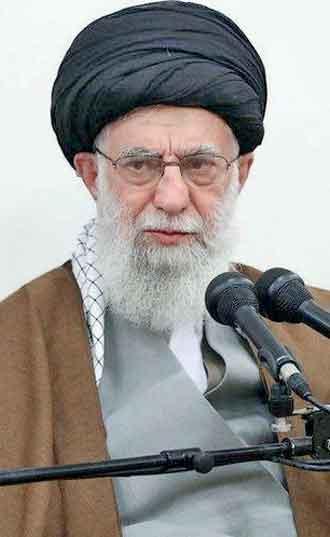
 On February 28th, Donald Trump, America’s president, delivered a death blow to the theocratic regime of Iran that a succession of his predecessors over the last five decades hesitated to authorise.
In the very first hour of the combined American-Israeli military action against Iran, America killed Iran’s octogenarian Supreme Leader, Ayatollah Ali Khamenei, and most of the military leadership.
Among the regime-affiliated political heavyweights who perished included former hardliner president Mohammad Ahamedinejad, who made a state visit to Sri Lanka during Mahinda Rajapaksa’s presidency ( Namal Rajapaksa has tweeted that “We stand by Iran at this hour of need.” Probably, he does not know what he is talking about).
|
Iran’s assassinated spiritual leader |
Trump called Ayatollah Ali Khamenei a ‘wretched and vile man’. He sure was. Barely two months ago, Khamenei oversaw the massacre of 8,000 protestors who demanded freedom from his oppressive and ruinous theocratic rule. That singular act of cruelty saved his regime, but also made it more reviled than ever before by a vast swathe of the country’s 90 million population.
Now, the regime fights a twin battle: One with America and Israel, which has decimated much of its military infrastructure, but also with the long- suppressed population, which is a pressure cooker set to blow off its lid anytime soon.
The ongoing war is an existential threat to the regime, not because of American military might ( which it faced and survived intact at home in June last year), but because defeat this time would unravel the regime at home.
The possible collapse of the Islamic regime would see many of the surviving regime leaders facing their own tryst with destiny.
How much reviled the regime was in display when it admitted to Khamenei’s death. It was soon followed by scenes of celebration inside Iran and abroad. Donald Trump has called on the Iranians to seize the moment and topple the regime. However, last time in January, he promised to come to their rescue if the Islamic regime killed protesters, but failed to back up his assurance. That enabled the regime to unleash brute force, revealing how far it would go to defend itself from its own population, no matter how weak its international posture.
The 12- day war in June saw America and Israel wiping out Iran’s nuclear sites and enrichment facilities. But at that moment, Trump vetoed against assassinating Ayatullah Khameini. The change of tactics might have partly been influenced by the regime’s cruelty to its own people, and the reckoning that Ayatollah was a hindrance, much less a bridge to a solution.
The Trump administration and Benjamin Netanyahu of Israel have claimed Iran had been racing towards a nuclear bomb, and could have been ‘immune’ within a few months. The American intelligence findings stand contrary to these claims – according to some, Iran is a decade away from a bomb. That might also suggest that regime change is a major part of the equation. Trump may fancy a solution similar to Venezuela, where the old guard was replaced by a more amenable old guard with the prospect of long-term qualitative change.
More doctrinaire than Venezuela
However, the Iranian theocracy and its regime structure are far more doctrinaire than Venezuela’s revolutionary Chavismo. The Islamic Revolutionary Guard Corps (IRGC), the regime’s praetorian guard and the real power behind the theocracy, was founded by Khameini’s predecessor, Ayatollah Khomeini, as the defenders of the Islamic regime, and is directly under the command of the Supreme Leader. The success of a power transition to a more amenable figure, such as reformist former president Hassan Rouhani or Mohammad Khatami, relies heavily on the IRGC’s acquiescence. After Khamenei’s death, Iran appointed a three-member panel led by another Ayatollah to manage the succession. However, without tacit approval by the US, it is unlikely the new leader, if ever, would be announced, for he would be a marked man.
Thus, the Iranian regime, which is in its death throes, would fight with all its might until it finds an opening that guarantees immunity for its past.
Contrary to the initial calculations, the war against Iran is likely to be a protracted affair, even short of boots on the ground. For the moment, it is a race between Iran’s large stocks of missiles and low-cost drones and the combined American and Israeli stockpile of interceptor missiles. Iran is claimed to be still using its old stocks of cruise and ballistic missiles, and swarms of drones, keeping a much more sophisticated missile arsenal for later use. Iran should expect that when America runs out of its interceptor missiles, it will sue for peace.
Iranian missile and drone attacks have targeted Middle Eastern states with American bases, effectively turning the war into a regional conflict -- UAE, Saudi Arabia, Bahrain, Kuwait, and a British air base in faraway Cyprus have come under attack. Iran has lived up to its warning to turn an attack against it into a regional conflict.
IRGC had threatened to set on fire any ship that passes through the narrow sea lane of the Strait of Hormuz, through which 20 per cent of all energy supplies pass. Saudi Aramco had suspended operations in its biggest oil site after two Iranian drones set fire to a portion of the site. Oil and gas prices have surged since the start of the conflict, now hovering just below 80 dollars a barrel, though JP Morgan has warned it could hit 120 dollars if the war persists.
The explosions in Dubai have shattered the cloak of security. Airspace in the region has been closed, leaving hundreds of thousands of travellers stranded.
The Iranian regime would fight a war of attrition, inflicting prolonged economic disruption and security chaos in the region through an extended missile and drone attacks. Tehran would expect this to force America to negotiate and save the regime’s grip at home. Another scenario would be America being dragged into a land war, which would be exhausting, costly, and protracted, reminiscent of the post-Saddam Hussein era in Iraq. Iran’s proxies, the ring of fire -– Hezbollah, Hamas, the Shia militia in Iraq and the Houthis – are declawed. However, Hezbollah dragged Lebanon into the war, and Israeli retaliation killed 52 people in Beirut. Others might follow suit.
In 1973, skyrocketing oil prices due to the Arab oil embargo following the Yom Kippur war set off the unravelling of Sirima Bandanaike’s left-leaning government and its unsound economic experiment in statism. The latest crisis comes in the wake of Sri Lanka recovering from yet another economic crisis. One million Sri Lankan workers work in the region – UAE (350,000), Saudi Arabia (246,139), Kuwait (175,000), and Qatar (140,000) -– contributed to the lion’s share of US$ 8.076 foreign remittance last year. A prolonged crisis in the region would have a devastating blow on the Sri Lankan economy. The 2022 economic crisis was exacerbated by the collapse of workers’ remittances and tourism due to Covid. Both sectors are under threat.
To make matters worse, surging oil prices would exact a heavy toll. It is generally accepted that a 10-dollar increase in the price of a barrel of oil would reduce economic growth by 0.5 per cent in developing countries. The silver line, is that the government claims it has unspent capital spending of three trillion rupees for 2025, which could serve as a cushion.
In the meantime, it is also advisable for the government to stay away from taking sides, even through tacit statements. This is a conflict that is beyond Sri Lanka’s remit and relative capabilities. Any misadventure could come to haunt the country. The government seems to be mindful of these perils, and it shows a greater degree of circumspection than its predecessors, including even Ranil Wickremesinghe, who declared a day of mourning over the death of former president of Iran Ibrahim Raisi, also known as the butcher of Tehran. The government should not seek any entanglement, no matter what social justice warriors and minority political parties might want.
14 Jun 2026 42 minute ago
14 Jun 2026 3 hours ago
14 Jun 2026 5 hours ago
14 Jun 2026 7 hours ago
14 Jun 2026 8 hours ago