27 Feb 2025 - {{hitsCtrl.values.hits}}
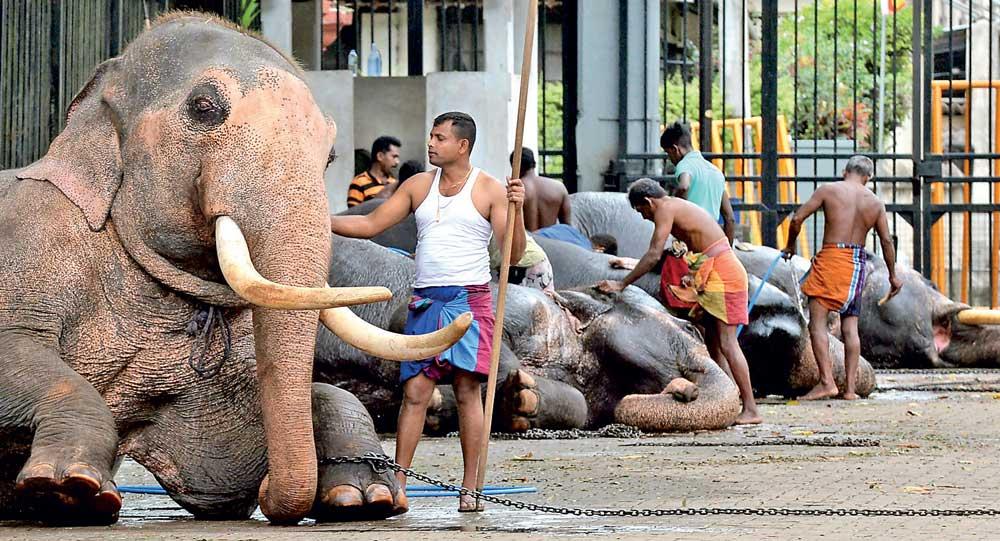
The idea of having domesticated elephants has earned the wrath of environmentalists who maintain that the elephant is at its safest when given its space in the jungle
Sri Lanka is an island where nature greets you wherever you go. The gifts of nature are free for Sri Lankans and the foreign tourists who step in here for a holiday
 Sri Lanka has always tried to showcase its rich culture for possessing elephants. From the elephants in the wild to the jumbos in domesticated set-ups, what Sri Lankans have tried to do over the years is associate this animal and the islander with pride. Very little has been done in terms of protecting the elephant from man-made accidents and disasters.
It is in this backdrop that the Peradeniya University has come with the idea of making a camera, which when fitted to the train, will help save elephants from being knocked down by the heavy locomotive. The university that is working on this product has said that artificial intelligence will be used in making this endeavour a success.
The present regime is yet to address this issue in a comprehensive manner. Past regimes have suggested the establishing of community based electric fences and building temporary electric fences in agriculture areas. Nothing much has been done in terms of removing man-made constructions that have obstructed elephant corridors. In the past, politicians allowed their close associates to build hotels in areas where elephant movement prominently existed.
Sri Lanka is an island where nature greets you wherever you go. The gifts of nature are free for Sri Lankans and the foreign tourists who step in here for a holiday. All foreign tourists who choose Sri Lanka as a travel destination have put ‘elephant watching’ on top of the to-do list. Most establishments and individuals involved in tourism went about their businesses with the blessings of past regimes. Hence there were occasions when there were violations of the law; because people involved in tourism were hell-bent on making money at the expense of disturbing the peace in the jungle.
Another issue was allowing religious institutes and individuals owning aristocratic homes to officially rear elephants. Sri Lanka’s peraheras (Pageants), which are associated with temples, demand the presence of elephants when parading the streets. This is one reason why past governments have allowed religious institutions and families, having close connections with people in power, to have domesticated elephants. This is an issue which has earned the wrath of environmentalists who maintain that the elephant is at its safest when given its space in the jungle. Politics has played a big part in threatening the existence of the Sri Lankan elephant.
The Sri Lankan culture is also responsible for elephants suffering much hardships. There was at least one past president who had an obsession for elephants and spent much time photographing himself along this animal. Sri Lankan people consider seeing an elephant on the road as auspicious. Still, poachers and hunters are big time operators in catering to the demand for elephant tusks, which are removed from elephants both living and dead for their ivory. Hence private individuals have an unofficial ‘licence’ to kill, tame or disturb the habitats of this majestic animal.
A government must have a soft corner for an animal who is in danger of losing its numbers in the forest. According to available statistics, there are about 7000 elephants in this country. And this number is slowly diminishing due to the human-elephant conflict (HEC).
Remember the cheese cracker advertisement on television where the foreign photographer asks the Sri Lankan mahout to ask the domesticated elephant to say ‘cheese’. What would children watching this commercial think about elephant and wildlife? Elephants are portrayed as playthings which can be manipulated, disturbed or bullied.
Indian author Ruskin Bond writes in one of his novels about travelling on a path which is frequented by foxes. The writer states that it’s okay to travel on that road in the morning, but an alternative route must be chosen for journeys during the night. This is because that road rightfully belongs to the fox after dark. Sri Lankans must learn about empathy and being sensitive to animal needs, especially the elephant.
Some years ago, a child, born to Sri Lankan parents and living abroad, had made a visit to the island and insisted that the parents take him to the temple that the family frequents. This temple has close connections with politicians. The child, in his early teens, had been shown the elephants in the temple and the head priest had spoken with pride about owning elephants and showcased his knowledge about how to treat domesticated animals. The child had responded with just one question, “What is this elephant doing in the temple when it should be happily living in the jungle”. The priest could not produce an answer to that question despite being a university academic and a lover of domesticated elephants.
As long as elephants are viewed as animals that have to share the same habitat with human there is unlikely that a solution will be found to the HEC. Let’s hope that the present regime starts thinking of the elephant and pictures it living in a protected environment sans human interference.
04 Jun 2026 24 minute ago
04 Jun 2026 27 minute ago
04 Jun 2026 32 minute ago
04 Jun 2026 42 minute ago
04 Jun 2026 2 hours ago