19 Sep 2025 - {{hitsCtrl.values.hits}}
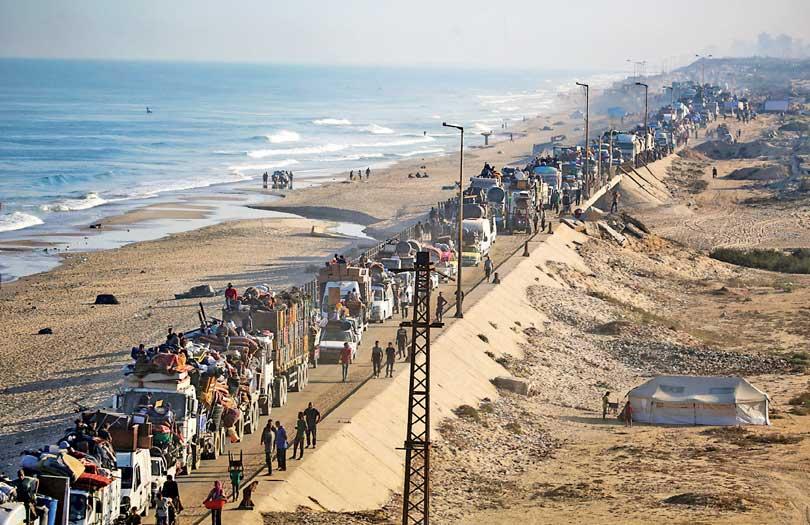
Palestinians move with their belongings southwards following renewed Israeli evacuation orders for Gaza City ahead of a ground offensive. AFP
 The buildup to Monday’s emergency summit of Arab and Muslim leaders in the Qatari capital, Doha, signalled a potential turning point in Arab-Israeli relations-or a tough retaliation against Israel for bombing Qatar on September 9. But in the end, the outcome was just another round of condemnations and a lengthy communiqué that Israel, the perpetrator, would hardly mind.
If there was one speech worthy of admiration, it was that of Malaysian Prime Minister Anwar Ibrahim. In a brief but pointed address, he declared that condemnations and declarations won’t stop Israel—only punitive measures will. Yet it seemed no one heeded his call for action.
The summit’s outcome was not worth the money spent on it or the elaborate preparations that went into making it happen. Most damning of all: of the 50-odd ‘leaders’ in attendance, only 20 spoke.
Lost on the summit attendees is the truism that if Israel goes unpunished, it will be emboldened to strike again. Iran is the only country that responded in kind and brought Israel to its knees; as a result, the Zionist state is now more circumspect—at least where Iran is concerned.
In the absence of concrete action—a fitting response—the Qatar summit seemed more like a projection of unity among Arab and Islamic nations than a genuine strategy. Israel would surely have dismissed it with a smirk, seeing it as little more than a charade.
Overenthusiastic supporters of the Palestinian cause were left disappointed; they had expected the summit to take a tough stance. Of course, they knew the Arab-Islamic countries would not resort to military action in response to the attack on Qatar. But they hoped, at the very least, that leaders would sever diplomatic and trade ties with Israel and suspend the so-called Abraham Accords—also known, by critics, as surrender documents. None of that happened.
However, the wordy communiqué did generate some positive vibes when it warned Israel of catastrophic consequences if it annexes any part of the occupied Palestinian territory. The communiqué rejected any such move as a blatant assault on the historical and legal rights of the Palestinian people, a violation of the UN Charter, international law, and relevant UN resolutions, and a nullification of all efforts to achieve a just and comprehensive peace in the region.
What remained unsaid, however, was what those catastrophic consequences would actually be.
In another positive move, the communiqué also called upon the Member States of the Organisation of Islamic Cooperation to examine Israel’s violation of the United Nations Charter and the conditions of membership in the world body-and to coordinate efforts aimed at suspending Israel’s membership in the United Nations.
It was a worthy call—but whether it will be followed by action remains the question, let alone the debate over the practicality of such a move, given the United States’ use of its veto power to shield Israel from international punitive measures.
Another worthy mention in the communiqué was the recognition of East Jerusalem as the capital of the Palestinian state, in line with the 1967 borders. Yet Israel’s annexation of East Jerusalem, the US recognition of it, and the expansion of Zionist settlements in the West Bank have made the prospect of a viable Palestinian state increasingly unattainable.
Still, the Qatar communiqué indicates that Arab and Islamic nations have placed their trust in the September 22 United Nations summit, hoping it will reaffirm East Jerusalem as the capital of the future Palestinian state.
Apart from a few positives, the Qatar summit served neither man nor beast. The message it sent to Israel was clear: we make noise with our mouths, not with our guns.
How can they, when the weapons they buy from the US come with a caveat—they must not be used against Israel? Besides, it’s no secret that Israel knows who holds which weapons and where they’re stockpiled, especially given the widespread belief that the US plays a double game: selling arms to Arab states while sharing intelligence with Israel.
No sooner had the summit ended with nothing but condemnations and declarations than media interest disappeared. In contrast, Wednesday’s “Together for Palestine” concert—the Gig for Gaza—at Wembley in Britain was a roaring success.
Speech after speech generated hope. Artist after artist expressed solidarity with Palestine. Echoing louder than the deafening silence of the sleeping Arab capitals was the cry: “Free, Free Palestine.”
Benedict Cumberbatch, Florence Pugh, Richard Gere, Bastille, James Blake, Paloma Faith, Jamie xx, and PinkPantheress—as well as Palestinian artists such as Sama’ Abdulhadi, Saint Levant, and Elyanna—were part of the star-studded concert where they denounced Israel for its horrific crimes in Gaza.
They were joined by French football legend Eric Cantona, whose #GameOverIsrael campaign calls on football federations to boycott Israel and urges players to refuse to play against the Zionists.
Yet the hypocritical FIFA—which took just four days to expel Russia following its invasion of Ukraine—is rejecting all calls for Israel’s expulsion. This is the same FIFA that imposed a hefty fine on a Sri Lankan footballer for displaying a sign in solidarity with Palestine.
Setting the Wembley arena ablaze was the electrifying presence of UN Special Rapporteur Francesca Albanese and journalist and media activist Mehdi Hasan.
To roaring applause, Albanese declared, “This cruelty did not start 700 days ago. Britain planted the seeds of this catastrophe… For nearly a century, Palestinians have been living under the weight of a brutal settler colonial project.” She urged the crowd to speak up for Palestine and to pressure their governments into action.
Hasan criticised the duplicity of Western media and the complicity of journalists in the Gaza genocide.
Yes, what was said at the Wembley Arena was louder and more impactful than the empty words of Arab and Islamic leaders in Doha. The concert organisers hoped that the Wembley show would help set Palestine free, just as the Mandela concert, also held at Wembley in 1988, helped secure the release of South Africa’s legendary freedom fighter Nelson Mandela and ultimately contributed to freeing South Africa from the yoke of apartheid.
We also saw film industry personalities in Venice doing their part for Palestine and calling for an end to the ongoing genocide, which took a turn for the worse on Tuesday when Israel began moving into Gaza City—giving more than a million Palestinians the grim choice to leave or be killed. Thousands have declared they prefer death to disgrace and displacement and are braving the bombs and bullets that await them.
In Venice, teary-eyed Anuparna Roy, winner of the Best Director award for her film Songs of Forgotten Trees, said, “Every child deserves peace, freedom, liberation—and Palestinians are no exception. I don’t want any applause for this. It’s a responsibility, in this moment, to stand by Palestine… I might upset my country, but it doesn’t matter to me anymore.”
While celebrities and sports figures declare that enough is enough and call for action against genocide, governments must also show that they stand with justice. Journalists, too, should not become mercenaries for Israel or complicit in the genocide.
In the resolve of these celebrity activists, there is a clear message for the dilly-dallying Sri Lankan government—and for journalists who embark on all-expenses-paid jaunts to Israel for a dose of Hasbara, the official Israeli propaganda.
19 Jun 2026 7 minute ago
19 Jun 2026 3 hours ago
19 Jun 2026 5 hours ago
18 Jun 2026 9 hours ago
18 Jun 2026 18 Jun 2026