02 Dec 2025 - {{hitsCtrl.values.hits}}
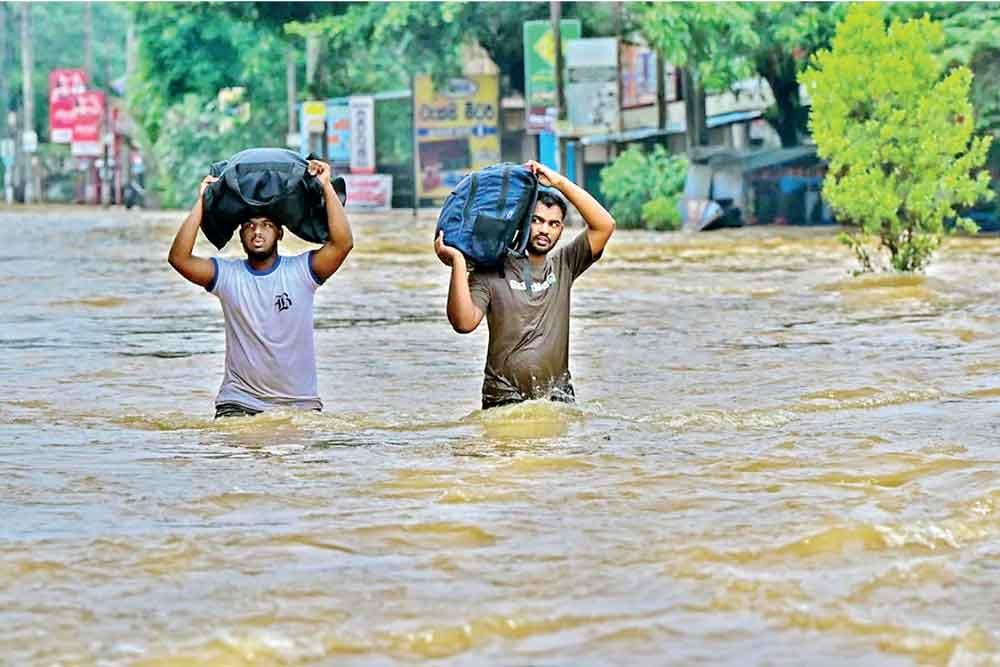
An already economically decimated country with an exhausted population must now cope with the loss of daily livelihoods, damaged homes, disrupted education, healthcare, transport and a badly damaged road network
 Cyclone Ditwah which created terror during four frightening days finally moved away. It made landfall on Wednesday, November 26. The death toll is now put at 300, with almost 200 missing, displacing 78,000 and causing enough destruction to bring back vivid memories of the 2004 tsunami.
The worst is not over. It lies ahead as an economically crippled country and its tired, dazed population must now cope with the loss of daily livelihoods, damaged homes, disrupted education, healthcare, transport and a badly damaged road network.
December is the peak month for tourism. Such high hopes were placed on its recent resurgence. This will not totally dent it, but December needs clear, good weather, and some of the roadways vital to tourism have been damaged.
Already, the blame games have started, with experts claiming that the government ignored Met Department warnings. While that needs to be looked at, the reality is that cyclones catch us unprepared. We have a disaster management centre and meteorological warning systems. But nothing can prepare us for the fury of the next cyclone except our own efforts. We may escape to safety with luck, but risk losing our homes and belongings.
Relief workers complain that many in flood-hit areas did not vacate their homes despite warnings. But there is a very human angle to this. Already, crime is rampant due to poverty and drug addiction. People are naturally reluctant to leave their homes and belongings behind. The loss of a bicycle, motorcycle, three wheeler or any household items can be crippling. They will hang in there and hope for the best. Many vacated homes were looted in recent floods.
Efforts undertaken by various government agencies, the armed forces and the police, as well as physically able citizens everywhere, to save lives, clear roads and get relief supplies through are nothing short of heroic. The high drama of a combined navy and air force operation to rescue 70 bus passengers on a flooded bridge gives us an idea just how difficult and time-consuming such efforts can be. All passengers including a tourist were rescued safely in an all-night long rescue operation braving heavy rain, strong winds and currents. These are the real national heroes.
But these passengers could have been rescued earlier, before flood waters rose and they were forced to climb to the roof, if a local rescue service was available.
There is an urgent need for more boats which can navigate rivers, canals and flood waters. The police and the armed forces must be equipped with such craft, and personnel trained to carry out difficult rescues. Citizen volunteers can be trained and equipped at district levels to meet floods, landslides and other natural disaster situations. In the future, the principal adversary will be the weather.
A special islandwide full time rescue service is essential, but given current economic woes, it’s hard to see how one can be created, equipped and maintained. For now, equipping and training the existing services, plus the creation of local volunteer groups, is the best solution.
Helicopters are essential in flood rescue operations. But we have only a limited number. Rescue operations in bad weather are risky. The movie ‘Perfect Storm’ showed a real life situation where a rescue helicopter is lost while trying to rescue the crew of a fishing boat caught in a storm.
An air force helicopter tried to rescue the stranded bus passengers, but violent rain, winds and its own downdraft got in the way. People were on the roof of a nearby house, and part of the roof collapsed due to the chopper’s downdraft. Helicopters would be more useful in reconnaissance, spotting refugees and carrying supplies. Much of the rescue work will have to be done by boats. A demand for more fiberglass boats can give a boost to the local boatbuilding industry. There is a need for more excavating machinery, too, given how frequent landslides are.
But disaster management training for citizens is another must. The horrific vision of a car plunging into a flooded canal and sinking with all three occupants shows the urgent need for such training.
At first, one can see the car with only the engine submerged. When a motor vehicle plunges into water, it’s the engine part which gets submerged first due to its weight. The vehicle will float for a while, and then sink.
Occupants instinctively follow the air bubble into the back seat where they can’t get out. The car goes down nose first and often flips onto its back. Since seat belts don’t retract under water, it’s easy to tangle in them.
One should try and get out as soon as the car hits the water. But the mind can get clouded in a panicky situation.
This drill should be taught in schools, universities and offices as we can expect more accidents of this type in future.
In the video, there is a large crowd shouting around the car. Dozens are in the water, some of them wearing life jackets. But the car’s windows are closed and you can’t see the occupants. Opening the windows before the car sank could have helped. But modern cars have electrically operated windows. If the driver got them opened while the engine was still running, the occupants had a chance. But presumably he was terrified when the car hit the water, and didn’t know what to do.
This is where lessons given by a disaster management instructor could have helped. Citizens should also be trained to give mouth-to-mouth resuscitation. There were many helping hands around the car but it was useless. A last option would have been to smash a window. But, even if a hammer was available, it isn’t easy to break open a car window, especially if it’s bobbing about in water. As a result, three lives were lost needlessly.
While we must do what we can to mitigate future floods, we should realise that this is not entirely a local problem. We can blame deforestation, illegal sandmining, and filling of marshlands for many natural disasters, but global warming is a global problem. Last year saw the highest ever rise in temperatures in history, and it hardly helps that some world leaders including the president of the United States are climate change deniers.
Our own disaster is so big that we remain oblivious to the fact that Cyclone Ditwah devastated Southern Thailand and Indonesia as well, with more than 800 dead in all three countries.
Rapid development anywhere leads to grave ecological problems. We can take the case of Indonesia. A couple of months ago, Bali experienced its worst floods in more than a decade. Bali rarely experiences floods, and these came at the peak of the dry season. Crops were washed away; roads turned into muddy rivers, and 17 people were killed.
Indonesia, the world’s fourth-most populous country, is one of the world’s most climate-vulnerable nations, and also the sixth-largest greenhouse-gas emitter.
Indonesia has experienced rapid economic growth over the past two decades, at an average of 5% a year since 1997. But this progress has been powered by carbon-intensive resources at a steep cost to the environment.
Deforestation, peatland drainage and the extraction and burning of coal have powered Indonesia’s development whose main ingredients are timber, pulp, mineral excavation and palm-oil booms.
Indonesia produces 55% of the world’s palm oil, contributing 4.5% of GDP and employing more than 3 million people. More than 90% of Indonesia’s energy comes from fossil fuels; coal dominates, providing 70% of electricity, and the country remains the world’s largest exporter.
But emissions are high: Indonesia released an average of 1.5 billion tonnes of CO2-equivalent annually in 2018–20, about 3.5% of the global total. Now the challenge is to decouple emissions from economic growth. Although there is a moratorium on new coal plants, this remains limited to paper.
Now Indonesia is paying a price for this rapid development. But this is a problem which began with the 19th century industrialisation in Europe, when every major European nation was coal-powered. We are now feeling the fallout. On average, about 85 tropical storms are formed each year globally, and 45 become full tropical cyclones.
We have just experienced the fury of one. This won’t be the last.
14 Jun 2026 20 minute ago
14 Jun 2026 1 hours ago
14 Jun 2026 1 hours ago
14 Jun 2026 4 hours ago
13 Jun 2026 13 Jun 2026