25 Oct 2025 - {{hitsCtrl.values.hits}}
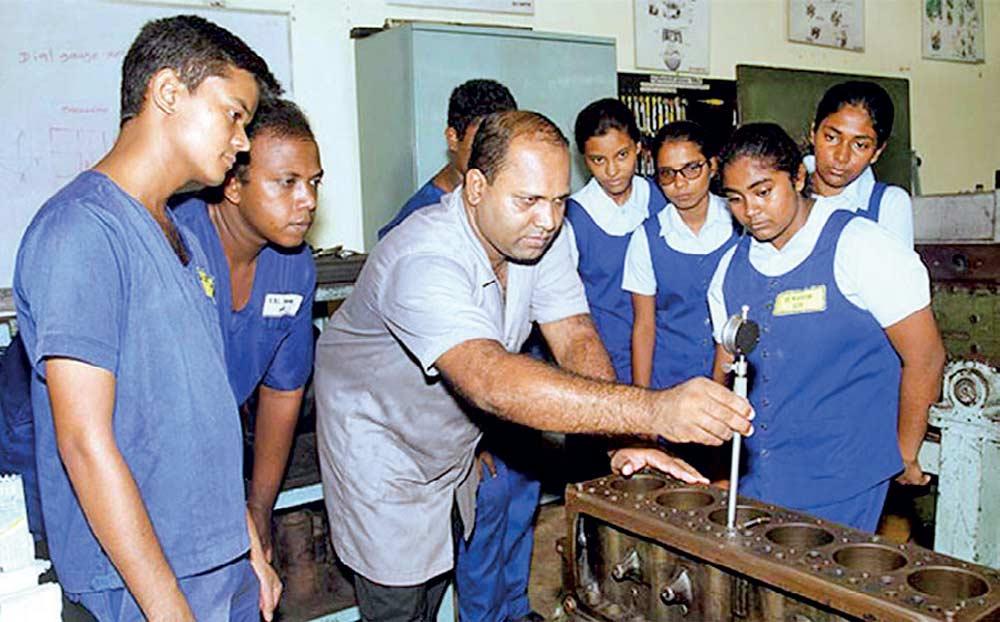
Technical and vocational education and training programmes exemplify the practical application of on-the-job training methods, where experienced instructors demonstrate real-world skills to trainees.
FILE PHOTO
 Employee performance isn’t just about skills—it hinges on four critical factors: ability, motivation, role perception and situational circumstances. However, Organisations ignoring any one of these will see training efforts falter
Most training fails because organisations never measure whether trainees actually change their behaviour or whether those changes improve business outcomes. The result? Money spent with no return
 Training is a vital component of Human Resource Development (HRD). In the context of HRD, Human Resources means a collective of personnel in organisations, either in the public or private sector. Human Resources differs from other resources the employer uses partly, because individuals (employees) are endowed with varying levels of abilities, which include aptitude, skills, attitudes and knowledge, with personality traits, gender, role perception, differences in experience, motivation and commitments.
HRD is considered part of the Human Resource management (HRM) process that specialises in the continuous development of human resources in organisations in the public and private sectors as well. HRD professionals emphasise that employees are the primary resource for gaining a sustainable competitive advantage for organisations. By integrating human resource activities with the corporate strategy, organisations can meet both efficiency and organisational objectives.
Performance of employees of any organisation is based primarily on three variables, namely skill, knowledge and attitude. In addition, organisational behaviour (OB) theorists suggest that behaviour and performance of human resources is a function of at least four variables, viz, ability (which includes skill, knowledge and attitude required to accomplish the job assigned to the employee), motivation, role perception and situational contingencies.
Training should be based on training need analysis. Training needs are based on the outcome of performance deficiencies. Identification of performance deficiencies is considered as first step of the Scientific methodology of training.
Various techniques could be used to identify performance deficiencies, such as performance appraisal schemes, questionnaires, surveys, skill tests, advisory committees, group discussions, interviews with potential participants, management requests, observation of behaviour, evaluation of past training programmes, etc.
Training need analysis involves a comparison of goals at the level of the organisation, goals of the jobs assigned to the employees that of the achieved levels of goals. In the process of comparison, performance deficiencies or performance gaps could be identified.
The next stage is to design a training programme. In that process, it is necessary to set provisions to integrate the objectives of the training with those of the objectives of organisation, to highlight budgetary allocation required for implementation of the training programme, the length of time required to complete the programme training model and resource persons needed, etc.
Training models are varied from on-the-job training to off-the-job training. On-the-job programme places the trainees into a real work situation where the experienced worker or the supervisor demonstrates the job. On-the-job training mostly focused on non-managerial employees.
Off-the-job training is based on multiple training techniques such as lectures, one-to-one instructions, role playing, business games, simulations, action learning, behaviour modelling, case studies, conferencing through audio, video, computer, etc.
In a systematic model of training, need assessment and analysis are concerned with identifying gaps between the actual work performance and the standard of work performance criteria which should have a training solution. Each employee has a responsibility to perform against the standard and to receive appropriate training if they are unable to do so.
Line Managers will be involved in the assessment and appraisal of employees on a continuous basis, where this occurs in a climate of natural trust and support and in the absence of fear, this is likely to release a flow of information about all aspects of workplace performance.
In the process of preparing a training programme, due consideration should be given to the training budget. Training needs cannot be met without budgetary allocations. When compared to developed countries budgetary allocation for training in Sri Lanka seemed very minimal.
Choosing appropriate resource persons for the delivery of training, particularly on off-the-job training, is a costly exercise. Training had become a big business for the procurement of resource persons to conduct off-the-job training. It is recorded that training staff salaries alone would be around seventy-one per cent (71%) out of the total estimate of US$45 billion allocated for formal training by US organisations in the year 1992.
The next stage is the evaluation of training. Evaluation encompassed by many trainers is that of the final stage of the training course. In such cases, evaluation serves to provide feedback to trainers. This process cannot be treated as a full-scale evaluation. Evaluation should be a free exercise from the perspective of trainees, trainers and the organisation concerned. Collecting data by evaluating activities is a vital process in establishing the credibility and value of training. The purpose of evaluation is primarily to enhance learning and to contribute positive transfer of learning from development activity to workplace behaviours and performance. Evaluating criteria should be able to determine whether training has achieved the original objectives, which means attaining the goals of the organisation along with the goals of the trainees. Training should clearly be linked to the objectives of the organisation and the objectives of trainees in order to become strategic training. The results of this evaluation become the basis for a new needs assessment and for continuing the training process. So that training is a continuous process of learning. Learning is a very vital contributory factor for relatively permanent change in knowledge, skill, belief, attitudes or behaviour produced by the experience of the employees.
Evaluation of the effectiveness of the training should be based on the response to the following questionnaire. Do the trainees feel good about the training? Can the trainees recall and understand the concept they were taught? Do the trainees apply the concept to their behaviour (behavioural change)? Do the change in behaviour affect organisational outcomes? Do the trainees leave with more positive feelings about the organisation or their work attitude? If answers to the above questions are positive or “yes”, it means training is successful and effective.
Cost-benefit analysis of the impact of training is necessary to determine the degree of effectiveness of the training. This is a vital requirement to justify the training programme from the financial point of view.
The benefits or revenue gained from training could be identified in brief as follows. Increased revenue from production/sales or services rendered to the customers. Higher productivity, reducing errors, client retention with the organisation and employee retention within the organisation.
The difference between total revenue without training and the total revenue after training is equal to the revenue (benefits) produced by training. The revenue produced by training, net of the cost of training, is equal to the total return on investment on training.
Cost-benefit analysis and calculating the return on training are rarely done or grossly ignored in many of the organisations, including Government Departments in the public sector and some organisations in the private sector as well.
Top management in public service is under an obligation to implement the decision of the cabinet of ministers, irrespective of their impact and effectiveness after implementation.
The only training required to perform that kind of job is nothing but to adjust knowledge, attitude and behaviour of himself or herself to satisfy the line of thinking of politicians who hold cabinet portfolios. That kind of role perception has been trickled down from top to bottom in public service in this country. It means employees from the top level of Secretary to the bottom level of office aide in public service are welded with a politicised perception of thinking on the performance of his or her job on the pretext of Government Policy. In short, this is considered another facet of the politicisation of public service. Politicisation has swollen the prospective values of the training by way of haphazard recruitments for political gains from time to time by politicians who hold governmental power.
Most of the training programmes in public sector organisations seem to be lopsided programmes, and lack of strategic approach to the training. It is a fact that nobody is bothered about the effectiveness of the training programmes conducted in the public sector. This type of training is called “Training for the sake of Training”.
It may be noted that there are some pivotal preconditions required for a successful training, such as trainees’ ability to learn, trainees’ motivation to learn, matching the training with the abilities of trainees, testing trainees prior to the beginning of training, etc. If training is to have any effect at all, trainees must learn something from the training and then implement it.
The most important motivational factor trainees need to have is the desire to change their behaviour and results on the job. Motivating job-related behaviour requires integration of training with compensation (remuneration), which includes a comprehensive remuneration package coupled with a package of fringe benefits based on benchmarks in corresponding industries.
Out of the multiple reasons for the failures of training programmes, the lack of methodological approach as above referred to when designing the training programmes, lack of reward for behaviour and skills learned in training, lack of motivation among trainees (employees), inaccurate training need analysis lack of appropriate support from the management, lack of competent resource persons and budgetary constrains are considered crucial. In addition, politicisation of public service has become an unavoidable obstacle to upkeep the effectiveness of the training, due to the fact that attitudes of every successive government towards public service have been vague or different from the attitudes of the previous Government based on the agenda of the political party that holds the governmental power.
The training programmes with shortcomings referred to above would serve nothing but wastage of public funds or funds of the organisations concerned, irresponsibly.
The writer is an HRM Consultant on the Fiscal Reform Programme of the ADB (covering Sri Lanka Customs, Excise Department and Inland Revenue Department, 2005), and holds an MBA from SJU.
19 Jun 2026 9 minute ago
19 Jun 2026 19 minute ago
19 Jun 2026 22 minute ago
19 Jun 2026 50 minute ago
19 Jun 2026 1 hours ago