07 May 2025 - {{hitsCtrl.values.hits}}
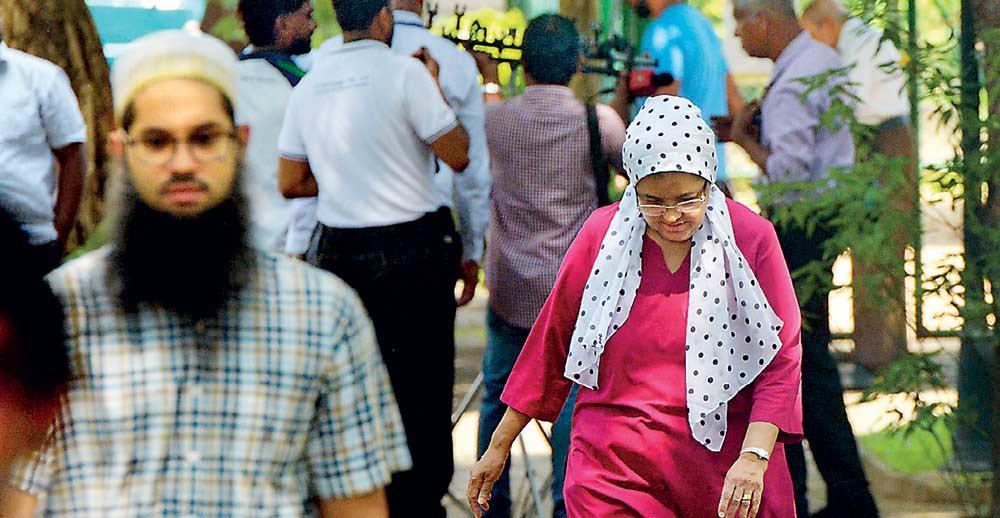
Voters of Colombo visited the College House polling station yesterday to cast their ballots for their next local government representatives.
Pix by Pradeep Pathirana
 The election commission reports it had received 4628 complaints of election violence during the period from March 20 to May 4. Thirty-five incidents are classified as related to violence, 4284 as violations of election laws and 309 as other
 For those of us who held reservations about the NPP government, one of the greatest concerns was that the 2024 election, which swept to power, could well be the last free and fair election in the country. That is not an unfounded fear, as the experience in many countries, where political fundamentalists or the militant left had won national power, has almost uniformly revealed.
That brings forth the less-talked-about question. Many observers described the election as the first test of the NPP’s popularity. But it was more than that. It was first and foremost a test of the NPP’s commitment to multiparty democracy, which, I must now concede, the JVP had passed with flying colours.
No matter who wins, the 339 local government bodies that went to the polls yesterday, the election was a victory for democracy. Again, imagine the opposite, which is not farfetched given how the JVP-affiliated unions run student councils in public universities, and you realise the relief the detractors of the government would feel. That should, however, not be a case for complacency, for the rot sets over time.
The election was overwhelmingly peaceful, and there were even fewer incidents of overt and covert abuse of state property to influence the voting, which was a major concern in the Presidential Election of 2024. The election commission reports it had received 4628 complaints of election violence during the period from March 20 to May 4. Thirty-five incidents are classified as related to violence, 4284 as violations of election laws and 309 as other.
Numbers may seem grim, but they were largely about petty bickering. More worryingly, two killings were reported. A social media influencer-cum-SLPP candidate, Dan Priyasad, was shot dead in a Wellampitiya flat, and in another incident, a man shot dead an alleged attacker who tried to stab him in Katana. Both incidents appeared to have little to do with the election and resulted from long-held personal animosities. (Though it might help to lump them together into the overall toll, if you are lobbying for funding from USAID or the EU for election monitoring).
Election violence and irregularities should be measured not by the numbers, but by how they influence the election. There is little evidence to suggest they did.
However, there were allegations, probably overblown, of a gaffe by the prime minister who was quoted as telling the party loyalists, to “still spread the word with a phone call, or a quick word while walking down the road,” during the 48 hours before the polling, when the law prohibits campaigning.
That may smack of naivety, though still disturbing. However, those of us who have seen how the democracy in this country was rigged, not just in the elections, but inside the house of Parliament, through cross-overs backed by millions of rupees to support Mahinda Rajapaksa’s dynastic ambitions through the 18th amendment to the Constitution, this is child’s play.
Generally, the Sri Lankan voters tend to favour the government in power during the local government and provincial council elections. This election is unlikely to be different. The JVP’s honeymoon had not ended, and though its lofty promises had not been delivered, it had striven not to harm the economic recovery. This election would reveal how many of JVP’s 6.8 million voters approve of its performance. There do not appear to be many reasons to dislike it unless they are gullible enough to believe the JVP’s promises to offer the sun and the moon in the first place.
It generally helps local development when the government has control of local councils. That provides for a degree of coherence in resource allocation and implementation. Whereas when the opposition controls the local government institutions, they are likelier to be talk shops and protest hubs—perhaps the most brazen example being the Northern Provincial Council with C.V. Wigneswaran as the Chief Minister.
The JVP may not win the overwhelming two-thirds majority as it did in the previous two polls. Local government elections are more of a contest of personalities, kith and kin, and local loyalties than party politics. That would also favour some of the minor parties and independent candidates.
Yesterday, more than seventeen million (17,156,338) eligible voters were expected to elect their representatives for 8,287 seats in 339 local government institutions.
Their vote will still influence the future course of action of the government and the opposition parties.
For the government, which has not displayed much initiative in economic development at the national level, the control of local government bodies would provide the opportunity, at least to try its economic vision at the grassroots level, where it might be more competent. It should also offer a degree of confidence to the government to deliver economic development at the national level, moving beyond useful but overblown concerns of good governance and a new political culture. Political cultures can not be implanted, they evolve with the social and economic development—You witnessed that most recently in Kandy.
For the main opposition, another defeat would not make much difference. But, a better-than-expected result may be far more delirious. It may feed the ego of a leadership detached from reality and hasten the party’s race to the bottom.
Follow @RangaJayasuriya on Twitter
05 Jun 2026 8 minute ago
05 Jun 2026 1 hours ago
05 Jun 2026 1 hours ago
05 Jun 2026 2 hours ago
05 Jun 2026 2 hours ago