03 Feb 2025 - {{hitsCtrl.values.hits}}
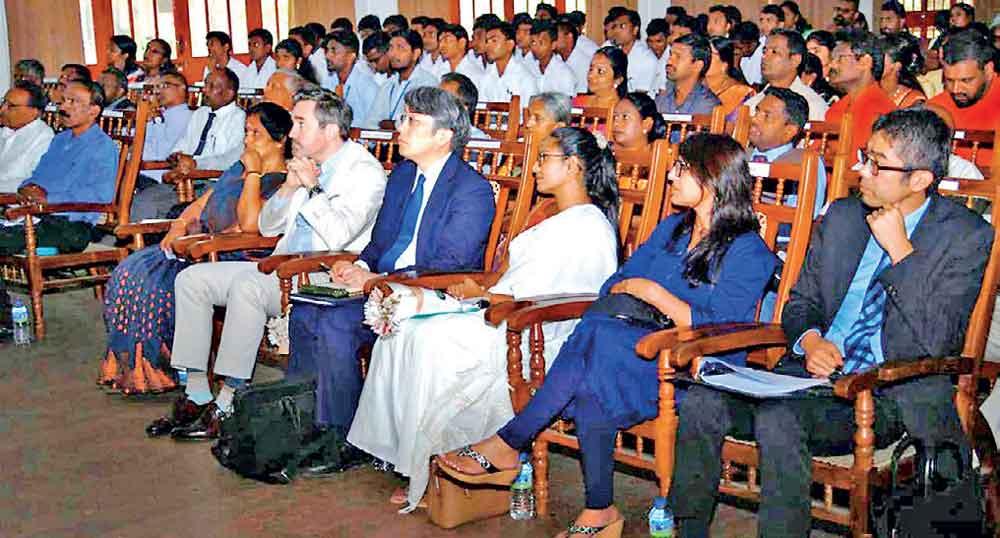
Last week a two-day conference was inaugurated in the auditorium of Sripada National College of Education to work with young teachers and graduates in the Hill-Country to research the predicament of education both within schools and in relation to their communities
 In approaching another Independence Day on February 4, we must reflect on the tragic history of our country. The original sin of our independent nation – despite our visionaries who had struggled against colonialism in the name of equality – was the disenfranchisement of the Hill-Country Tamils. How are we as a country and a people addressing the dark history of exploitation and social exclusion of the Hill-Country Tamils who beyond all other communities have been the backbone of Sri Lanka’s economy for over two hundred years?
It took the Hill-Country Tamils over five decades to redress the despicable act of revoking their citizenship soon after Independence. Despite many shortcomings of their political parties and trade unions, they all stood together in the struggle to regain their citizenship rights. However, that resolution came after tremendous suffering. Hundreds of thousands of Hill-Country Tamils were repatriated and to this day live in harsh conditions in India. Others were dispersed to many parts of Sri Lanka following pogroms. And the Hill-Country Tamil community as a whole was denied access to the robust social welfare system that was for all other purposes the pride of the country.
Denial of citizenship and the system of captive labour in the plantations meant they were also excluded from the free education system for close to the three decades after Independence. Their struggles, including the emergence of a new generation of teachers from the community in the 1970s and 1980s has led to a major transformation in education. It is these advances including a younger generation of teachers and educated youth that are the hope and the subject of this column.
Education is obviously not the only issue facing the community. Their working and living conditions continue to be atrocious along with incomes well below poverty levels. This situation was condemned by the UN special rapporteur on contemporary forms of slavery after a visit to Sri Lanka a couple years ago, but little has changed. Indeed, to this day the Hill Country Tamils do not have access to decent housing with the continuing denial of land rights. I argue the litmus test of the NPP Government that has come to power condemning the lineage of elite rule since Independence, will be whether they address the land rights of the Hill-Country Tamils.
Education conference
In this context, there has been an interesting initiative by the Young Researchers Network, to work with young teachers and graduates in the Hill-Country to research the predicament of education both within schools and in relation to their communities. Some of us have been working with close to forty youth in this participatory research process of understanding their struggles. And last week a two-day conference was inaugurated in the auditorium of the Sripada National College of Education and continued in a smaller venue at a Rest House the next day. Recognising the support for this conference, I quote a press release about it: “The United Nations in Sri Lanka and the Embassy of Japan jointly supported the Malayaha Teachers’ Research Conference, held on 27 and 28 January 2025. Commemorating the 200th anniversary of the Hill-Country Tamil community’s arrival in Sri Lanka, the event celebrated their resilience and contributions while addressing pressing challenges faced by the community.
“Organized by the Law and Society Trust in partnership with the Young Researchers Network, the conference brought together educators and young researchers from the Hill-Country Tamil community. Over the past year, this initiative has cultivated a network of young teachers and researchers, predominantly women, who have been trained by senior academics to develop research on key issues including land rights, education access, employment, and gender equality.”The conference, which was attended by key stakeholders including the Coordinating Secretary to the Minister of Education, Higher Education and Vocational Education, showcased research that delves into the socio-economic challenges affecting the Hill-Country Tamil community, including the ongoing impacts of Sri Lanka’s economic crisis. It served as a platform for dialogue, aiming to foster sustainable solutions and broader social change, particularly through improvements in education, housing, and working conditions.
“The Hill-Country Tamil community exemplifies resilience, yet systemic barriers continue to hinder their progress. This conference is a vital step toward empowering this community through education and actionable research,’ said Marc-André Franche, United Nations Resident Coordinator in Sri Lanka. ‘Through collaboration, we can ensure sustainable development that truly leaves no one behind.’
“The Embassy of Japan emphasised its shared commitment with the United Nations to fostering resilience and inclusive growth. Mr. Kamoshida Naoaki, Deputy Head of Mission of the Embassy of Japan in Sri Lanka stressed the importance of human security and the empowerment of vulnerable communities including their access to education, healthcare, and employment opportunities.”
Indeed, the presence of senior officials of the Education Ministry, the United Nations and the Japanese Embassy, was encouraging for the community and the hundreds of teacher students at the College of Education. I hope this engagement will lead to investment in much needed infrastructure for education and reinforcement of free education in the Hill-Country by the Government and international.
Radical pedagogy
The discussions during the second day with about fifty participants was thought-provoking. I was really impressed by the senior educationists from the community who came and engaged with the young teachers and researchers and their papers. Their comments reflecting on the fifteen papers, including the history of education in the Hill-Country, high incidence of school dropouts with the economic crisis, the impact of migrant work on education, unaffordable education related costs, toilet facilities in the plantations etc., drew from their own struggles for the right to education four to five decades back. Amidst those inspiring discussions, what resonated with me was that education is a collective process of the community.
These grounded discussions on the myriad set of problems facing the Hill-Country Tamil community, evoked the ideas of Paulo Freire in his profound book, the Pedagogy of the Oppressed: “Problem-posing education, as a humanist and liberating praxis, posits as fundamental that the people subjected to domination must fight for their emancipation. To that end, it enables teachers and students to become Subjects of the educational process by overcoming authoritarianism and an alienating intellectualism; it also enables people to overcome their false perception of reality. The world—no longer something to be described with deceptive words—becomes the object of that transforming action by men and women which results in their humanization.”
Are we as a country ready to take on such broader challenges of the education process? In reflecting on education after seventy seven years of Independence, I believe the redemption of education including in relation to overcoming authoritarianism, humanization and emancipation, must begin in the Hill-Country.
14 Jun 2026 6 hours ago
14 Jun 2026 8 hours ago
14 Jun 2026 9 hours ago
14 Jun 2026 14 Jun 2026
14 Jun 2026 14 Jun 2026